

1st Quarter of FY March 2027 Performance Briefing (Speech Text)
FY March 2027 Results Highlights

Tetsuji Yamanishi
Senior Executive Vice President & CFO
Hello, I am Tetsuji Yamanishi. Thank you for taking the time to attend TDK’s performance briefing for Q1 of FY March 2027. I would like to explain the highlights of our consolidated business results.
Q1, FY March 2027 key points
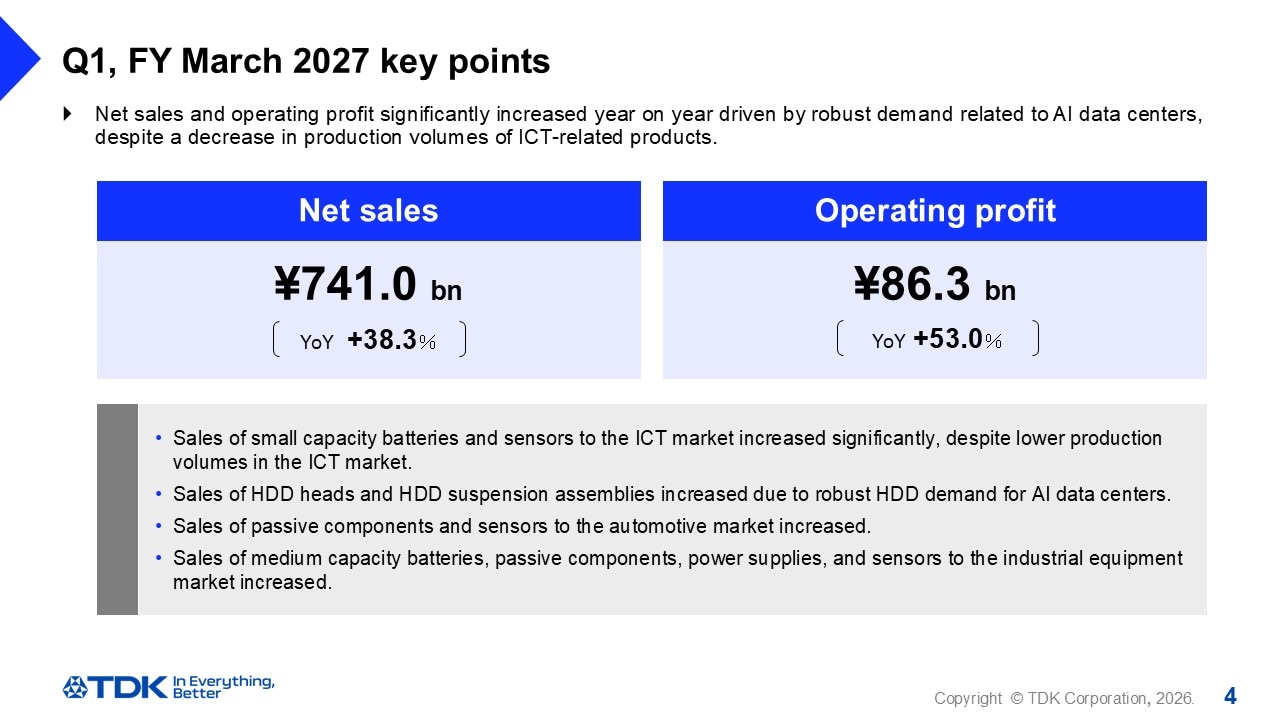
First, I would like to explain the key points of our financial results for Q1 of FY March 2027.
In the electronic components market, which has a significant impact on TDK’s business results, the production of ICT-related products, including smartphones, declined year on year due to tight memory supply and soaring prices.
Meanwhile, demand for nearline HDDs for AI data center applications remained robust. In the industrial equipment market, capital investment demand also remained robust. In the automotive market, demand remained brisk, driven by progress in the adoption of electrified and self-driving vehicles.
In this business environment, despite the impact of a decline in production of ICT-related products, all segments recorded year-on-year increases in both sales and operating profit, driven by strong sales of new products for smartphones and other devices and solid demand related to AI data centers.
Overall, net sales increased by 38.3% and operating profit rose by 53% year on year, with both reaching record highs for a first quarter.
Q1, FY March 2027 results
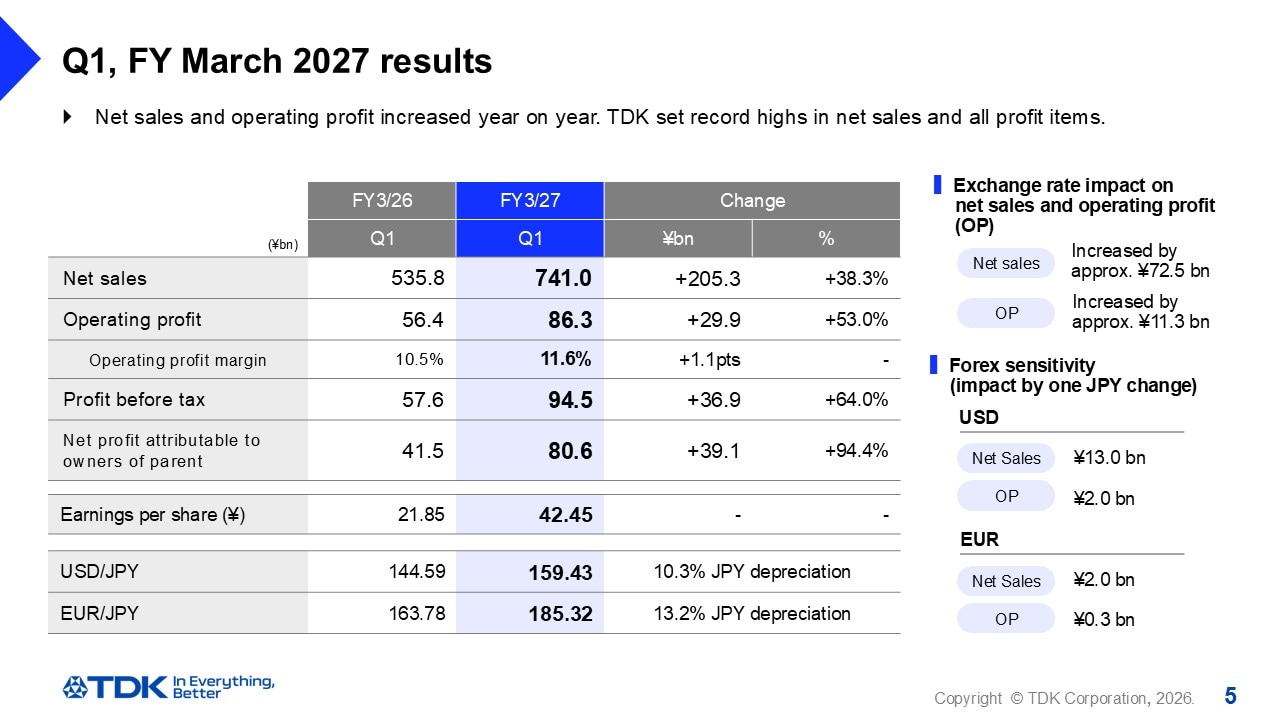
Next, I will provide an overview of our financial results for Q1 of FY March 2027.
Net sales and operating profit increased by approximately 72.5 billion yen and approximately 11.3 billion yen, respectively, due to the positive impact of exchange rate fluctuations against the US dollar and other currencies.
Net sales increased by 205.3 billion yen, or 38.3%, year on year to 741.0 billion yen. Operating profit increased by 29.9 billion yen, or 53.0%, to 86.3 billion yen. Profit before tax increased by 36.9 billion yen, or 64.0%, year on year to 94.5 billion yen. Net profit attributable to owners of parent increased by 39.1 billion yen, or 94.4%, to 80.6 billion yen. As a result, net sales and profit at every level reached record highs for a first quarter. Earnings per share were 42.45 yen.
Regarding the sensitivity of operating profit to exchange rates, our estimates remain unchanged. We estimate that a 1-yen fluctuation in the yen-dollar exchange rate has an annual impact of approximately 2.0 billion yen, while a 1-yen fluctuation in the yen-euro exchange rate has an annual impact of approximately 0.3 billion yen.
Passive Components segment -Q1
Next, let’s look at the segment results for Q1.
First, in the Passive Components segment,
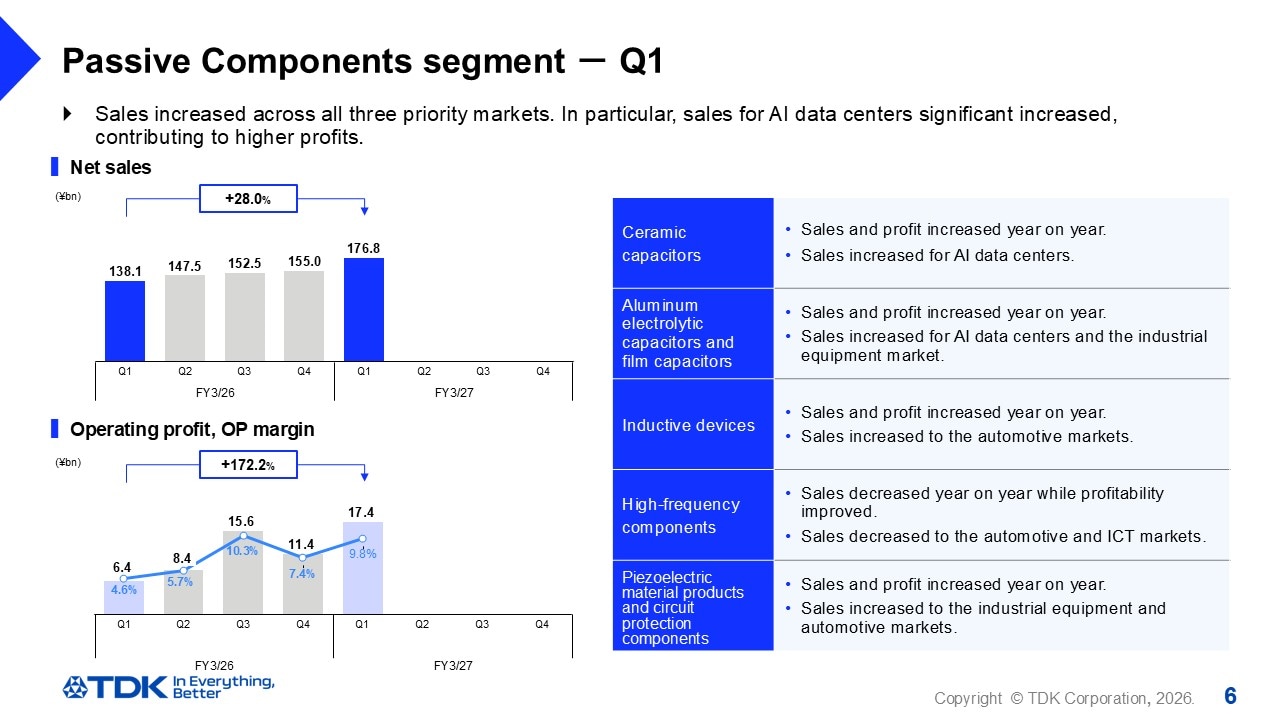
Sales increased across all three of our key markets: the automotive, ICT, and industrial equipment markets. In particular, sales for AI data center applications increased significantly. As a result, net sales increased by 28.0% year on year to 176.8 billion yen, while operating profit increased by 2.7 times year on year to 17.4 billion yen.
Sales of ceramic capacitors for AI data center applications increased, resulting in higher net sales and operating profit, along with a significant improvement in profitability. For aluminum electrolytic capacitors and film capacitors, sales to the automotive market increased. In addition, sales for AI data center applications grew significantly, resulting in higher net sales and operating profit.
Sales of inductive devices to the automotive market increased, leading to higher net sales and operating profit. Sales of high-frequency components to the automotive and ICT markets declined, but profitability improved. Sales of piezoelectric material products and circuit protection components to the industrial equipment and automotive markets increased, resulting in higher net sales and operating profit.
Sensor Application Products segment -Q1
In the Sensor Application Products segment,
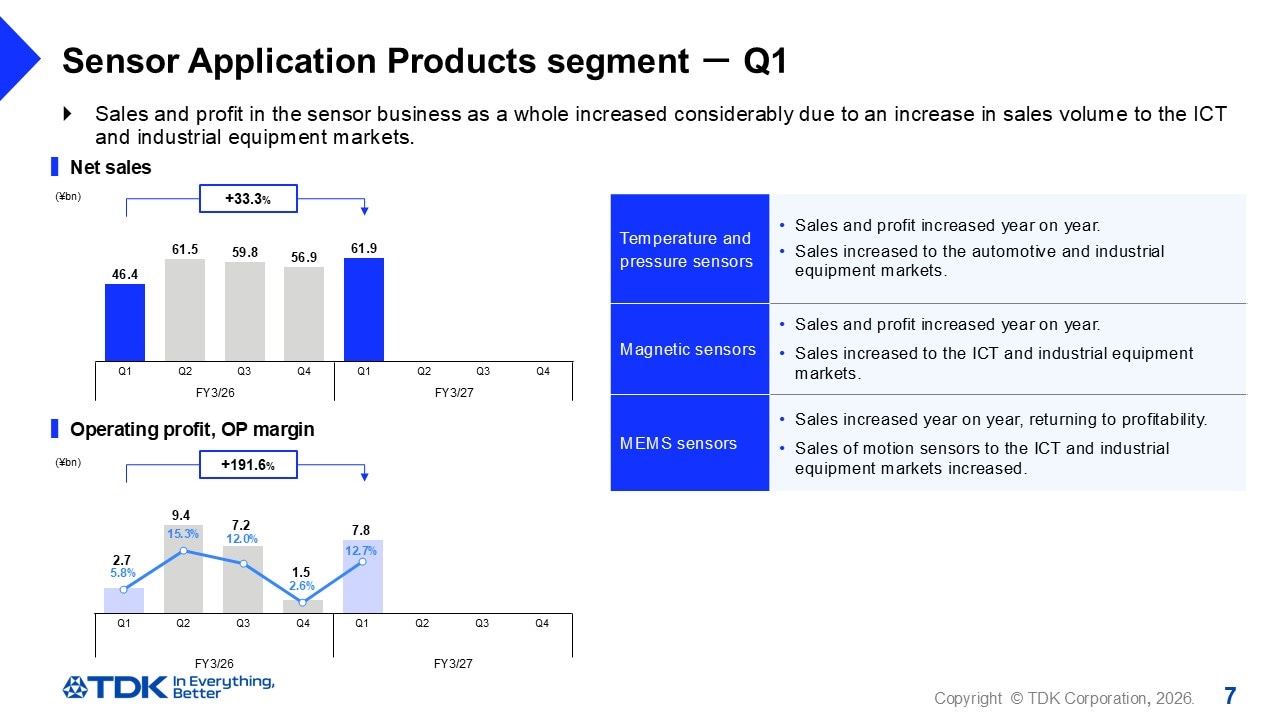
Sales volume to the ICT and industrial equipment markets increased. As a result, net sales totaled 61.9 billion yen, up 33.3% year on year, while operating profit reached 7.8 billion yen, approximately 3 times that of the same period of the previous fiscal year.
Sales of temperature and pressure sensors to the automotive and industrial equipment markets increased, resulting in higher net sales and operating profit.
For magnetic sensors, sales of TMR sensors for smartphone applications increased, and sales of Hall sensors to the industrial equipment market also increased. As a result, the magnetic sensor business as a whole recorded higher net sales and operating profit.
For MEMS sensors, sales of motion sensors to the ICT and industrial equipment markets increased. As a result, MEMS sensors as a whole recorded higher net sales and returned to profitability from a loss in the same period of the previous fiscal year, contributing significantly to the overall improvement in profitability of the Sensor Application Products segment.
Magnetic Application Products segment -Q1
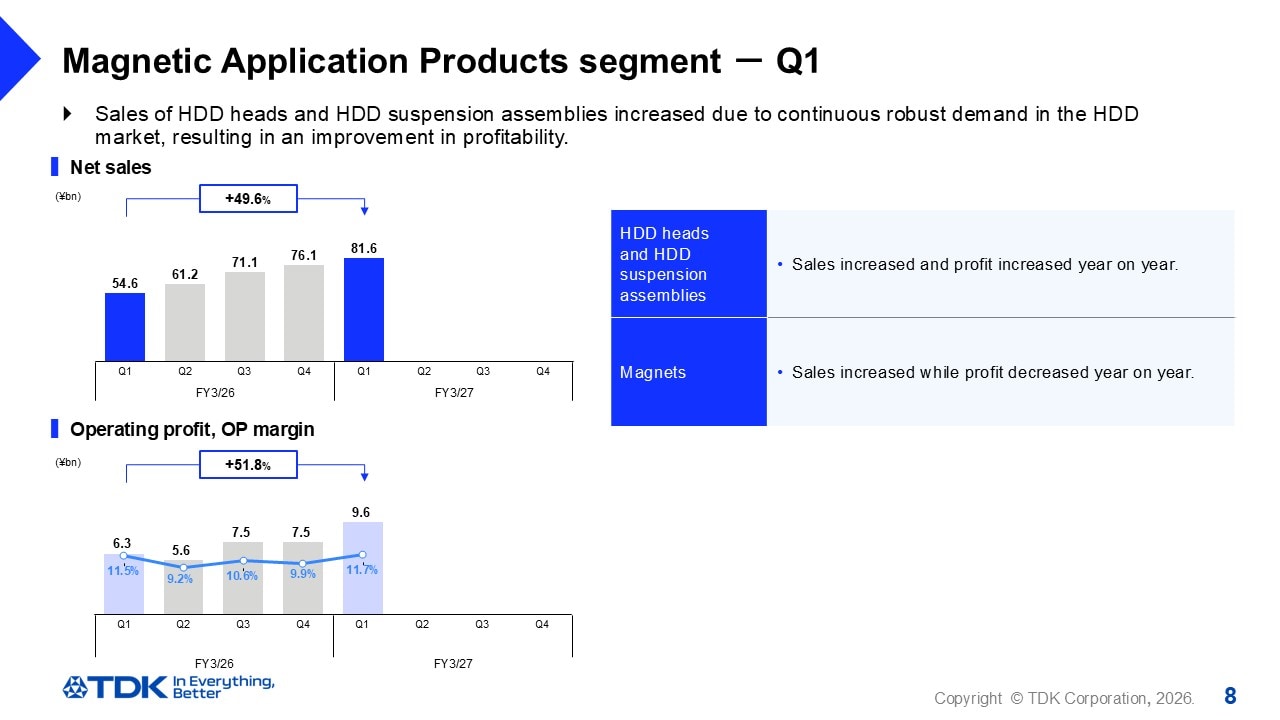
In Magnetic Application Products segment,
Net sales increased by 49.6% year on year to 81.6 billion yen, while operating profit increased by 51.8% to 9.6 billion yen.
Against the backdrop of growing demand for AI data centers, robust demand in the HDD market continued. Sales volumes increased by 36% for HDD heads and 31% for HDD suspension assemblies, resulting in significant increases in both net sales and operating profit. Sales of magnets to the automotive market increased, resulting in higher net sales. However, operating profit declined due to the absence of the approximately 1.0 billion yen in one-time gain recorded in the same period of the previous fiscal year. Meanwhile, the underlying loss has narrowed as a result of cost improvement initiatives, including quality improvements.
Energy Application Products segment -Q1
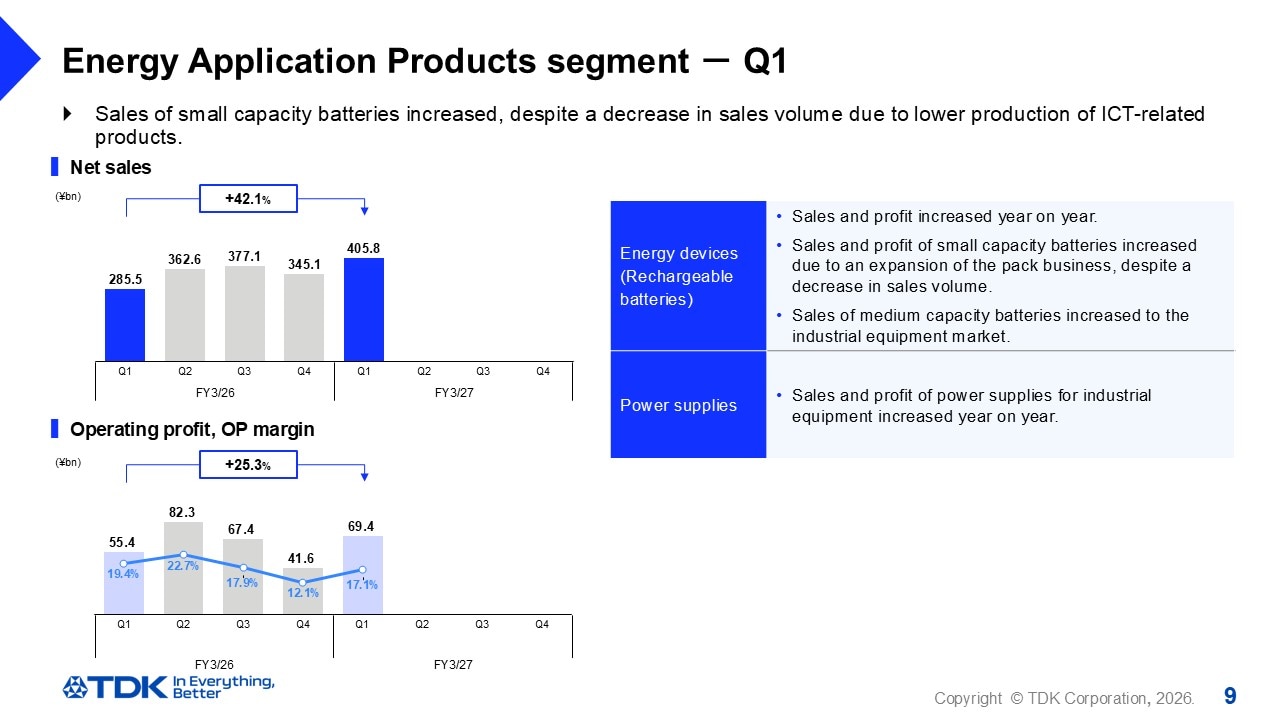
In the Energy Application Products segment,
Net sales totaled 405.8 billion yen, up 42.1% year on year, while operating profit reached 69.4 billion yen, up 25.3% year on year.
For rechargeable batteries, although sales volumes declined due to lower production volumes of ICT-related products, sales of small-capacity batteries increased as a result of price revisions reflecting changes in material costs, as well as the expansion of the small-capacity battery pack business. As a result, the rechargeable battery business recorded higher net sales and operating profit.
Sales of medium-capacity batteries to the industrial equipment market increased, resulting in higher net sales and operating profit of the rechargeable battery business as a whole.
For power supplies for industrial equipment, demand from the semiconductor manufacturing equipment market showed signs of a gradual recovery, resulting in higher net sales and operating profit.
In addition, during Q1 of FY March 2027, we completed the transfer of a new development business within the EV power supply business and recorded one-time gain of 2.6 billion yen as a gain on the transfer.
Quarterly results by segment
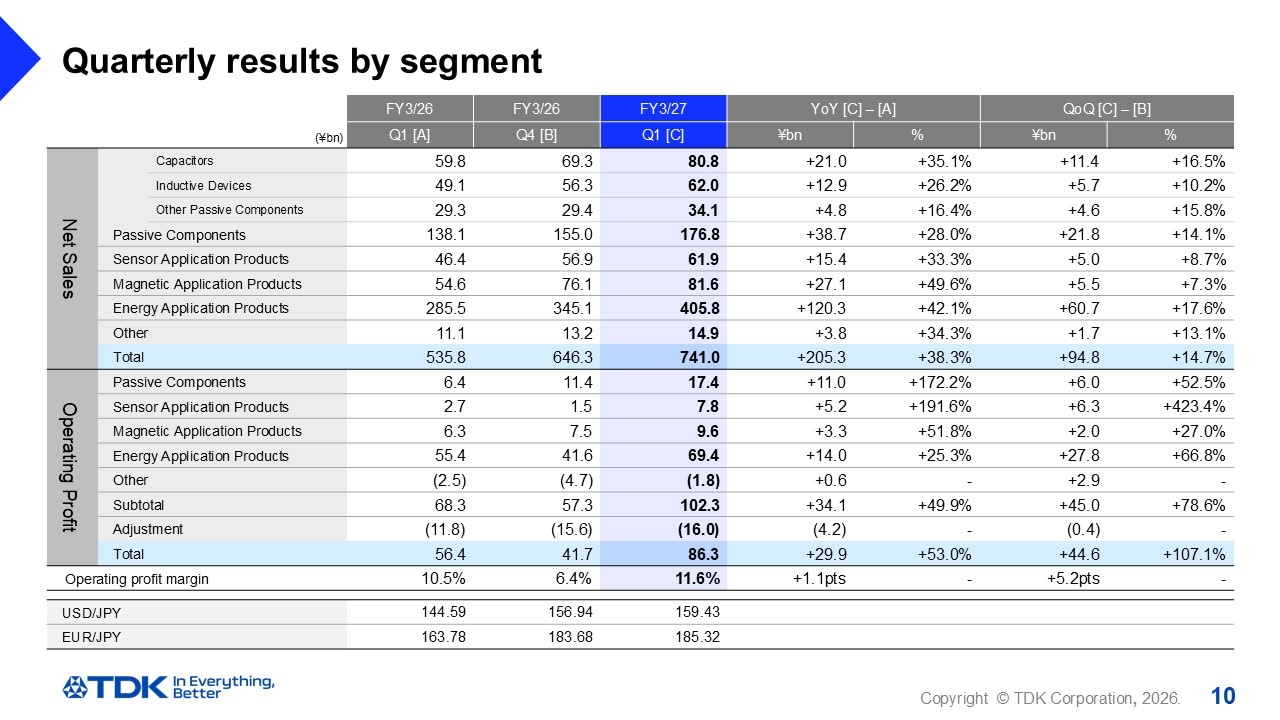
Next, I will explain some of the factors behind the changes in segment sales and operating profit from Q4 of FY March 2026 to Q1 of FY March 2027.
In the Passive Components segment, net sales increased by 21.8 billion yen, or 14.1%, from the Q4, while operating profit increased by 6.0 billion yen, or 52.5%.
For ceramic capacitors, sales to the automotive market increased, along with sales to the industrial equipment market including for AI data center applications, resulting in higher net sales and operating profit. Sales of aluminum electrolytic capacitors and film capacitors for AI data center applications and to the automotive market increased, resulting in higher net sales and operating profit. Sales of inductive devices to the automotive and ICT markets increased, resulting in higher net sales and operating profit. Sales of high-frequency components to the ICT market increased, resulting in higher net sales and operating profit. For piezoelectric material products and circuit protection components, increased sales to the automotive and industrial equipment markets led to higher net sales and operating profit.
In the Sensor Application Products segment, net sales increased by 5.0 billion yen, or 8.7%, from Q4, while operating profit increased by 6.3 billion yen to more than 5 times Q4 level.
Sales of temperature and pressure sensors to the automotive and industrial equipment markets increased, resulting in higher net sales and operating profit. Among magnetic sensors, while sales of Hall sensors remained flat, sales of TMR sensors to the ICT market increased due to seasonal factors, resulting in higher net sales for magnetic sensors as a whole. Excluding the 1.2 billion yen restructuring costs recorded for Hall sensors in Q4, operating profit of magnetic sensors as a whole also increased. In MEMS sensors, sales of motion sensors to the industrial equipment market increased, resulting in higher net sales and operating profit for MEMS sensors as a whole.
In the Magnetic Application Products segment, net sales increased by 5.5 billion yen, or 7.3%, from Q4, while operating profit increased by 2.0 billion yen, or 27%.
Sales volume of HDD heads increased by 12%, resulting in higher net sales, while sales volume of HDD suspension assemblies also increased by 8%. As a result, the HDD head and suspension assemblies as a whole recorded higher net sales and operating profit. Although sales of magnets declined, the loss narrowed due to ongoing cost improvement initiatives.
In the Energy Application Products segment, net sales increased by 60.7 billion yen, or 17.6%, from Q4, while operating profit increased by 27.8 billion yen, or 66.8%.
Sales volume of small-capacity batteries to the ICT market increased by approximately 4%. Together with increased sales of small-capacity battery pack products and medium-capacity batteries, this segment saw significant increases in both net sales and operating profit. For power supplies for industrial equipment, recovering demand resulted in higher net sales and operating profit. As mentioned earlier, we recorded a one-time gain of 2.6 billion yen in Q1 from the transfer of a new development business within the EV power supply business. The 9.6 billion yen difference between the approximately 7.0 billion yen restructuring costs recorded in Q4 and the 2.6 billion yen gain on the business transfer recorded in Q1 is included in the increase in operating profit for the Energy Application Products segment.
Analysis of change in operating profit -Q1
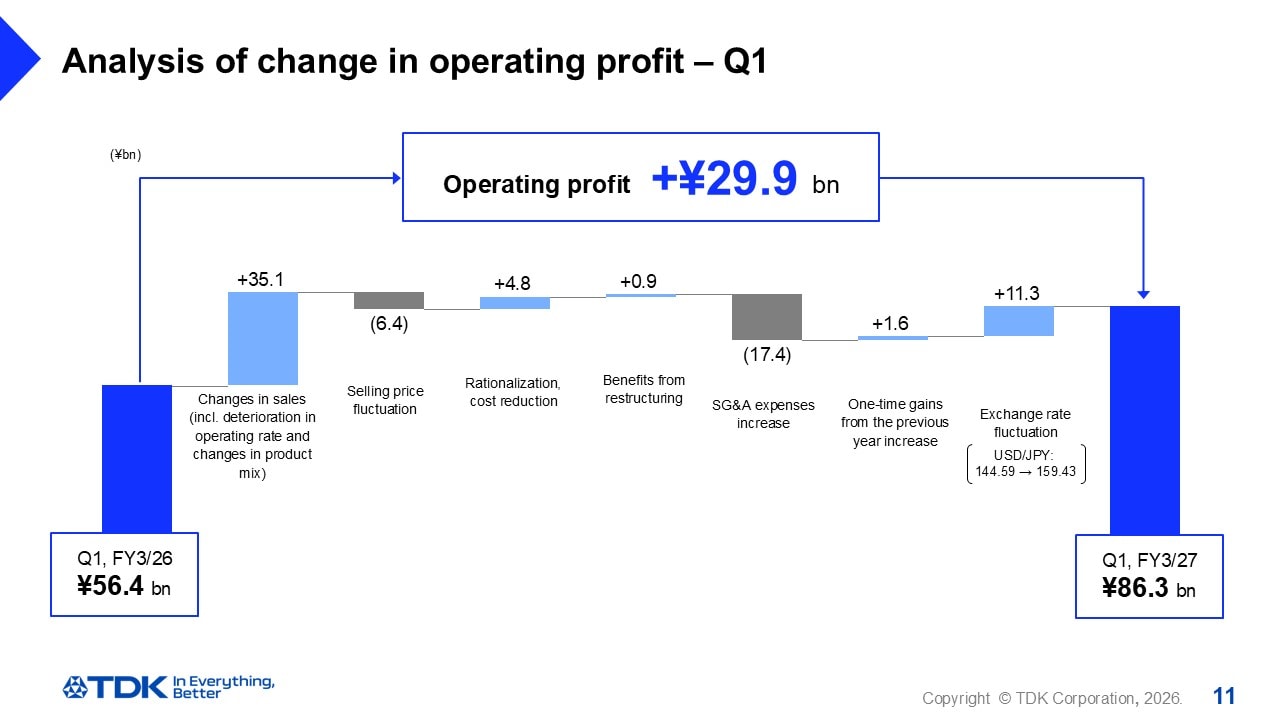
Next is an analysis of the 29.9 billion yen increase in operating profit.
Higher sales volumes across all segments contributed a 35.1 billion yen increase in operating profit. Changes in selling prices had a negative impact of 6.4 billion yen, which was largely offset by 4.8 billion yen in rationalization and cost reductions and 0.9 billion yen in benefits from the restructuring initiatives implemented in the previous fiscal year.
SG&A expenses increased by 17.4 billion yen, primarily due to higher R&D expenses for rechargeable batteries, reflecting accelerated development of new technologies and products, and for HDD heads, where development of next-generation technologies, including HAMR, is underway.
Meanwhile, the increase in one-time gains contributed 1.6 billion yen to operating profit, and the depreciation of the yen had a positive impact of 11.3 billion yen. As a result, operating profit increased by 29.9 billion yen overall.
Cash flows -Q1
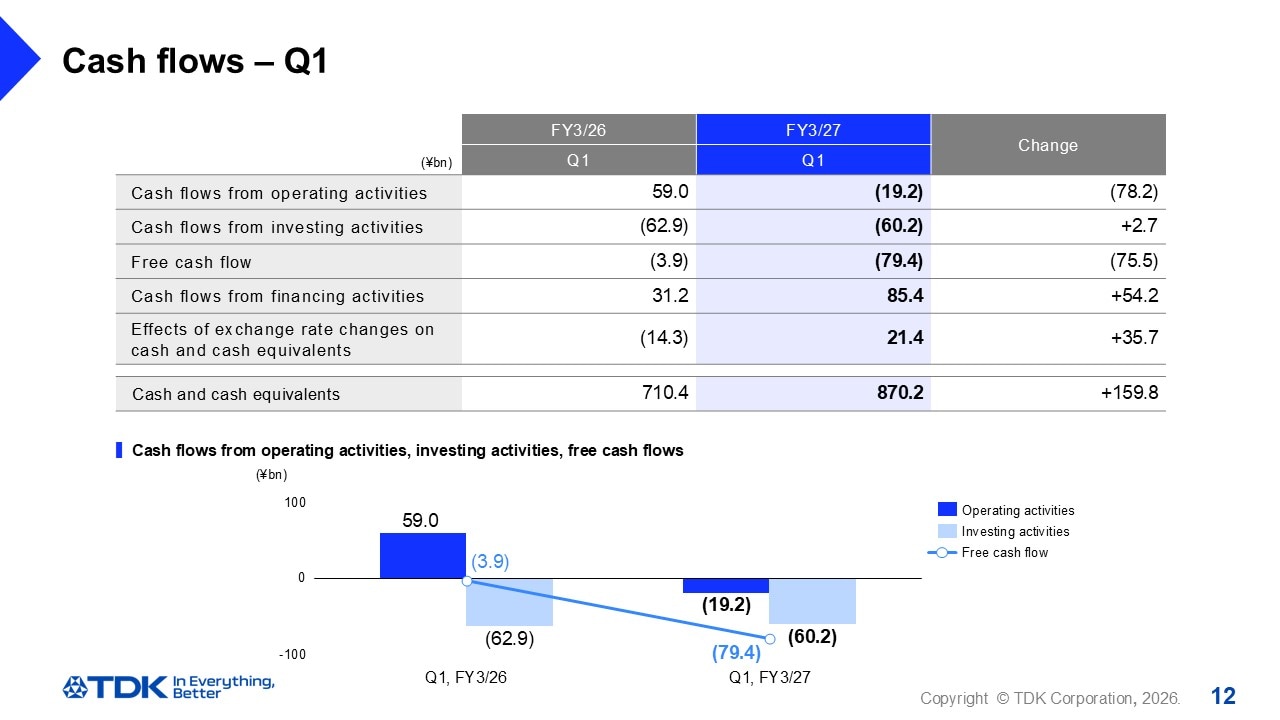
Next, I will present an overview of our cash flows in Q1.
Operating cash flow was an outflow of 19.2 billion yen. In addition to an increase in working capital associated with higher sales, a temporary cash outflow, primarily due to the payment of withholding taxes, was a factor behind the decrease in operating cash flow. In terms of investing cash flow, capital expenditures were largely in line with our initial plan. Cash outflows related to the acquisition of Linergy in the rechargeable battery business were also recorded, resulting in an investing cash outflow of 60.2 billion yen.
As a result, free cash flow was an outflow of 79.4 billion yen.
Although free cash flow was a significant outflow in Q1 due to increased investment associated with business expansion, including acquisitions and higher working capital, as well as temporary cash outflows, we expect only a limited impact on the capital allocation projected under our current Medium-term Plan.
FY March 2027 Projections
Projections by segment for Q2 of FY March 2027
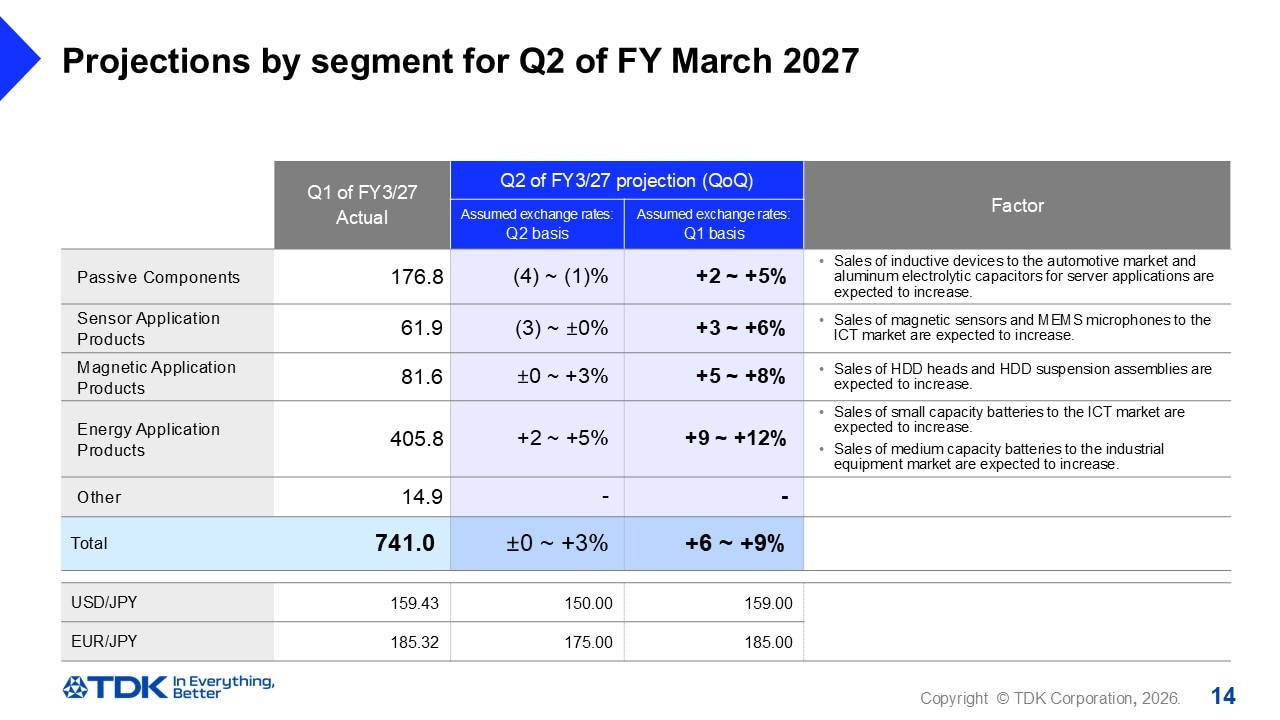
First, I will explain our projected quarter-on-quarter changes in segment net sales from Q1 to Q2.
Our assumed exchange rate for Q2 remains unchanged from the exchange rate assumption announced at the beginning of the fiscal year at 150 yen to the U.S. dollar. The figures in this slide exclude the impact of exchange rate fluctuations.
In the Passive Components segment, we expect inductive devices to see higher sales to the automotive market. In addition, sales of aluminum electrolytic capacitors and various other products for AI server applications are also expected to increase. As a result, we expect overall sales for the segment to increase by 2% to 5%.
In the Sensor Application Products segment, we expect overall sales to grow from 3% to 6%, driven by higher sales of magnetic sensors and MEMS microphones to the ICT market due to seasonality.
In the Magnetic Application Products segment, we expect sales volumes to increase by approximately 10% for HDD heads and approximately 6% for HDD suspension assemblies, supported in part by higher sales volumes for captive use. As a result, the overall sales for the segment is expected to grow by 6% to 8%.
In the Energy Application Products segment, taking seasonal factors into account, smartphone production is expected to peak in Q2, with an increase of approximately 5% quarter-on-quarter. Accordingly, sales volumes of small-capacity batteries are expected to increase by approximately 10%, while sales of medium-capacity batteries to the industrial equipment market are also expected to increase. As a result, we expect overall sales for the segment to increase by 9% to 12%.
FY March 2027 projections
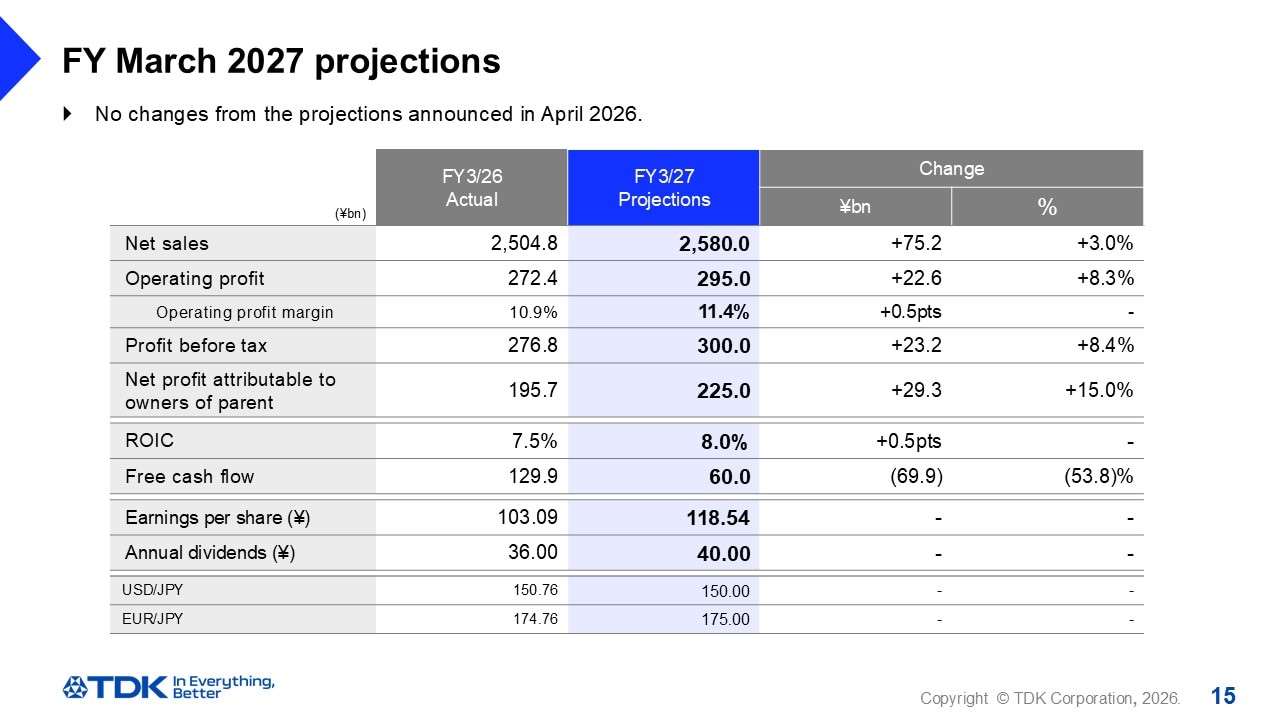
Next, I will go over our full-year projections for FY March 2027.
In Q1, sales for AI data center applications remained strong. In addition, despite a year-on-year decline in production volumes of ICT-related products, new product sales for smartphones and other applications had a positive impact on our results. As a result, our business results significantly exceeded the level initially anticipated at the beginning of the fiscal year.
In Q2, we also expect net sales in all segments to exceed the levels initially expected at the beginning of the fiscal year, and we expect our overall results to remain strong.
However, we recognize the need to closely monitor future developments in the global environment, changes in market demand, and exchange rate levels. Therefore, we have maintained our full-year projections for FY March 2027 at the levels announced at the beginning of the fiscal year.
Publication of TDK United Report 2026 (Integrated Report)
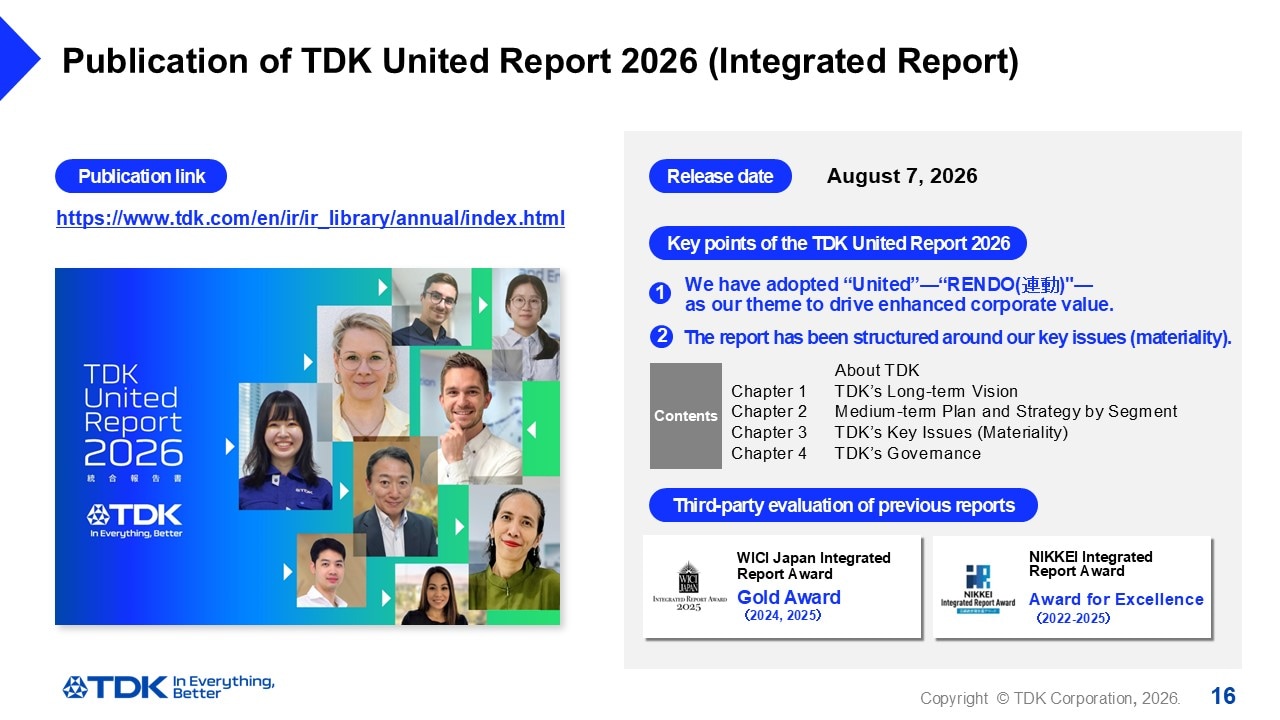
Finally, I have two announcements.
On August 7, we are scheduled to release the “TDK United Report 2026.” This year’s report focuses on the theme of “RENDO (連動)” under the concept of “TDK United,” and highlights our initiatives toward realizing our long-term vision and enhancing corporate value, with our materialities at the core.
The report is available on TDK’s website, and we hope you will find it informative.
Publication link: https://www.tdk.com/en/ir/ir_library/annual/index.html
TDK Investor Day (Pre-financial Capital Briefing)
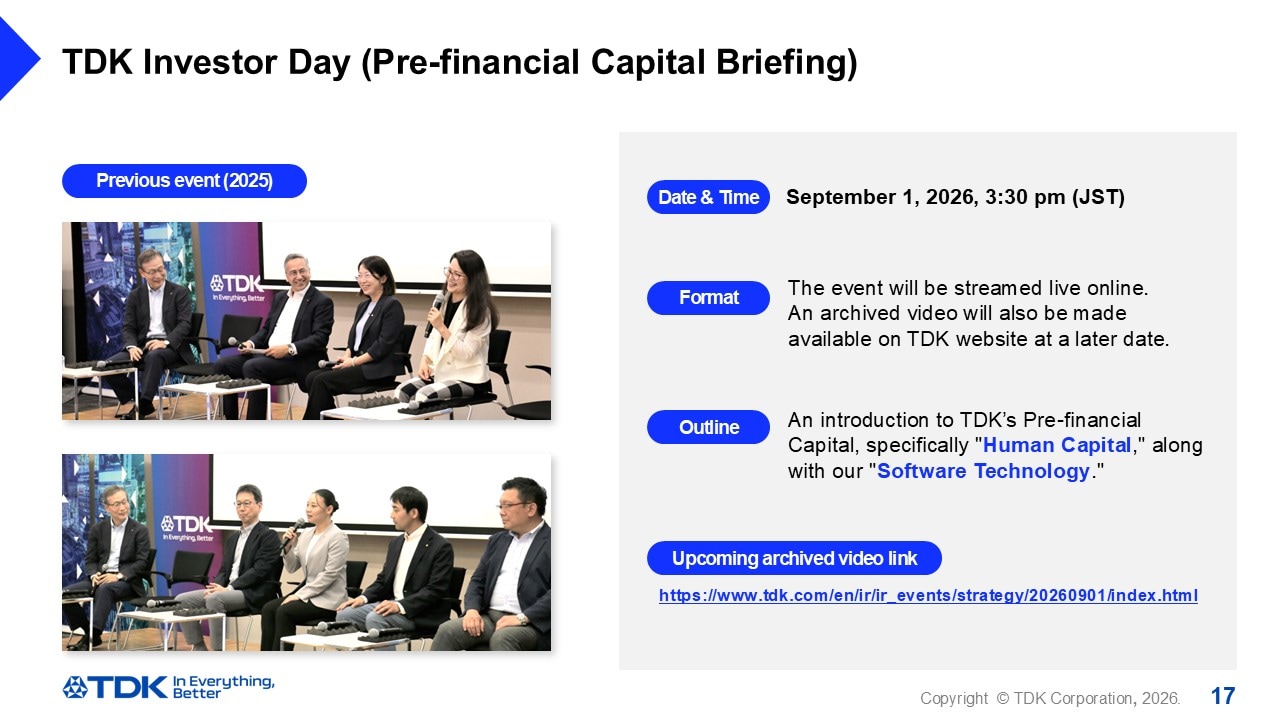
One more announcement:
we will hold our TDK Investor Day on September 1. the TDK United team members will introduce our human capital and software technologies, which are key components of our pre-financial capital.
The event will also be webcast live.
This concludes my presentation. Thank you very much.


