

TDK Investor Day 2026: To Enhancement of Corporate Value through Pre-Financial Capital (Human Resources Strategy & Cutting-edge technology)
(Conducted for September 1, 2026)
Speech Text
1. Opening Remarks
Thank you all for gathering here today. I am Noboru Saito, CEO of TDK.
My Commitment as President & CEO
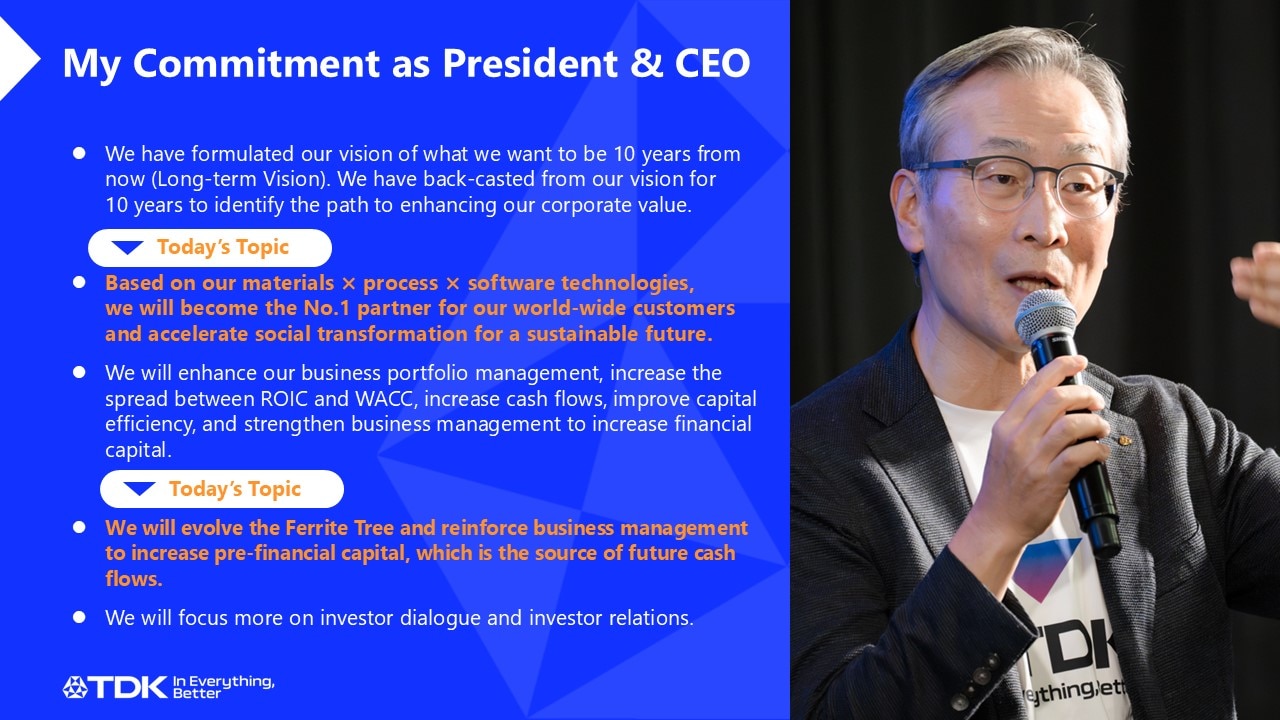
We had our first pre-financial capital briefing last year. Regarding my commitment to "strengthening management that enhances pre-financial capital," today I would like to explain our technological capabilities and the human capital that supports them.
Pre-Financial Capital Supporting the Long-term Vision
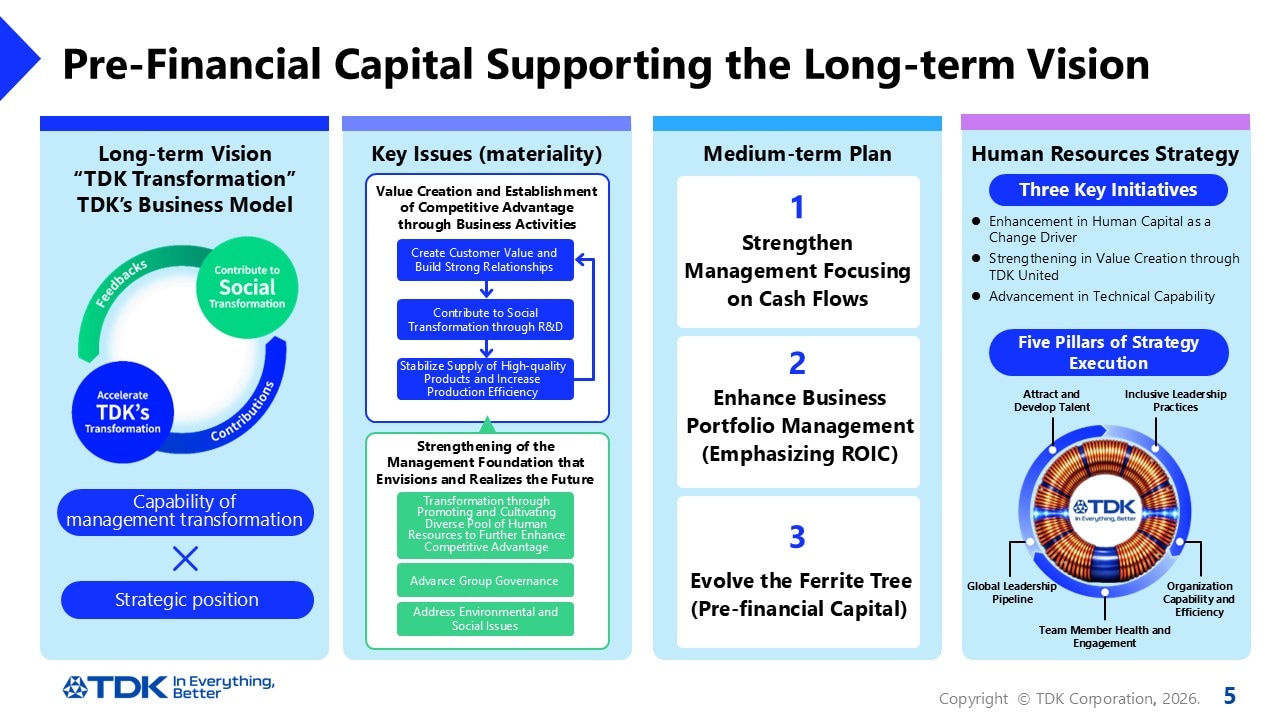
This slide illustrates the positioning of our materiality, Medium-term Plan, and Human Resources Strategy, which is aimed at strengthening pre-financial capital, to achieve our Long-term Vision.
To realize the Vision, our materiality focuses on elements that maximize our corporate value, premised on long-term value creation for all stakeholders. To this end, we have adopted the approach of pursuing the synchronization of sustainability for both society and the company.
Regarding the materiality related to pre-financial capital, we have identified the following: "Contribute to Social Transformation through R&D," and "Transformation through Promoting and Cultivating Diverse Pool of Human Resources to Further Enhance Competitive Advantage," which supports this R&D.
“RENDO“Alignment of HR Strategy with Corporate Strategy
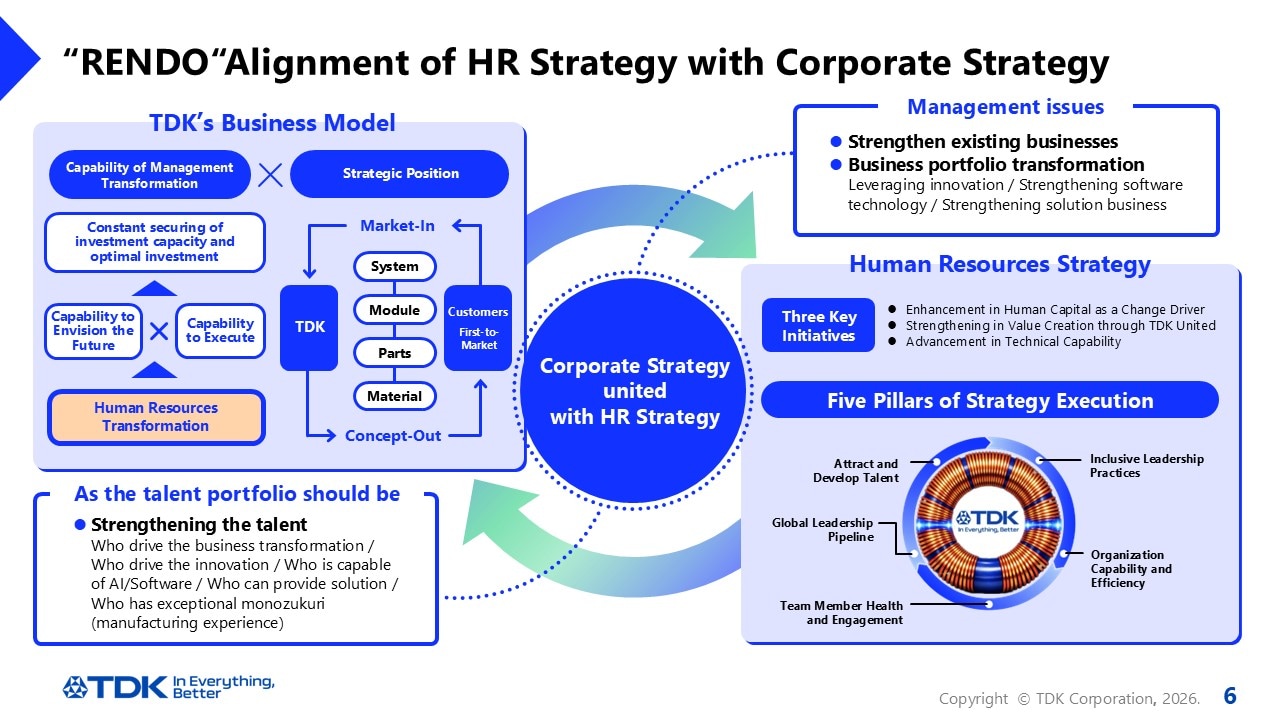
Our HR strategy—how we develop and strengthen this talent—is closely RENDO (aligned) with our corporate strategy.
To achieve our Long-term Vision, we do not view human capital merely as a resource, but rather as the very driver of transformation and the core capital that propels the execution of our corporate strategy and value creation.
There are two major challenges in advancing our management transformation: one is strengthening our existing businesses, and the other is our business portfolio transformation. To overcome these challenges and evolve our management, it is crucial to enhance the transformative power of our human resources.
Our ideal HR portfolio consists of talent capable of driving business transformation and promoting innovation. Later in this session, our CHRO, Andreas Keller, will explain how we are acquiring and strengthening such talent.
Toward Realizing Our Mid‑ to Long‑term Target State
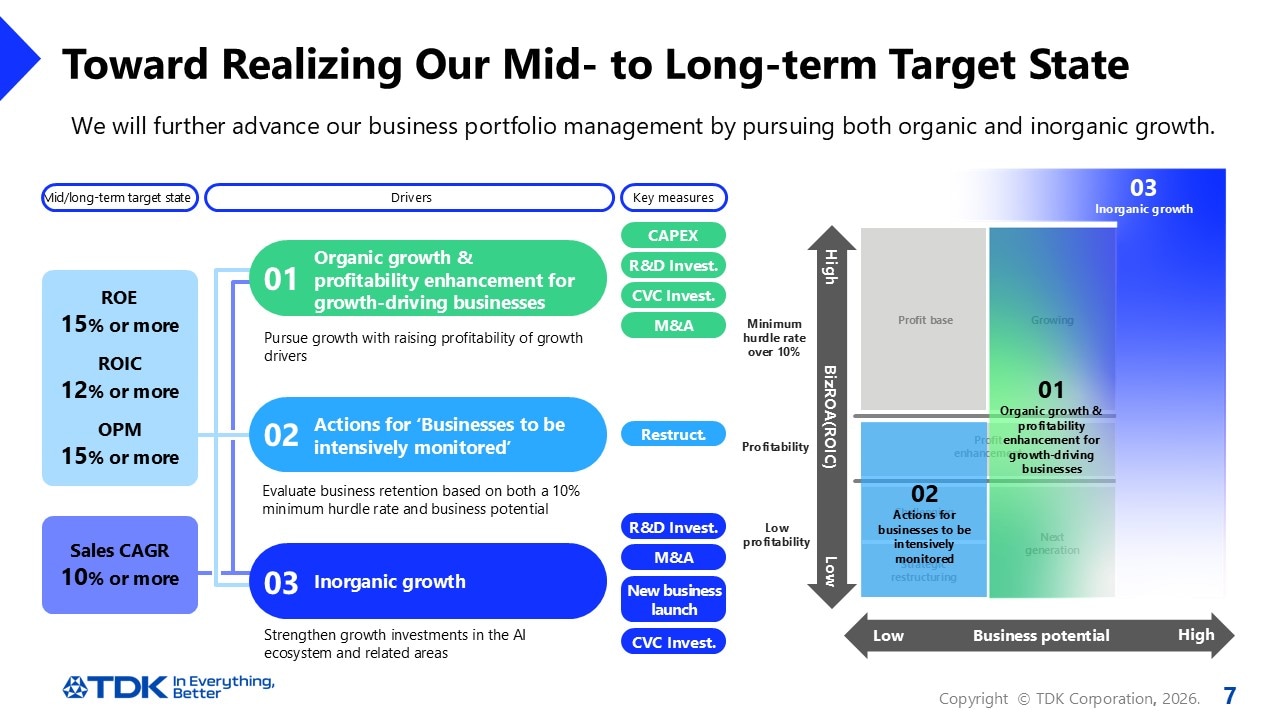
This talent will continue to drive and lead our growth strategy—namely, our portfolio management—to achieve our Medium- to Long-term Target State.
We Will Help Boost Sales for the Entire AI Ecosystem
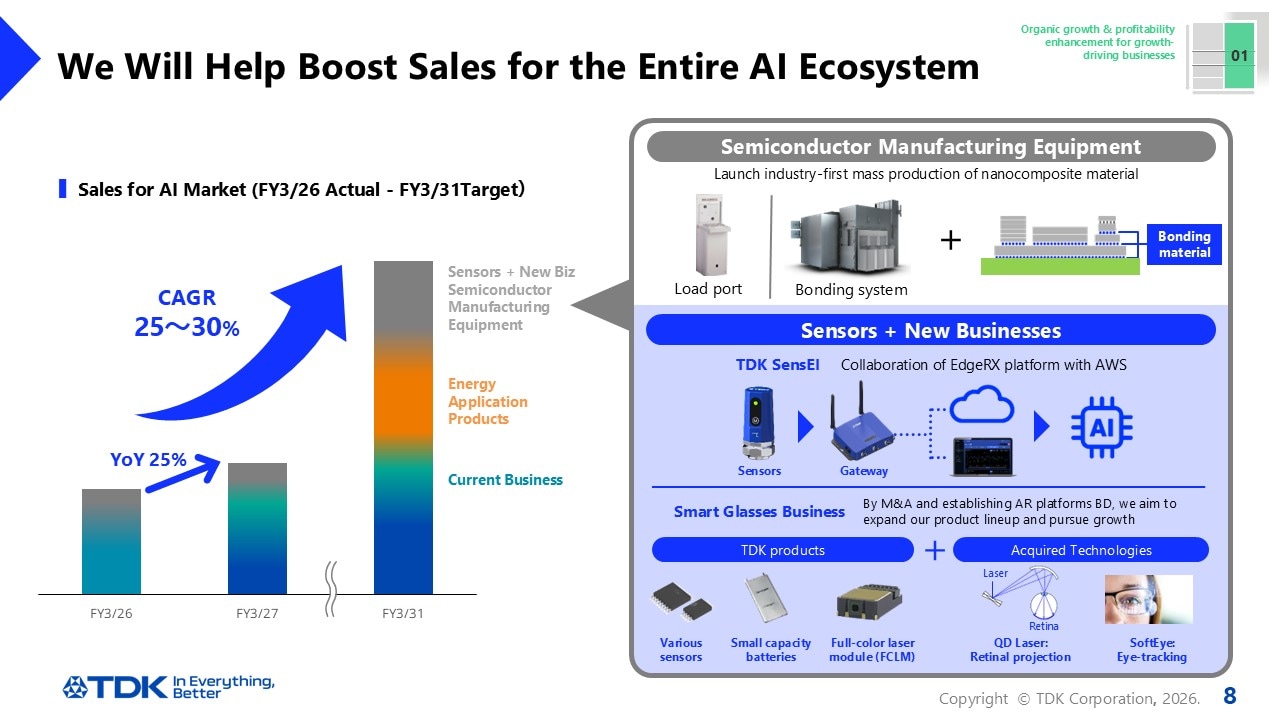
The biggest driver of this growth strategy is the expansion of our business for the AI ecosystem.
We plan to expand our sales in the FY March 2031 to approximately three times the level of the FY March 2026. I am also pleased to report that our Q1 results have shown stronger growth than initially expected.
Today, our CTO, Shuichi Hashiyama, and DGM of the Tech & IP HQ, Jim Tran, will explain our cutting-edge technology development and solution businesses utilizing software and other technologies aimed at expanding the new businesses shown in the gray section of this chart.
2. Human Capital Management
Good afternoon, everyone. My name is Andreas Keller, CHRO of TDK. Last year, I stood here with Tomoyo Hiraoka, Head of HR Center of Excellence, and Angela Yuan, DGM of Human Resources HQ — and I am pleased that Hiraoka-san is with us again today. This year, I will present together with Greg Brower, another key member of our global HR leadership team. Together, we will spend the next 20 minutes on what we believe is the most fundamental driver of TDK's ability to execute on everything you have heard today — our people.
When you look at the title "Human Capital Management: Fueling Innovation and Inclusive Growth," The title says it all. Every growth target, every technology ambition, every market expansion — none of it happens without the right people, with the right capabilities, in the right culture. That is what Greg and I are here to demonstrate.
Andreas Keller
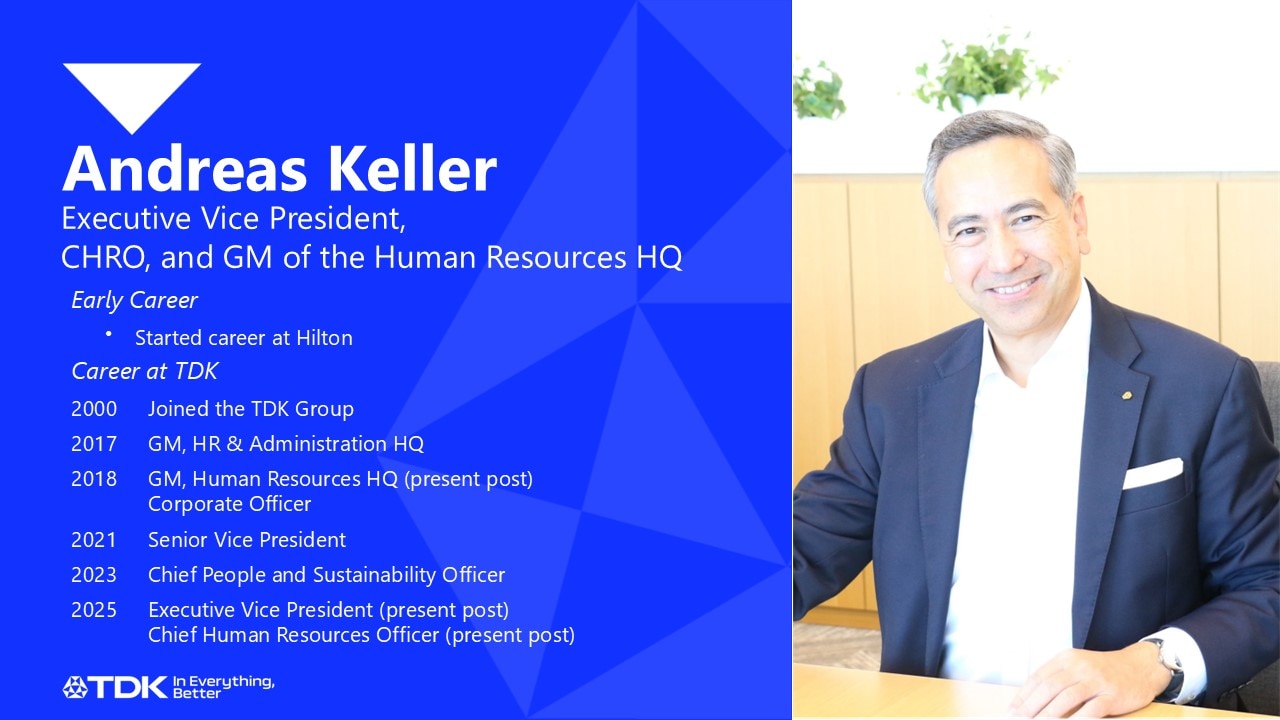
My background before TDK was Hilton Hotels — 13 years, multiple countries, an industry where every single competitive advantage ultimately comes down to people. I carried that conviction with me when I joined TDK 26 years ago at our German subsidiary — starting in Supply Chain, moving through various roles in Business Administration, HR, and eventually making my way to this role as CHRO at HQ. That journey, across so many of TDK's chapters of change, gives me both perspective and conviction. And perhaps more importantly — it is itself an example of what I am here to tell you about: TDK's genuine capability to identify, develop, and grow its own leaders.
“RENDO“Alignment of HR Strategy with Corporate Strategy
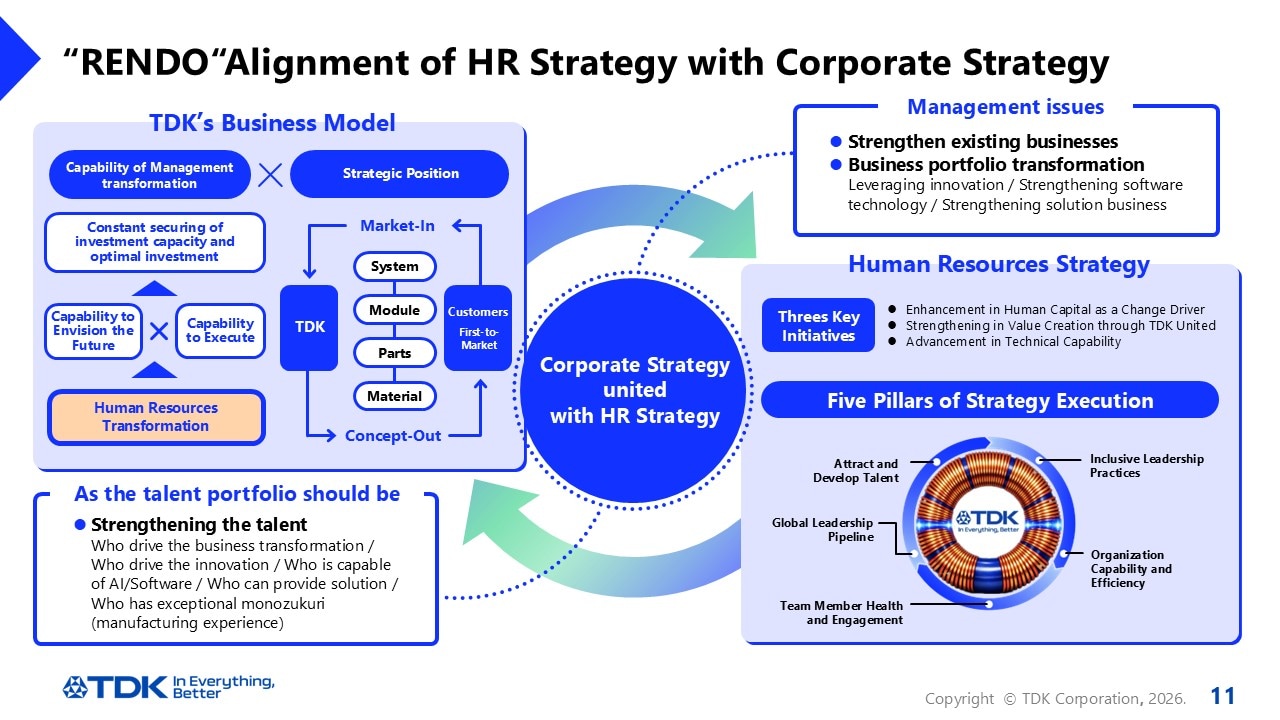
Everything in our HR approach begins with one principle: “RENDO” — alignment. As Saito-san said earlier, HR strategy and corporate strategy do not run in parallel at TDK. They move as one.
Delivering that strategy requires us to build a talent portfolio of four distinct strengths which you see at the bottom left: people who drive business transformation; people who drive innovation; people who are capable in AI and software, translating that capability into solutions; and people who can directly deliver those solutions to our customers.
These four are not aspirational — they define the talent portfolio we are actively building today. And five HR pillars bring this to life which you see on the right in our HR Strategy: Attract and Develop Talent; Inclusive Leadership; Global Leadership Pipeline; Organisational Capability and Efficiency; and Team Member Health and Engagement — all driven by our TDK United HR transformation.
TDK Human Induction Cycle
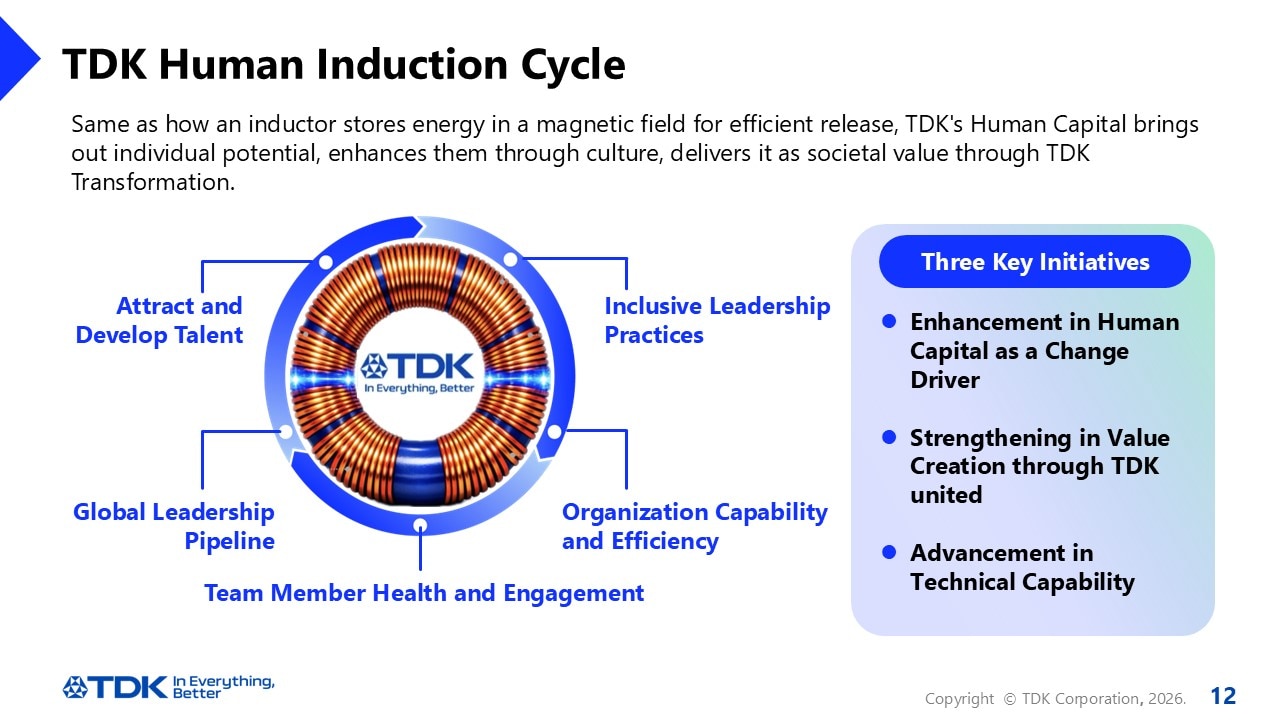
To bring this strategy to life, we use a model we call the TDK Human Induction Cycle — and I love this concept because it is very TDK.
Just as an inductor stores energy in a magnetic field and releases it efficiently when needed, we bring in individual potential, enhance it through our culture, and release it as business and societal value through TDK's transformation.
And like an inductor, this is not a one-time charge. It is a continuous, self-reinforcing cycle: stronger culture builds a stronger pipeline; a stronger pipeline drives greater innovation; greater innovation attracts exceptional talent.
This cycle is driven by three initiatives, which you see on the right: Enhancement of Human Capital as a Change Driver; Strengthening Value Creation through TDK United; and Advancement of Technical Capability. Let me now show you how this maps to our value creation model.
TDK Human Capital Value Creation Model
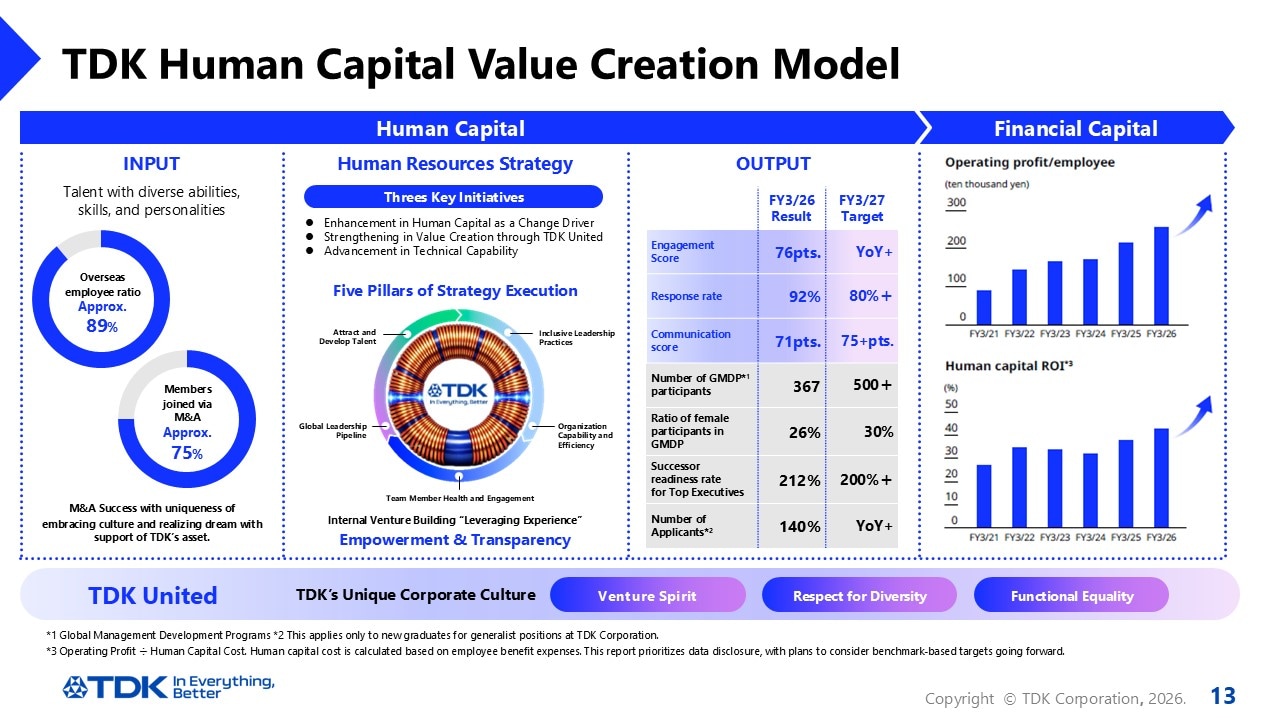
This slide represents the output and financial dimension of our Human Capital strategy.
We believe human capital investment must be measurable — not just in engagement scores, but in its direct contribution to financial value creation. We track Human Capital Return on Investment as a key metric, and we are actively working to define clear benchmark targets in dialogue with you, our investors going forward.
The Human Induction Cycle — operating at full capacity — translates into faster innovation cycles, stronger leadership decisions, lower organizational friction, and improved market positioning. These are not just soft outcomes. They are strategic returns on people investment.
TDK Human Capital Value Creation Model
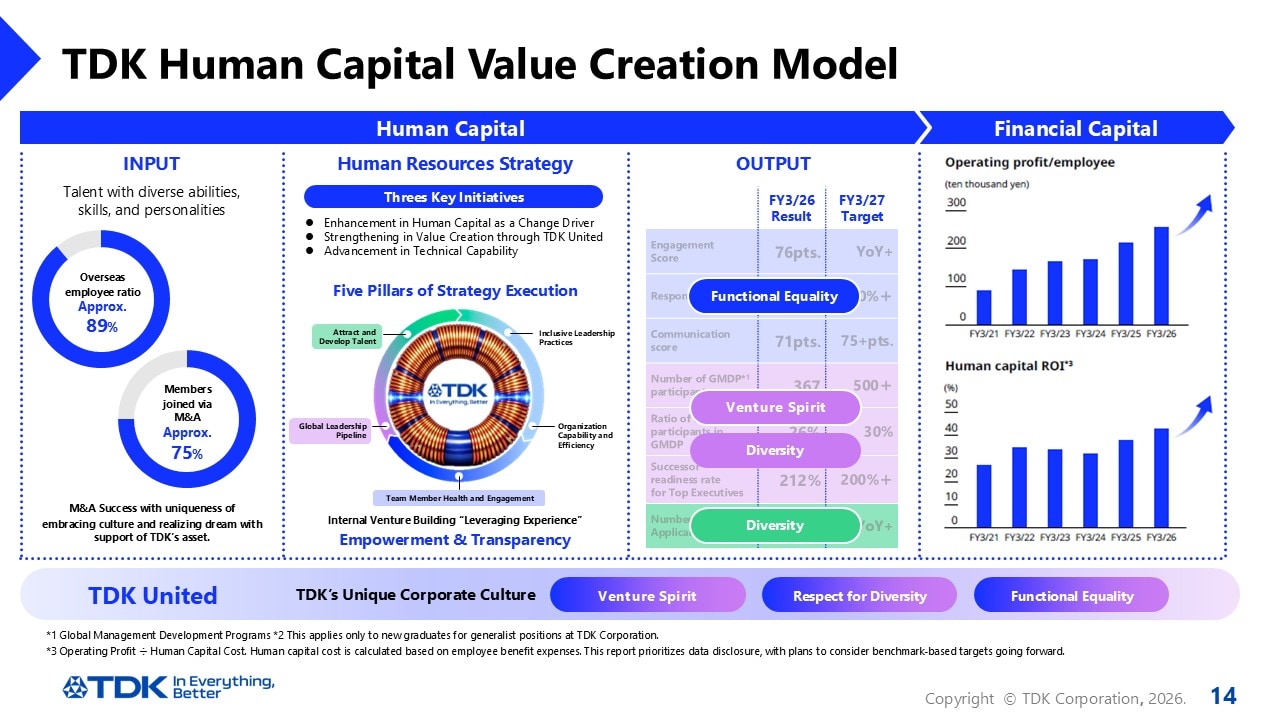
Today I want to take you through the major KPI progress that demonstrates this model working in action — but first, let me anchor it in the three cultural values that make everything possible: Functional Equality, Venture Spirit, and Diversity.
Functional Equality — every team member has a meaningful voice, regardless of title or location. It is the cultural condition that makes genuine engagement real.
Venture Spirit — TDK’s entrepreneurial DNA. The drive to always challenge, always create, always be willing to pursue the new. It is what makes our internal incubators possible.
Diversity — of thought, background, gender, and nationality — is the fuel for differentiated innovation. Diverse teams see problems differently and solve them better.
These are active operating principles we measure, reinforce, and hold ourselves accountable to. Let me show you the KPIs.
Team Member Engagement
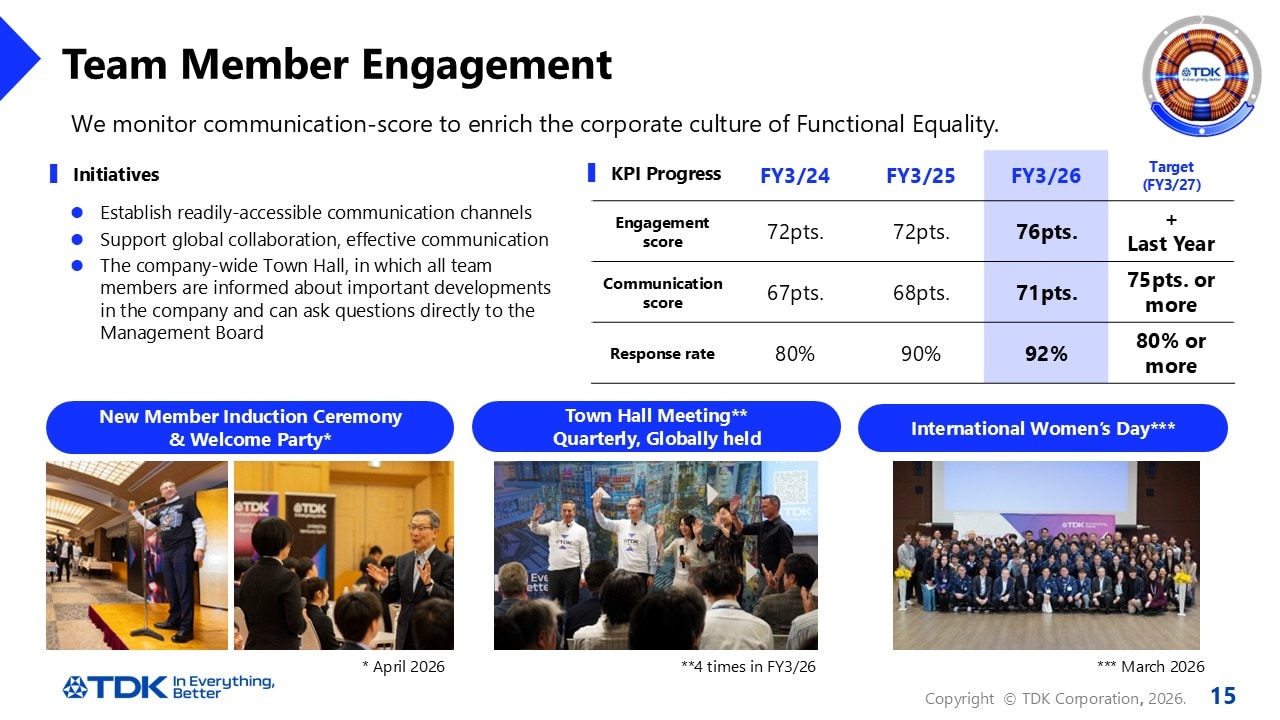
The first major output KPI I want to highlight is Team Member Engagement.
We monitor this globally through an annual survey, paying particular attention to our Communication Score, which is also quite unique — because quality of communication is the truest measure of Functional Equality in practice.
Our Engagement Score has risen from 72 points in FY March 2024 to 76 points in FY March 2026. A meaningful step forward.
Our Communication Score has grown from 67 to 71 points, advancing toward our target of 75 or more.
And our Survey Response Rate has climbed from 80% to 92% — a 92% participation rate at a global company is exceptional, and it tells me our people trust that their voice matters.
How do we achieve this? Through concrete initiatives: quarterly global Town Hall meetings — held four times in FY2026 — where every employee worldwide can ask questions directly to the Management Team. New Member Induction Ceremonies. And events like International Women’s Day, used as a genuine platform for inclusion dialogue. Moreover, it is not shown here, but every department in every location is having follow-up conversations with the respective teams for improvements.
Global Leadership Pipeline
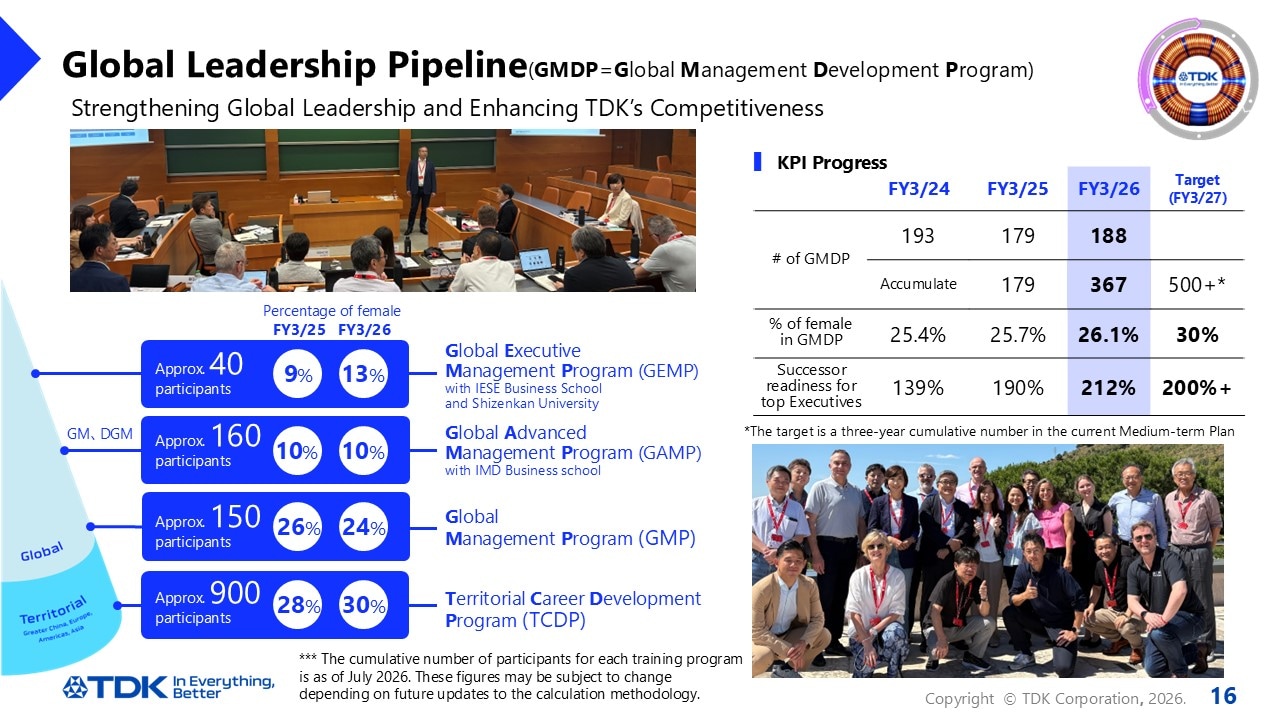
You will recall our Global Management Development Program — GMDP — from last year, so let me go straight to the progress.
Just to remind everyone, the program runs across four management levels — TCDP, GMP, GAMP with IMD Business School, and GEMP with IESE and Shizenkan University — covering approximately 1,250 participants in total so far, from territorial leaders all the way to our most senior executives.
The numbers speak for themselves: cumulative GMDP participants stand at 367 for this mid-term, on track toward our target of 500+. Female participation is growing year-on-year — 25.4%, 25.7%, 26.1% — advancing toward our 30% target. And Successor Readiness for Top Executives has reached 212% — well beyond our 200% target. We have more than twice as many ready successors as positions to fill.
Outcome of Cross Functional and International GMDP Training
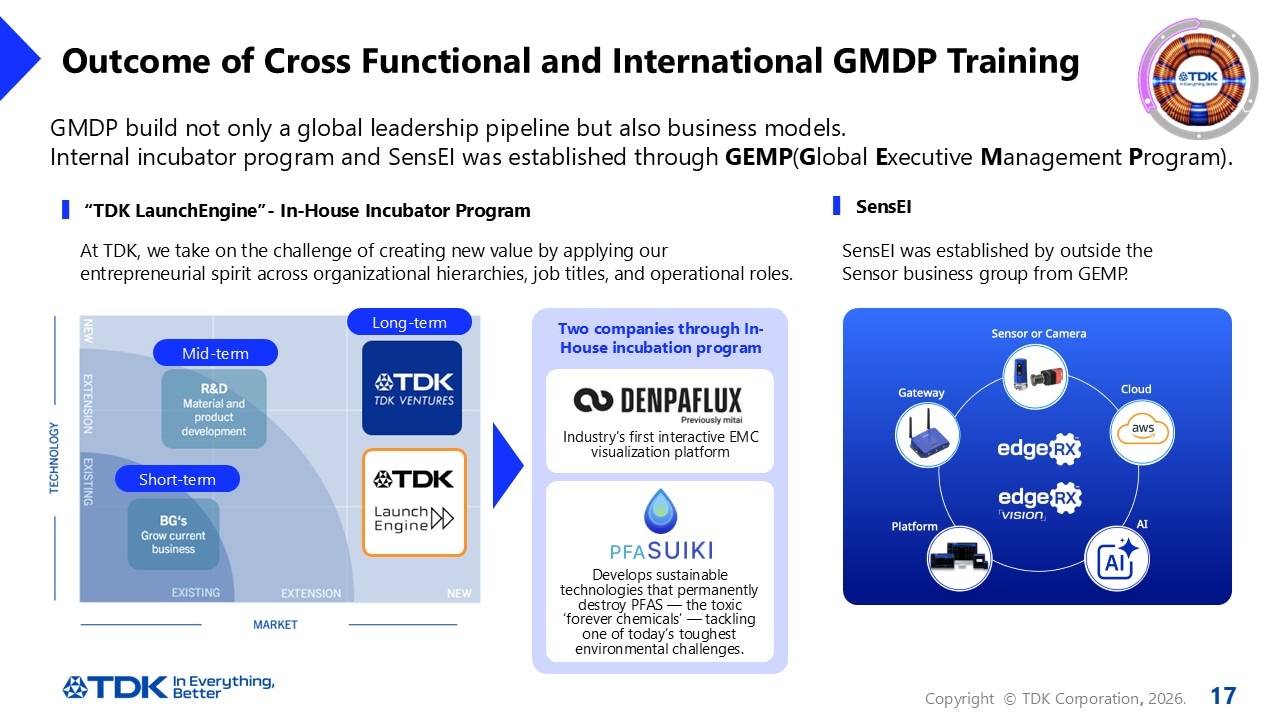
But I would like to emphasize one point: GMDP does not only build a leadership pipeline. It builds businesses.
Through our Global Executive Management Program, participants have launched real ventures.
Let me highlight SensEI (on the right) as Jim Tran will talk about it during the CTO session. It is a company established entirely by GEMP participants from outside the Sensor business group — they identified an opportunity, formed a cross-functional team, and built a new business. SensEI is now a functioning venture. By the way, Jim Tran as well as our CTO Hashiyama-san have both participated in the GEMP program.
The others start-up companies that emerged through our “TDK Launch Engine” were already mentioned last year, so let me skip that part.
This brings me to the next dimension of our talent strategy — how we make TDK visible and compelling to the world’s best talent. Let me first share the strategic framework — and then hand over to my colleague Greg Brower, who will elaborate on this important topic further.
Employer Branding Initiatives
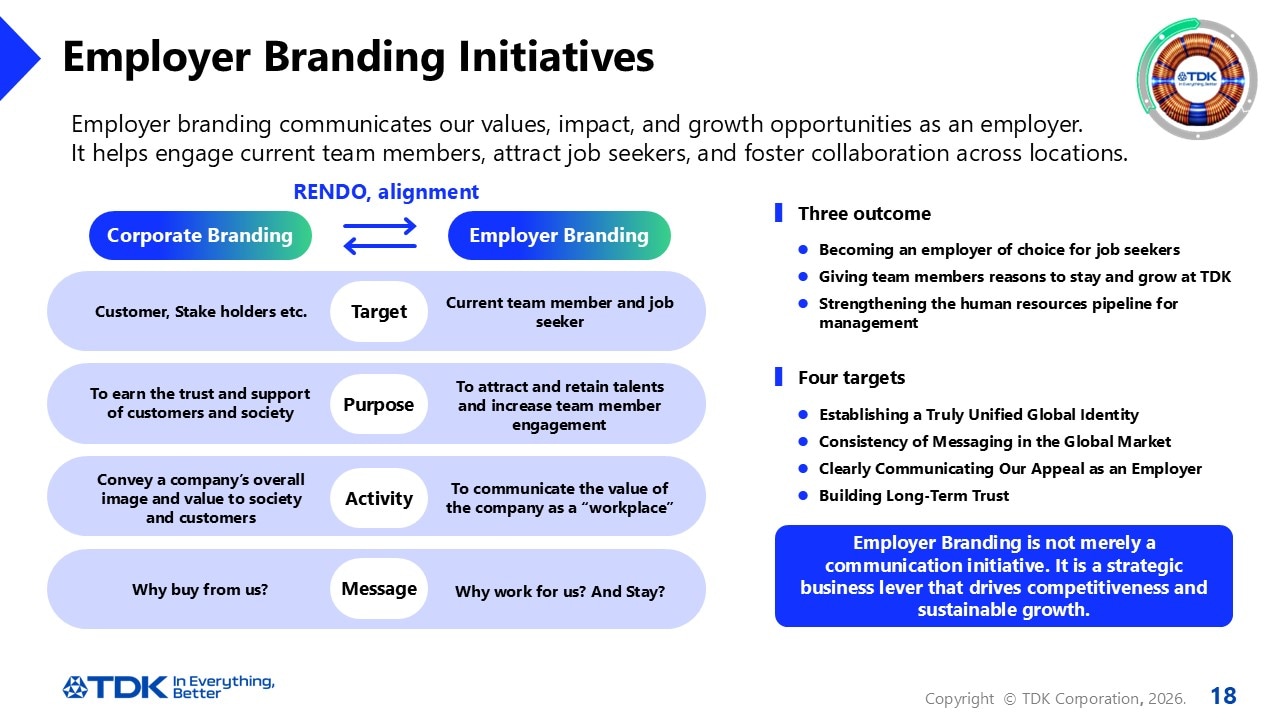
Let me emphasize: Employer Branding is not a communication exercise. It is a strategic business lever that drives competitiveness and sustainable growth.
Corporate Branding answers: "Why should I buy from TDK?" Employer Branding answers a different question entirely — the one every candidate and every team member asks: "Why should I work for TDK? And why should I stay?" Separate strategies — but deeply aligned. That alignment is RENDO in action.
Our Employer Branding strategy targets three outcomes: becoming the employer of choice for job seekers; giving team members compelling reasons to stay and grow; and strengthening the HR pipeline for our management bench. Delivered through four goals: a unified global identity; consistent messaging across all markets; clearly communicating our appeal; and building long-term trust with candidates, employees, customers, and society.
I now hand over to Greg Brower — who joined TDK in 2017 through the InvenSense acquisition and leads our global HR Business Partnering.
Greg Brower
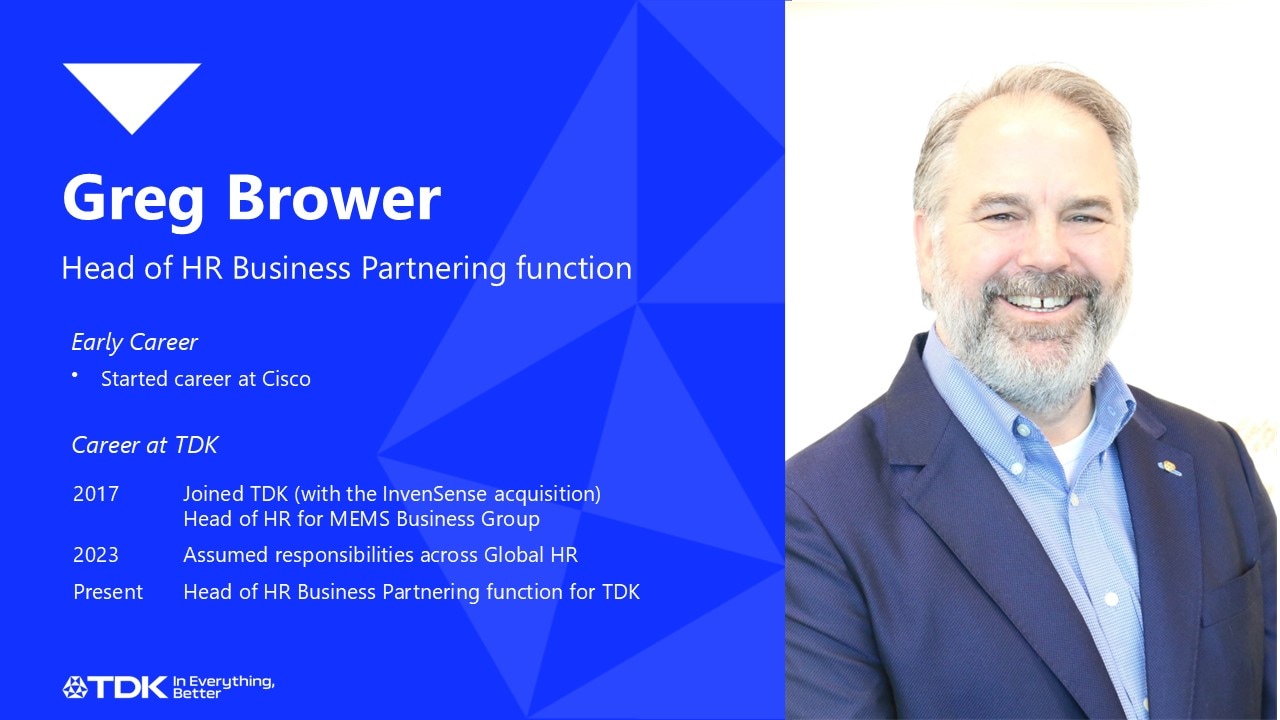
I am Greg Brower, the head of HR business Partnering Function. Prior to joining TDK, I was at a company called Cisco, a global IT enterprise company, and I had a variety of roles that prepared me for this one, working in IT, manufacturing, engineering, and also HR.
Today we will discuss aligning the strategy to a shared culture of employer branding. It's a Rendo use case for us, and we're going to take you from concept to implementation.
High-autonomy Integration to Structured Alignment “RENDO” Driven by Employer Branding
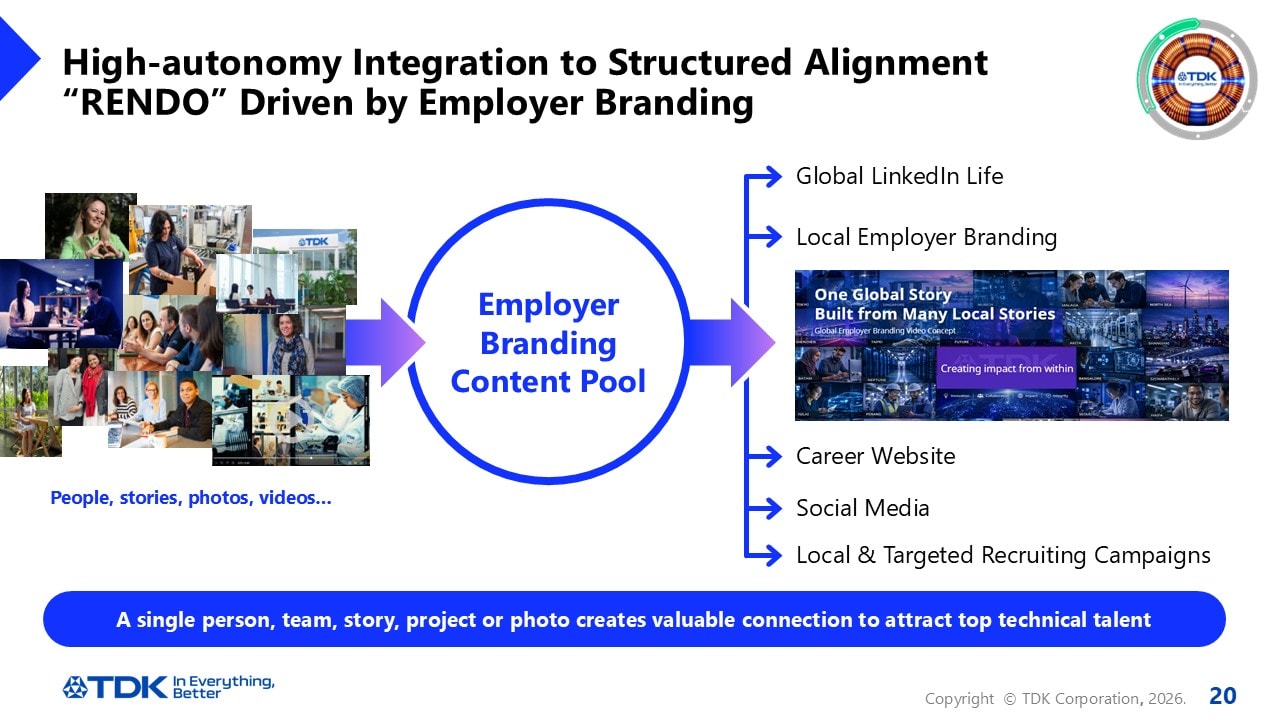
Employer Branding should be aspirational to attract talent: “TDK: In Everything, Better” is a wonderful description of our company. For our team members (employees), there must be consistency and integrity between our brand and their working experience at TDK. Whether they are hired in University, mid-career, or through acquisition, we seek to understand and encourage them to share their authentic voice. From there, we build a coherent global story and scale the impact though structured social media, career pages, and local recruiting events. Our branding campaign is consistent, scalable, and effective. That’s RENDO: we’re transitioning from high autonomy to a more structured, aligned entity through employer branding. Let’s look at some real activities.
Attract Talents
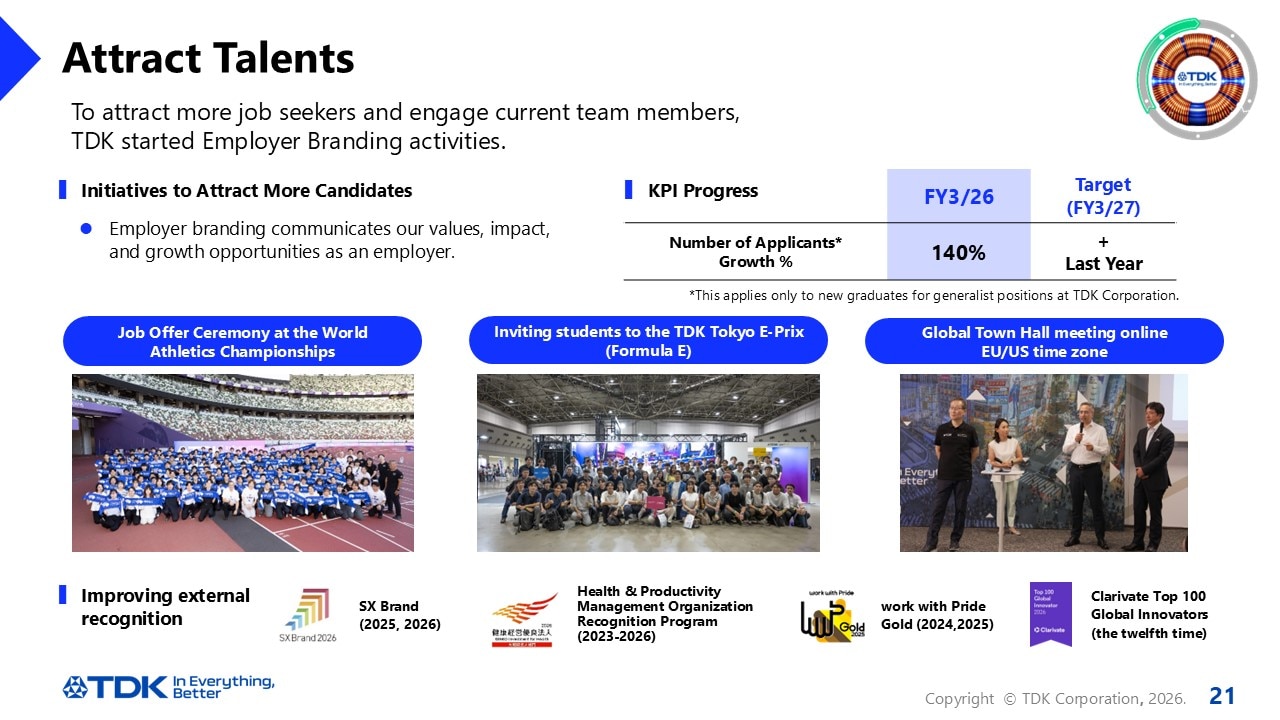
To attract talent, we implement Employer Branding to keep our current and future team members engaged. For new graduates, Mr. Keller already mentioned the special onboarding experience at the World Athletic Championships; and the town hall meetings that keep our team members informed and engaged. So let's focus on the middle picture. You are seeing a group of young engineers that we brought to the TDK Tokyo E-Prix. Our HR team and Software Tech IP team collaborated to ensure that our recruits understood our special technical partnership with Porsche. we use the brand to attract the talent in, and then what we do is show them our exciting world of technology within TDK. And the results show it. You can see how we have increased the amount of candidates applying by 140%. But there's also a branding result here that we'd like to share with you.
We Improved the Ranking in Japan and Germany
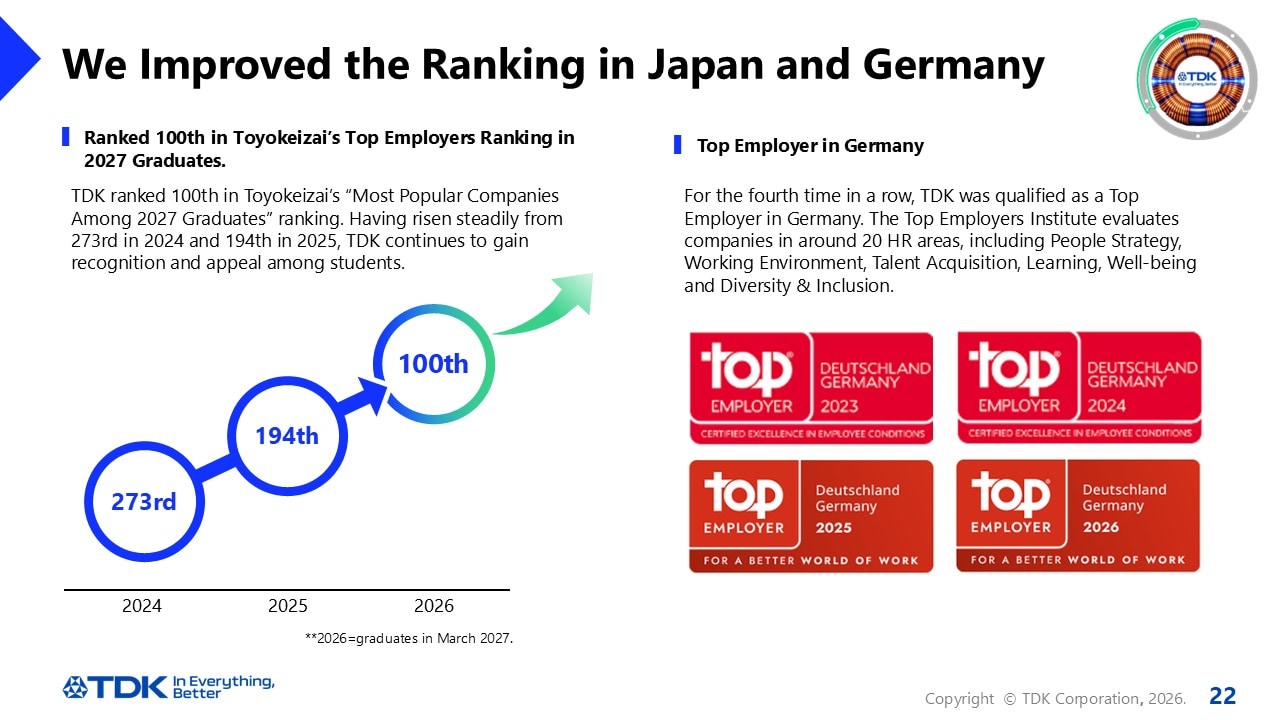
According to Toyo Keizai’s Employer Ranking, TDK ranked 100th in the “Most Popular Company Among 2027 Graduates”. We are paying attention and relentlessly focused on it for continual improvement as you see it rise into the future. For the fourth time in a row, TDK also qualified as a Top Employer in Germany for the Top Employers Institute. These are the Employer Branding trends we're seeing globally, and it's because we're focused on applying the brand into our reality and then telling (and living) a cohesive story to the market. Let’s take a look at how we leverages brand to support our growth strategy.
“RENDO“Alignment of HR Strategy with Corporate Strategy
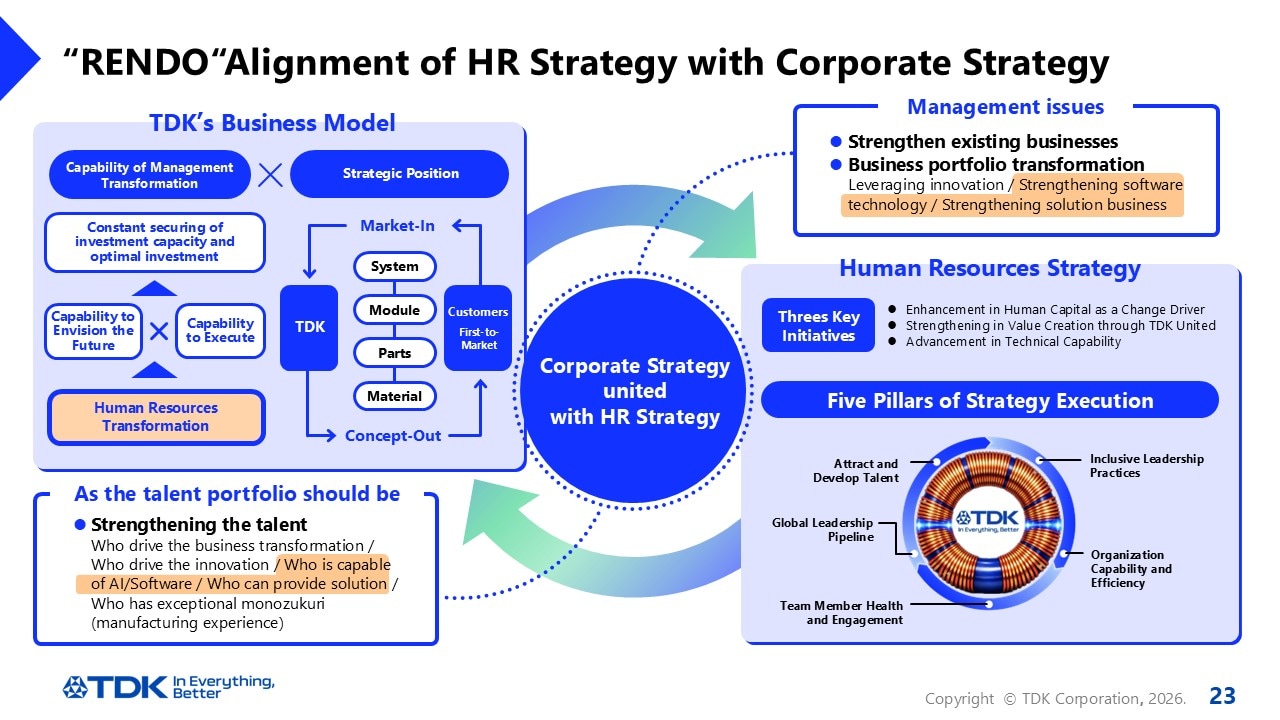
Mr. Keller has already emphasized the alignment of HR and Corporate strategy. These must connect for us to win. Let's dive into a use case of strengthening our technical capabilities together.
Systems, Solution and AI Software Capability
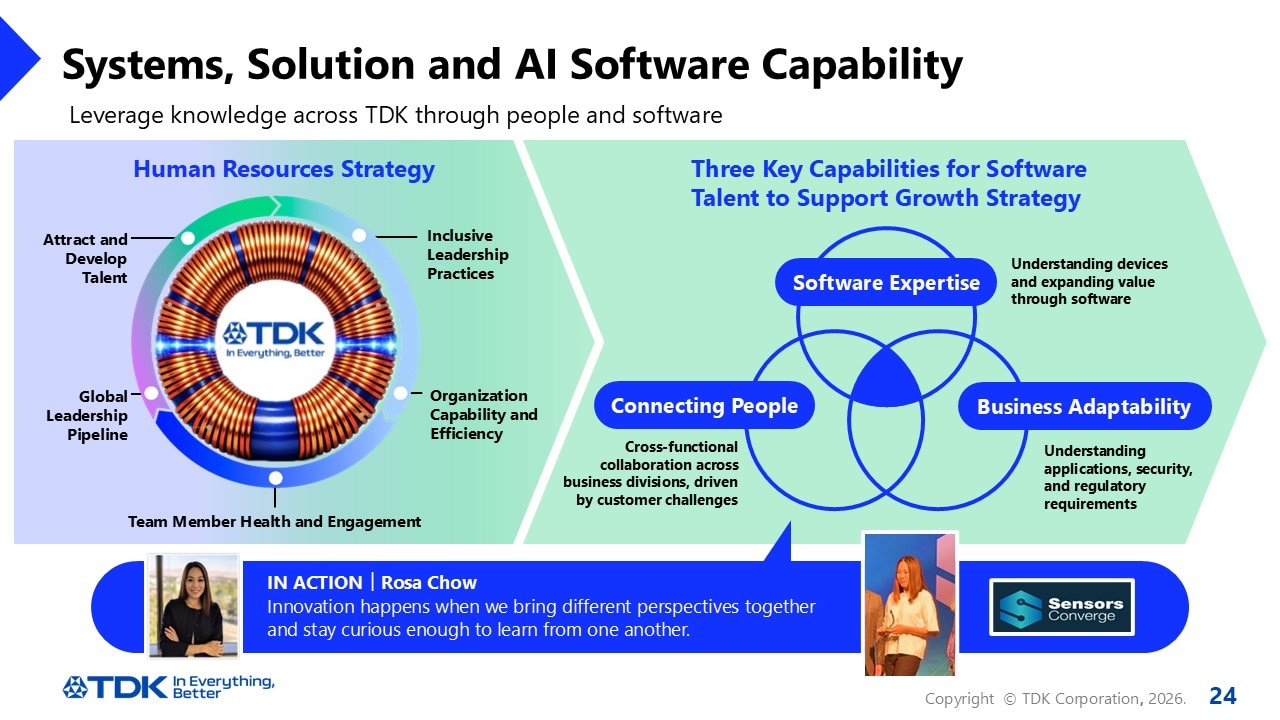
TDK will create value through providing total solutions to our customers. We have expertise in materials and process, and we are strengthening our software capability, which is critical for a total solution. With the CTO office, we have an approach.
First, you must both software expertise with an understanding TDK devices. Second, we must be able to adapt to the business by changing customer requirements and applications, security, and regulatory requirements globally. Third, we connect our expertise to TDK United, working cross-functionally across divisions, technologies, and products to share our knowledge. When you combine these three together, you build software capability that solves customer needs.
From an Employer Branding standpoint, Rosa Chow is that example. Rosa was named the Women of the Year at the Sensors Converge professional conference. She began her software career at InvenSense, as a software engineer, progressed to manager, and progressed to software executive. She has adapted within TDK’s Sensors Systems Business Company (SSBC) developing not only motion sensors, but also microphones, temperature, pressure, and magnetic sensors, creating different technologies and then connecting them for more value. She is TDK United – leading teams and collaborating across Korea, Japan, China, She leads teams in Korea, Japan, China, San Jose, and throughout Europe as part of our technical software community.
Expertise, adaptation, connection. We have real stories like Rosa's for marketing, for manufacturing, for information technology, and HR, and we're building capability and creating that impact from within. This is the Employer Branding from concept through implementation. TDK is a platform for careers to flourish and to create value, and this is what happens when you align the HR and the business strategy together. Thank you very much.
Keller:
Let me summarize and let me close with what matters most. RENDO aligns every people decision to our corporate strategy. Our engagement is up with a 92% response rate. Our people trust us. Our GMDP successor readiness is beyond target. Our leadership bench is deep. That same pipeline produced real businesses like TDK SensEI. Our Employer Brand has increased, and we are actively building AI and software talent that will power TDK's next solutions.
We're not only running HR programs, we are building the human foundation of TDK's future. Thank you very much.
3. Cutting-edge Technology Development
Hello, everyone. I am Shuichi Hashiyama, CTO and General Manager of the Technology & Intellectual Property HQ. Today, I will be presenting this CTO session together with Jim Tran, Deputy General Manager of the Technology & Intellectual Property HQ.
Shuichi Hashiyama
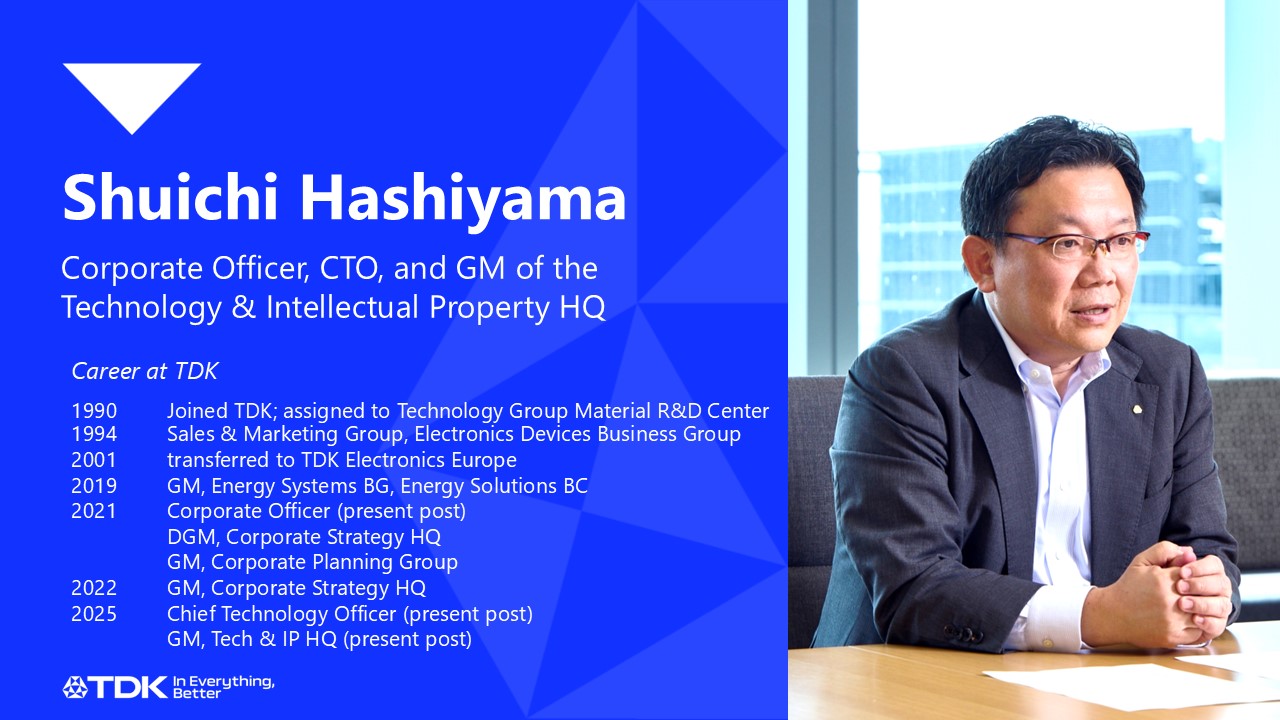
Although I have spent my entire career at TDK, I have gained a wide range of experience since starting out as an engineer at the R&D center. I have worked in sales, transferred to Europe, assigned as the GM of the Business Group, and the GM of the Corporate Strategy HQ before assuming my current role as CTO.
Developing Software Talent for AI Ecosystem Value Creation
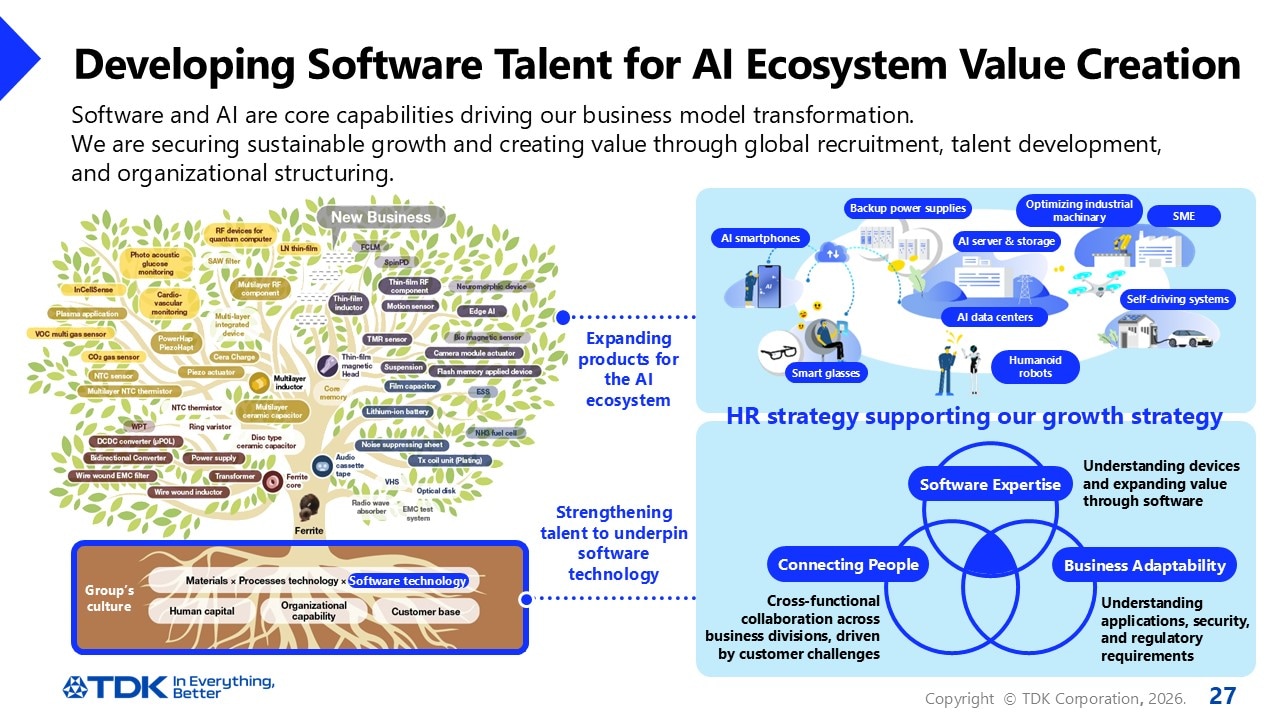
Our Long-term Vision, "TDK Transformation," embodies our two commitments: to contribute to the Social Transformation and to continuously transform our own company. In the area of pre-financial capital, which is represented by the "roots" of our Ferrite Tree, we have added software technology. We aim to further enhance our corporate value by strengthening our software technologies, including AI.
To achieve this, we are focusing on recruiting and developing the software talent necessary for us to continue our transformation. Providing solutions unique to we require more than just “software expertise” backed by a deep understanding of the characteristics of devices such as sensors. It also requires the “capability of connecting people" to promote team-based development, and the “business adaptability" to comply with security requirements and regulations.
TDK’s Business Model
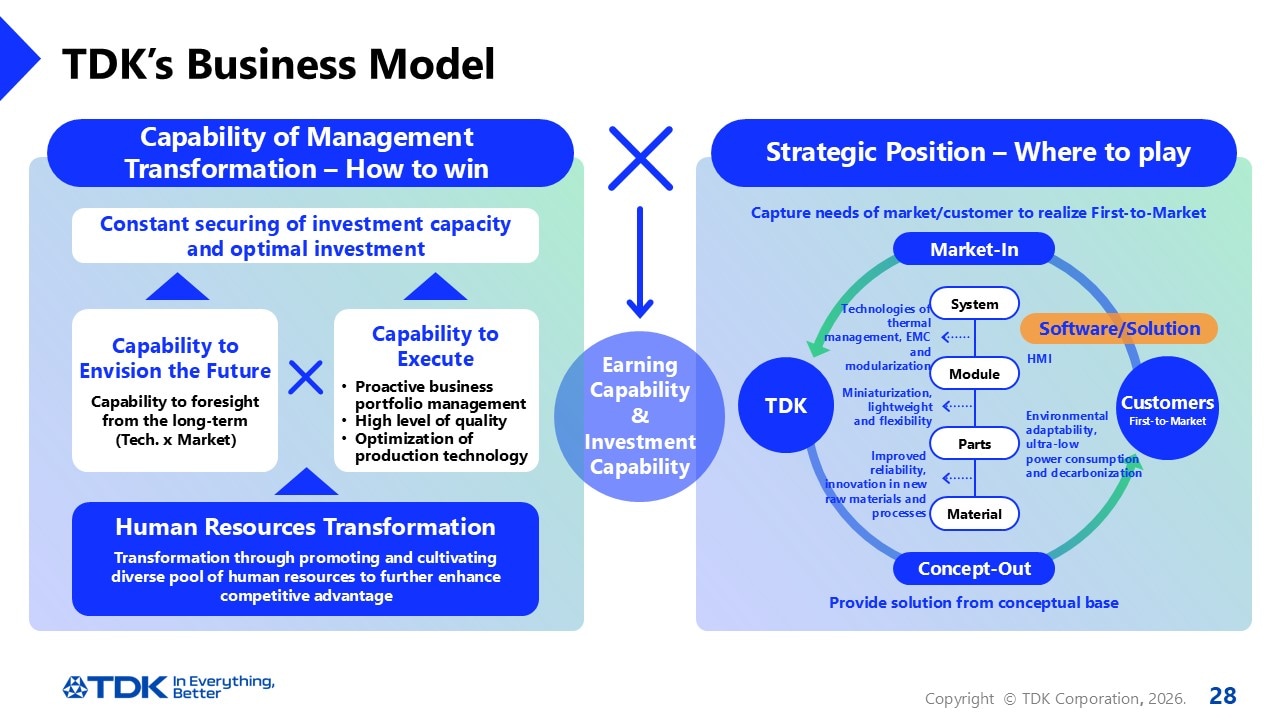
Our business model is based on a foundation of diverse talent. We strive to differentiate ourselves by envisioning the future while maintaining the execution capabilities to rapidly introduce new technologies to the market. At the same time, we develop our business in optimal positions leveraging our technologies and products.
For example, in the sensor business, we aim to contribute to the AI ecosystem with higher value-added solutions—such as at the module or system level—by combining sensors with edge AI and software.
M&A Aimed at Providing Solutions for AI Ecosystem
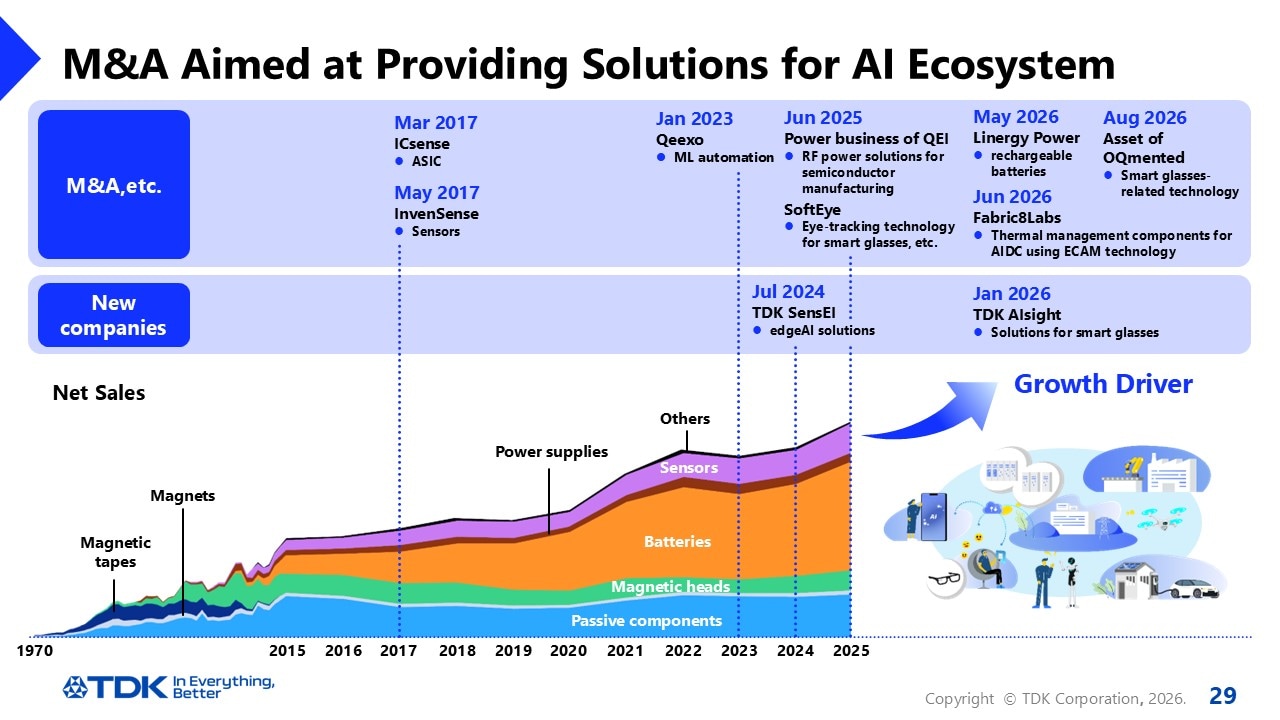
Historically, we have transformed our business portfolio through M&A. More recently, we have accelerated the acquisition of complementary technologies to provide higher value-added solutions for the AI ecosystem.
For smart glasses, this includes the acquisition of companies like SoftEye, which possesses eye-tracking technology to detect user intent through eye movement, and the assets of OQmented, which has system design technology for smart glass displays.
For AI data centers, this includes making Linergy Power a subsidiary to produce medium capacity batteries in Malaysia, and the acquisition of Fabric8 Labs, which possesses the ECAM technology required to manufacture cold plates that contribute to GPU cooling.
AI Initiatives in Four Domains for Strengthening Solutions
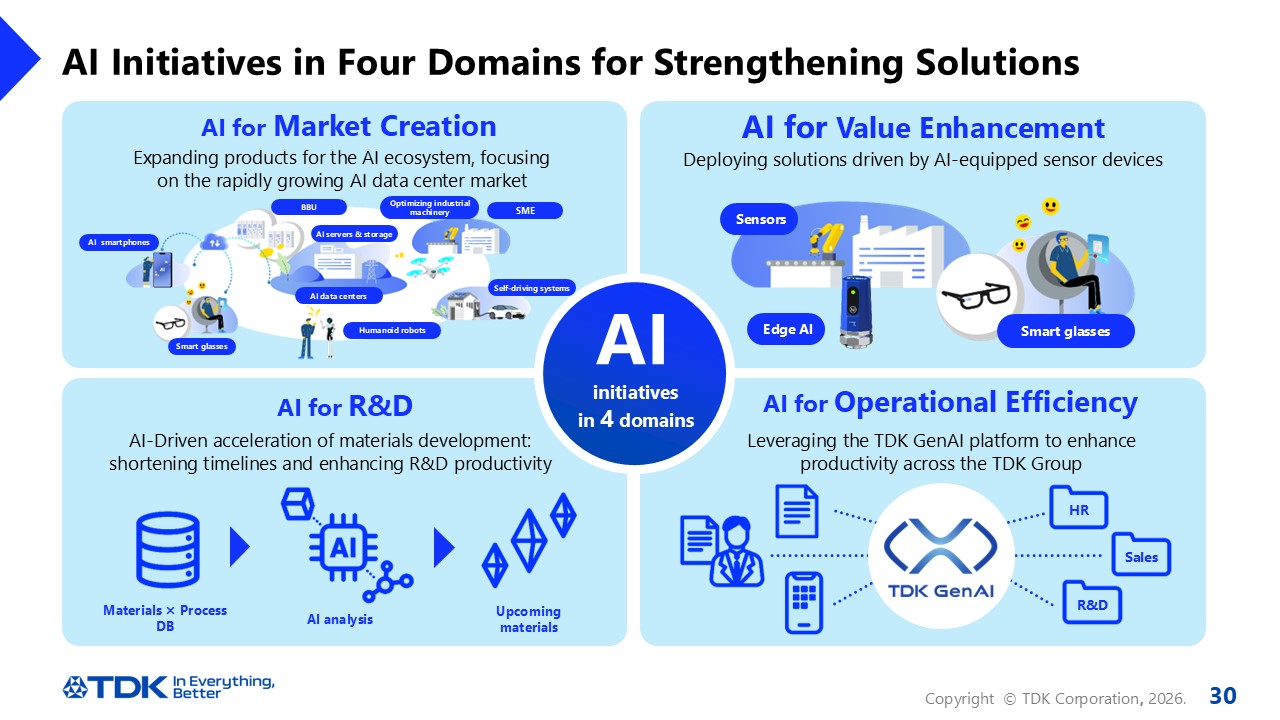
As shown in this diagram, we believe there are four main domains to AI for our company. Regarding the bottom right of the diagram—improving operational efficiency through the use of AI—this is something many companies are actively working on, so I believe you are already familiar with it.
The top left diagram represents AI for market creation; in other words, the expansion of the AI ecosystem driven by AI advancements presents an opportunity for us to offer new technologies.
The top right represents AI designed to enhance the added value of our products and solutions. This includes our SensEI business, which enables predictive maintenance in factories, and our business for smart glasses, which is expected to see significant growth in the future. Jim Tran will explain these businesses in more detail in the latter half of the session.
The bottom left represents the use of AI to accelerate research and development activities. Among these, I will explain Materials Informatics (MI), which is expected to contribute to the development of new materials, on the next slide.
Advancing Materials Development with Materials Informatics (MI)
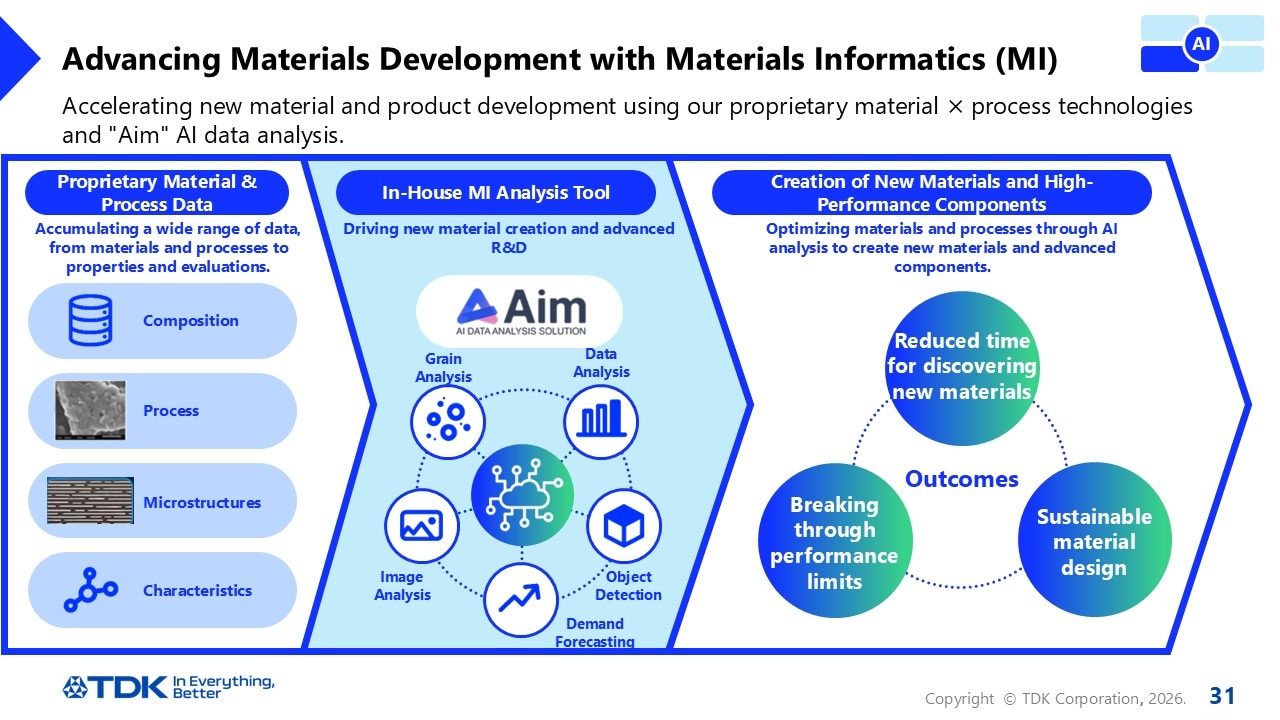
It has long been said that material development takes a significant amount of time. This is because traditional development methods relied on researchers repeatedly conducting trial and error and accumulating experimental results.
Today, by utilizing the vast amounts of data accumulated from the past and leveraging AI, we aim to accelerate development speed and improve material characteristics.
Furthermore, the use of MI has become crucial for establishing sustainable material design methods that will lead to next-generation material development.
We will continue to pursue TDK's unique material development going forward.
Strengthening the Technology Portfolio Supporting the AI Ecosystem
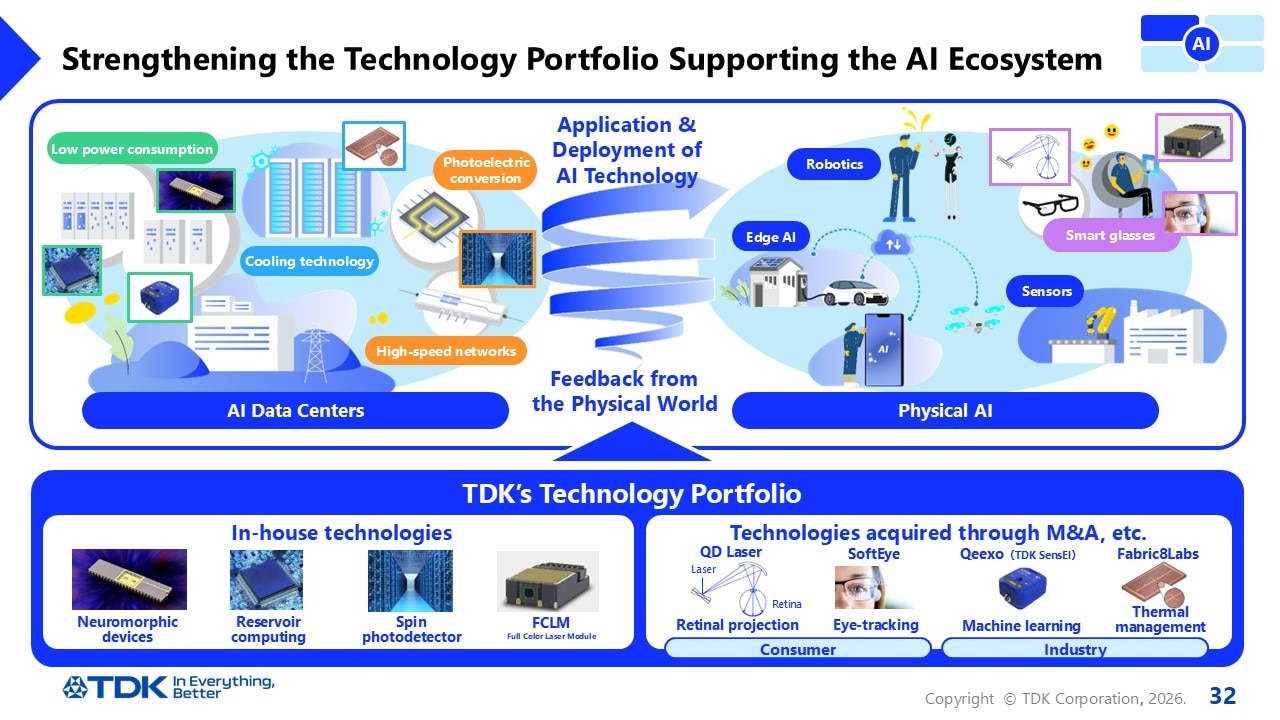
As Physical AI goes into full swing in the future, we believe our opportunities within the AI ecosystem will grow even larger. This is because AI cannot be utilized without data, and the necessary data cannot be obtained without sensing technology.
As you can see, by integrating the technologies we have advanced through our own R&D with new technologies acquired through M&A, we will continue to contribute to infrastructure such as AI data centers. At the same time, we will continue our medium- to long-term technological development to maximize our new technological contributions to Physical AI.
Now, I will pass the baton to Jim Tran, who will provide a more detailed explanation on one of the four domains I mentioned earlier: "AI for value enhancement," including our contributions to Physical AI.
Jim Tran
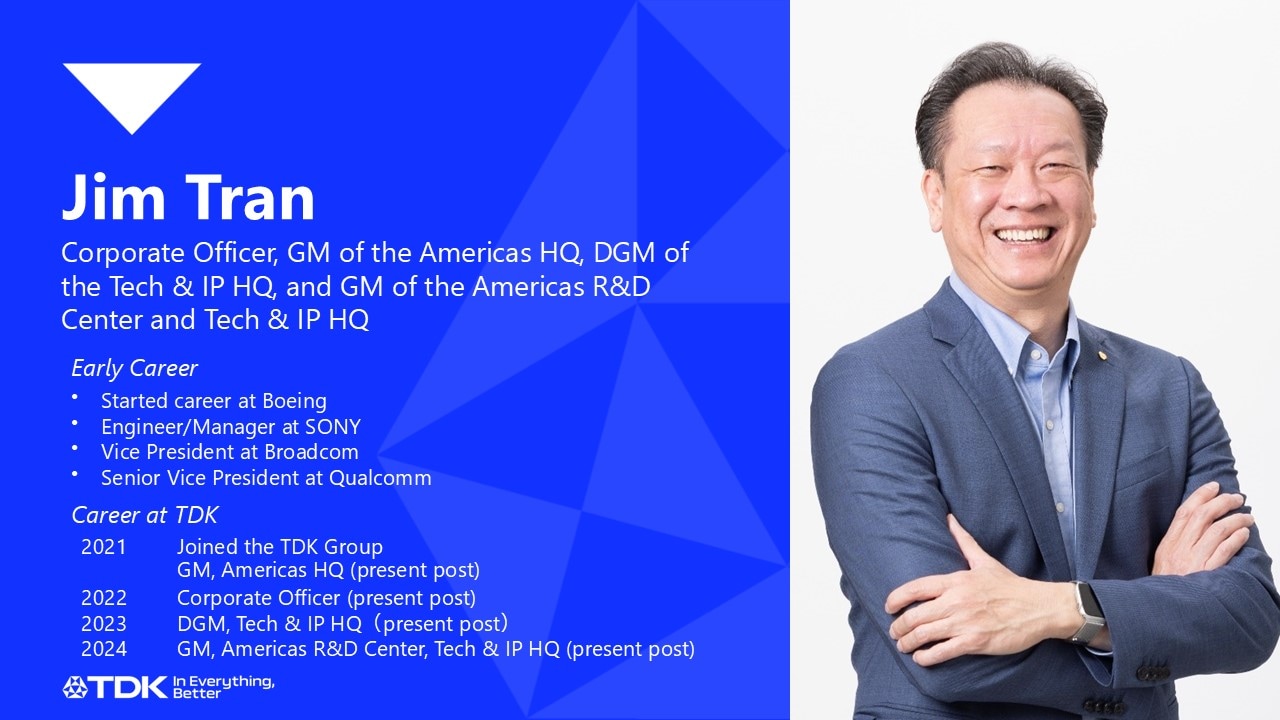
Hello, my name is Jim Tran. I am the GM of Americas HQ and DGM of Tech&IP HQ. I’ve been at TDK for a little for than 5 years. Prior to that, I was an engineer. A long time ago, I started as an electrical engineer at Boeing and then at Sony. Then I moved my way up. I was a Vice President of Broadcom, and prior to joining TDK, I was a Senior Vice President at Qualcomm.
Contribution to Physical AI
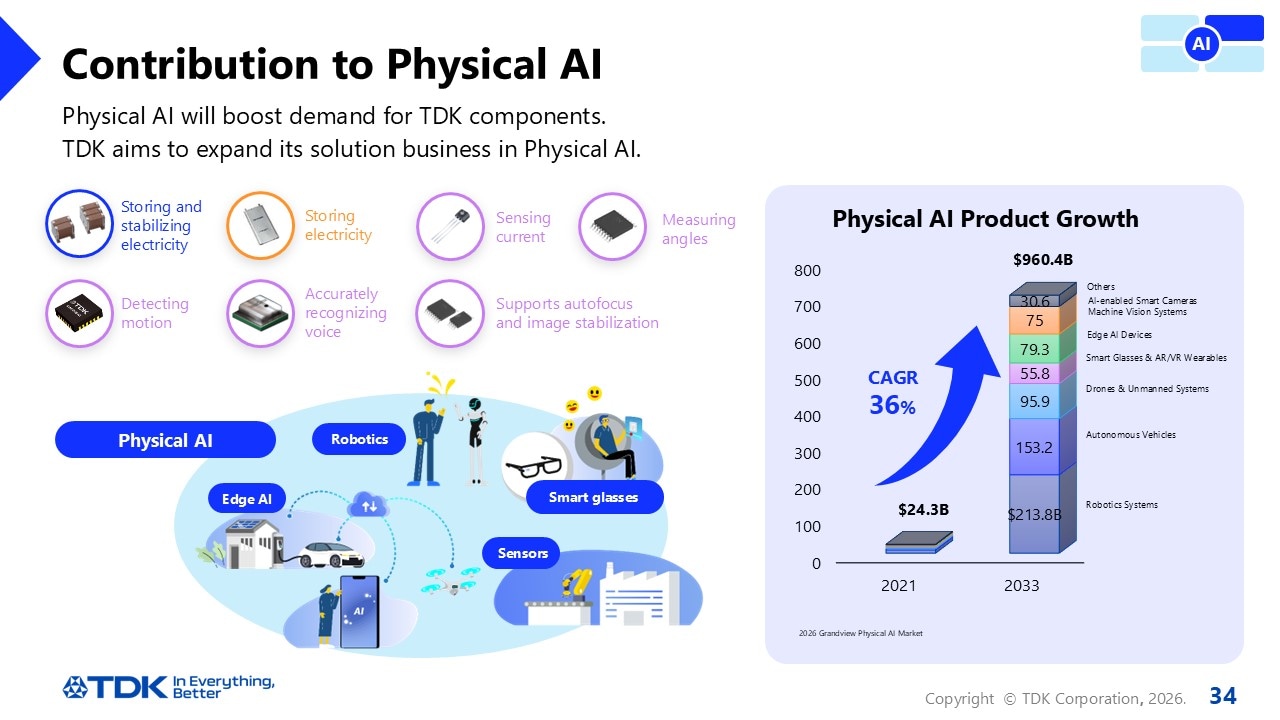
Today, I will focus my discussion on Physical AI, but at the end, I'll give a quick update on AI data centers.
Physical AI spans across many markets, including robotics, smart glasses, AI edge devices, autonomous vehicles, and drones. As Physical AI ramps to a TAM of almost $1 trillion, TDK’s components and solutions will be part of this growth. In the next few slides, I will explain how TDK will be part of this ramp.
Growth Strategy for SensEI
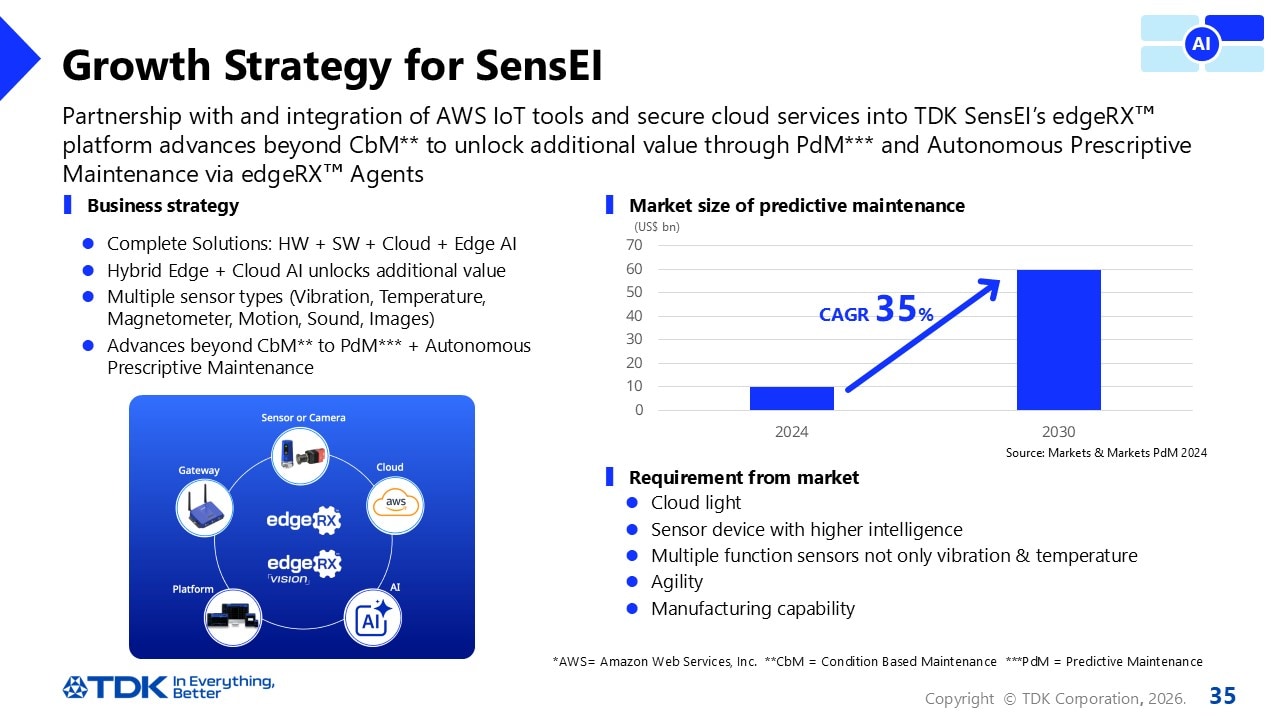
Two years ago, we created a company called TDK SensEI, whose goal was to provide Edge AI solutions to improve the efficiencies factories and warehouses. We started with CbM or condition-based monitoring, where our edgeRX™ devices can tell you what went wrong when a machine went down in the factory.
This was our first entry into Edge AI. Since then, we’ve partnered with AWS (Amazon Web Services) to add cloud computing capabilities to our solution.
This now allows TDK to bring predictive and prescriptive maintenance to the market, enabling our customers to plan ahead before the failures happen. Not only will we be able to predict the failure, but we will also prescribe what to do before the failure occurs. We expect this market to grow by 35% in the few years.
Market Landscape
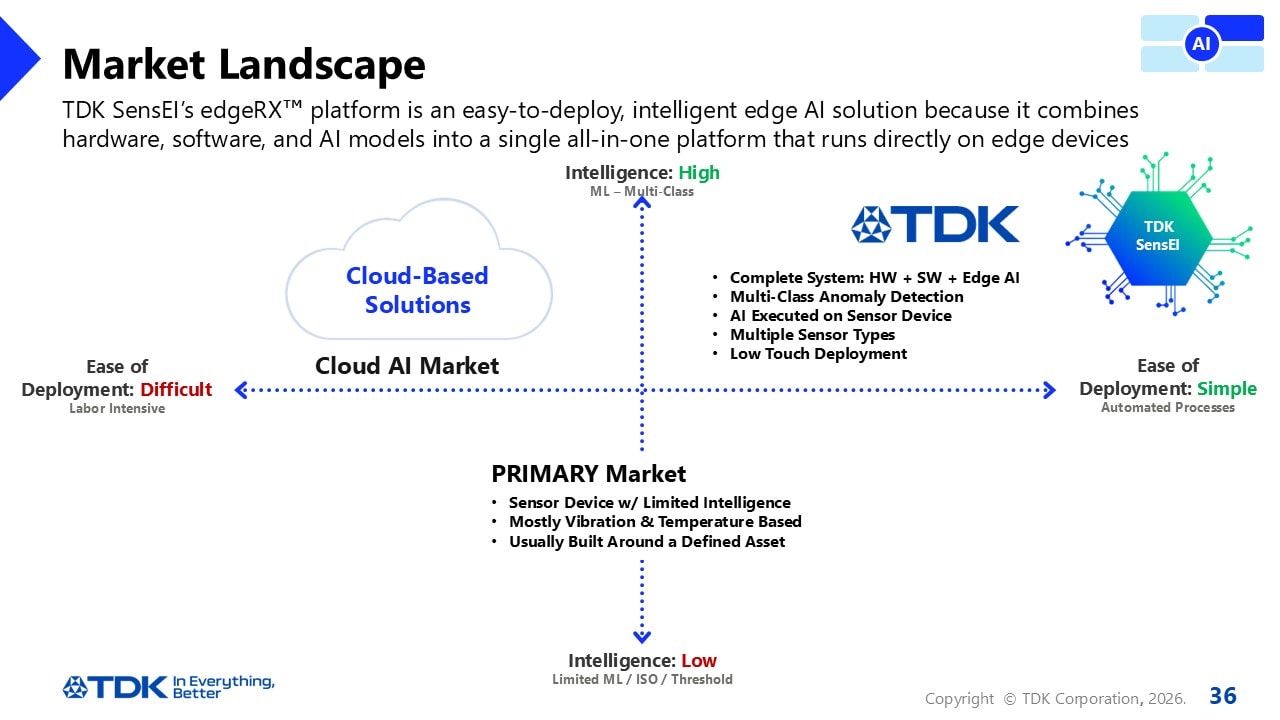
I want to explain a little more color about the market landscape. Many others have tried to deliver solutions in this space, but they focused either on the cloud only or on a sensor device with limited capabilities. But here at TDK, we believe that in order to bring competitive solutions to the market, we need to bring together edge devices that easy to deploy with multimodal sensing, leverage the compute power of cloud AI, and provide a total system solution. And that's what we are doing.
Industrial Health Monitoring for Machines & Products
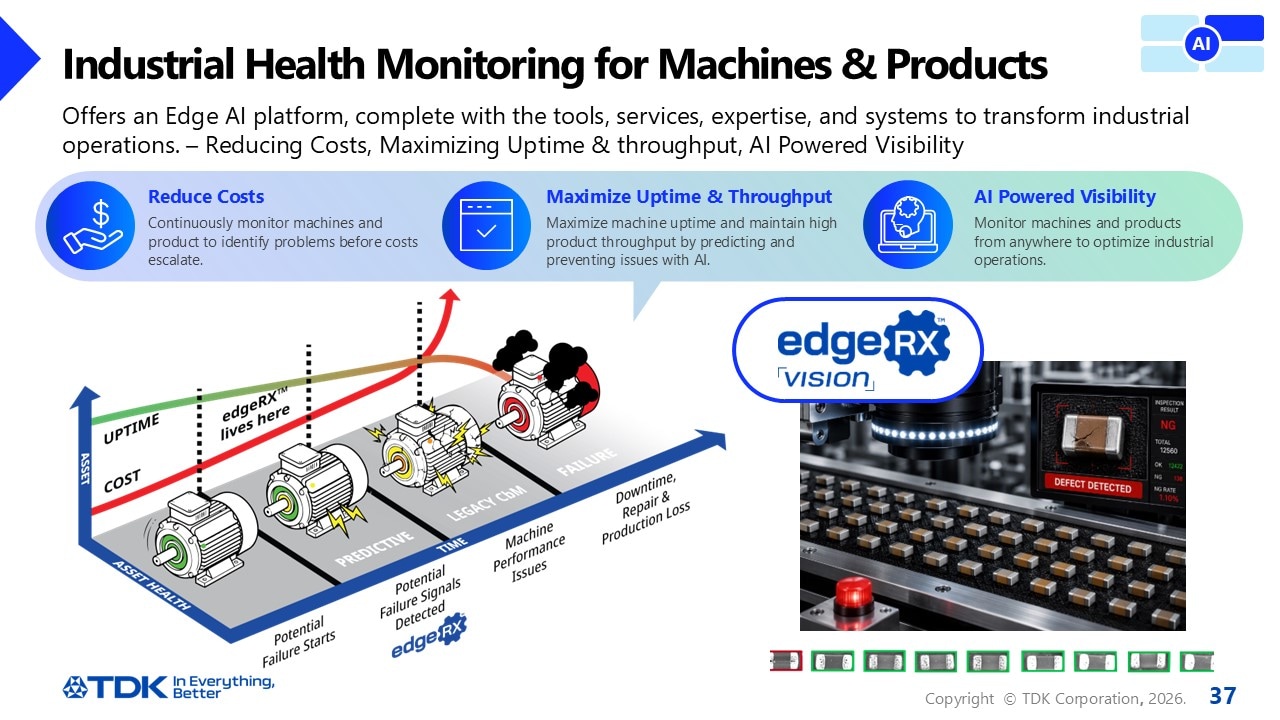
All factories want to maximize the uptime of their machines. This is the goal of our edgeRX™ and edgeRX™ Vision solutions. By helping our customers maintain the uptime of their machines, we can help improve the efficiencies of their factories.
As you can see in the graph, edgeRX™ aims to alert the factory management of the potential failures as early as possible to avoid downtime all together. This will reduce costs, maximize throughput, and provide AI-powered visibility throughout the factory.
Growth Strategy for Smart Glasses Business
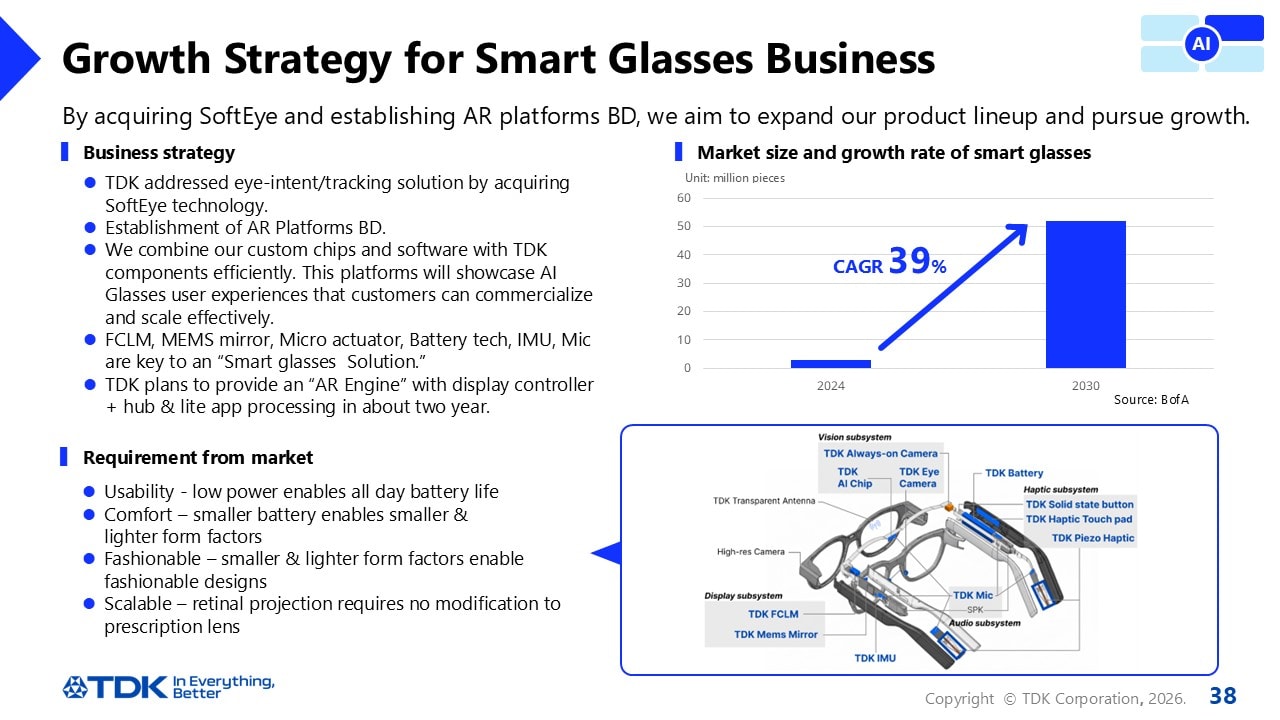
The next topic of physical AI, I want to touch base on smart glasses. Last year, we announced the acquisition of SoftEye, Inc. and formed the AR Platforms Business Division. SoftEye is a provider of low-power eye-tracking technology. Together with other TDK technologies like FCLMs (full-color laser modules), MEMS mirrors, advanced battery technology, and sensors, we will provide platforms that will enable the smart glasses market.
By optimizing all the components in the system, our platforms will enable smart glasses that feature all-day battery life; have small-sized electronics, which allows for fashionable designs; and with TDK's direct retinal projection technology are scalable such that the prescription lens no longer needs to be dependent on electronics manufacturing. This market is expected to have a growth of 39% in the next coming years.
Seamless Input Technology
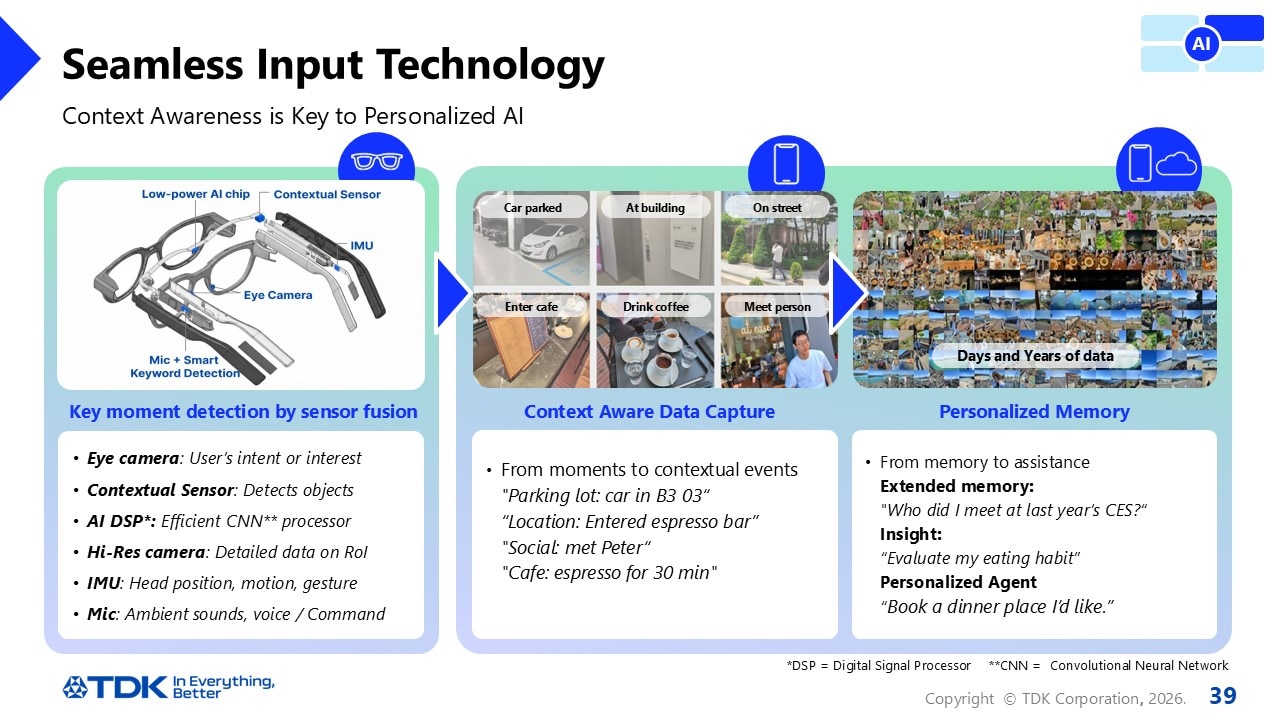
We believe this technology brings a different type of Human-Machine Interface (HMI) to the computing world. It will be a seamless way for humans to interact with AI. With the fusion of the various sensors on the glasses, we will be able to provide the contextual awareness for AI to be useful. For example, the AI will be able to use the sensors on the glasses to know where you’ve parked your car. It will recognize when you step out of the car and close the door, which will trigger the glasses to take a picture of where you parked. Later, as you come out of the shopping mall, you can ask, “Where did I park my car?” and it will pull up where you parked. There are many more examples like this, and I'd like to go through a few of them on the next page.
Solution for Seamless User Interactions
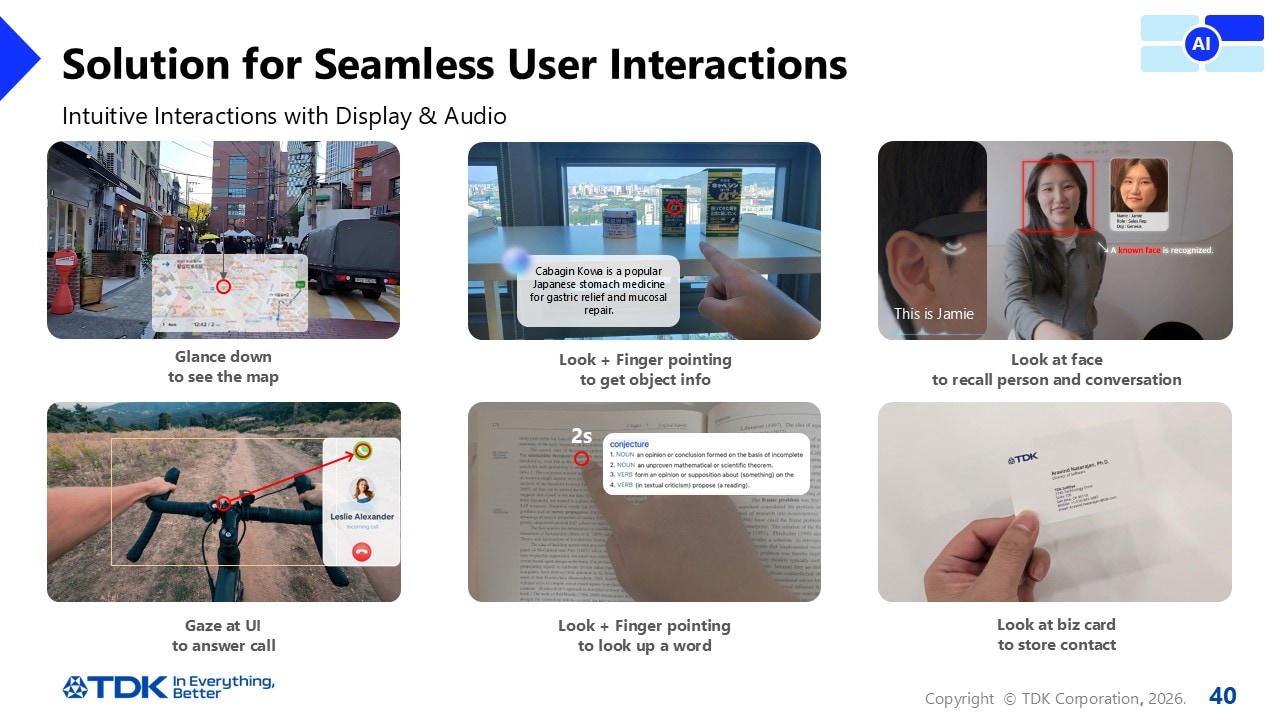
Here are some other examples of what smart glasses with eye tracking can enable. For instance, you could receive a business card from somebody, and by having that AI trained, it automatically takes a picture of the business card because it knows you just met somebody new. You can also navigate while walking or riding a bike and have eye tracking invoke functions on the UI, giving you a truly hands-free experience. I won't go through the rest of the examples, but I think you get the idea.
Growth Strategy for SensorGPTTM
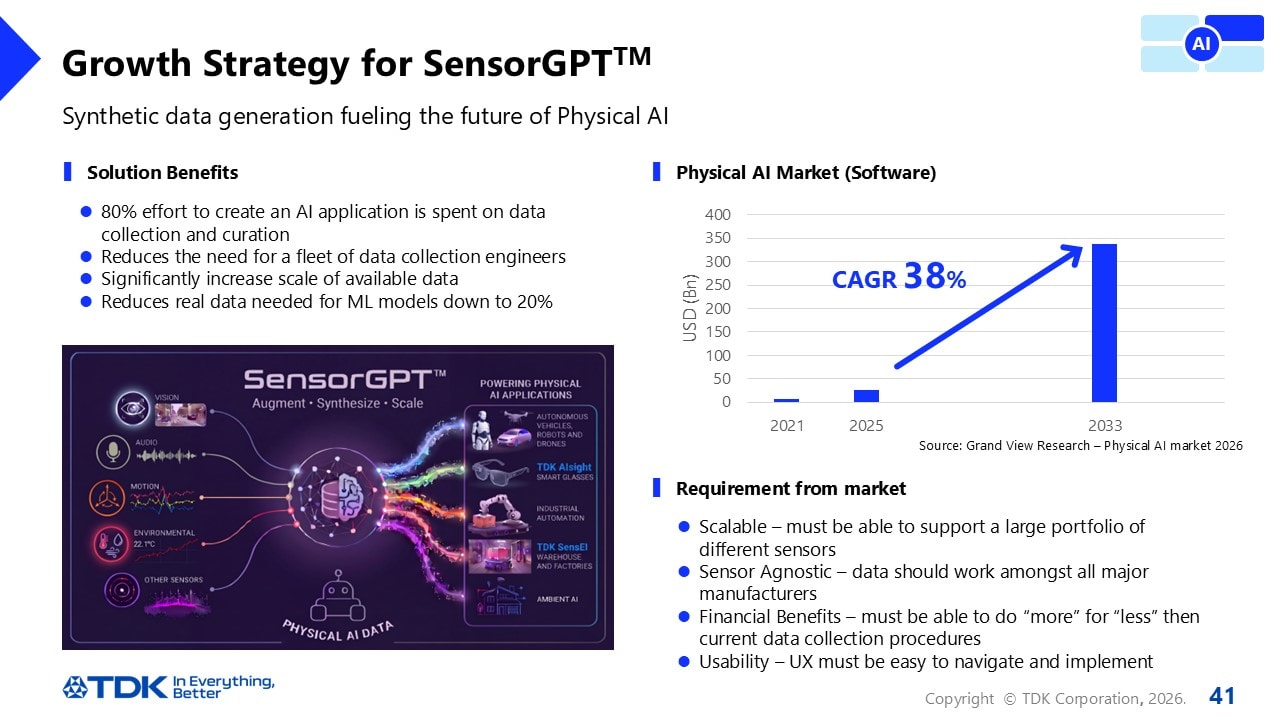
Now, let me draw your attention to something exciting coming out of our R&D Labs, called Sensor GPT. Just for background, every AI application requires data to train the model. In fact, 80% of the effort in creating an AI app is actually spent on collecting, curating, and labeling the data. This poses a huge challenge to getting AI apps into the marketplace quickly.
SensorGPT technology aims to reduce the amount of data that needs to be collected. With a small sample of data, SensorGPT will augment or synthesize enough data to produce similar accuracy as collecting real data. This will vastly improve the time to market for AI applications that require a lot of sensor data. Our goal is to make this scalable to support a wide range of sensors. In addition, we will be sensor-agnostic and will provide a user experience that is as simple to use as other LLMs in the marketplace, and we see this data market growing very rapidly in the coming years.
Growth Strategy for Advanced Metal 3D Printing Technology
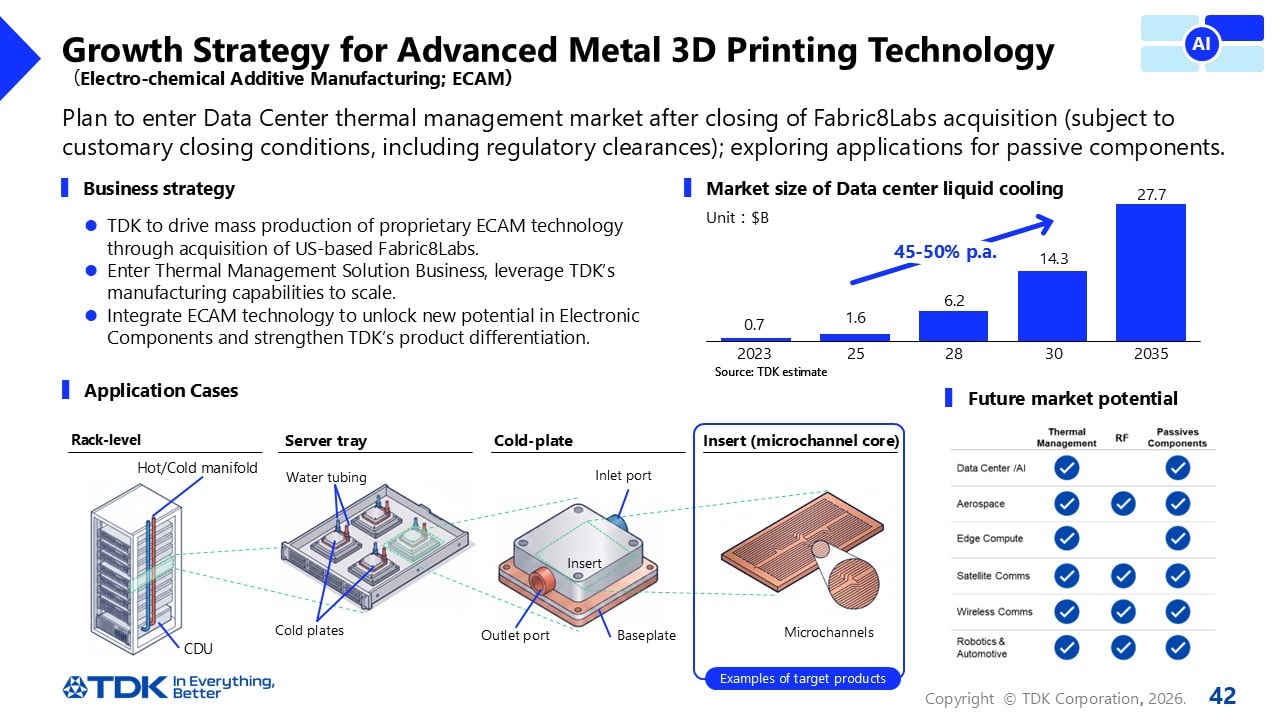
Lastly, I would like to showcase a newly acquired technology called ECAM: Electro-chemical Additive Manufacturing. We recently announced the acquisition of Fabric8Labs, which has created a 3D printer capable of printing metals like copper.
There are many applications for this type of technology, such as thermal management, RF antennas, and passive components. This technology allows for ultra-fine pitch printing of metals, like copper, to create unique structures. One of the near-term applications is for thermal management in data centers. Power and thermal management are some of the biggest challenges for AI data centers. With this technology, we can print inserts, or cold plates, with microchannels that allows for efficient flow of fluid to provide better heat dissipation.
This technology allows TDK to further participate in the growth of the AI data center market. We are awaiting regulatory approvals and look forward to bringing you updates as we get clearance.
This brings me to the end of my presentation.
4. Closing Remarks
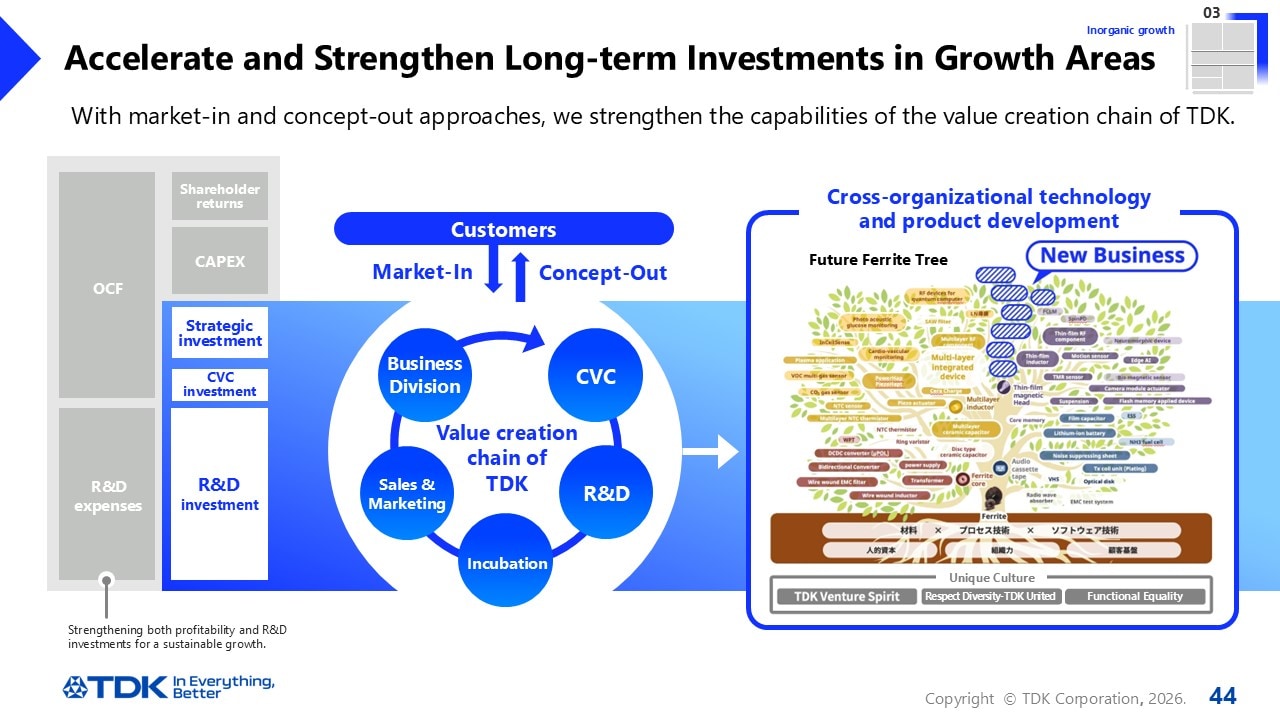
Accelerate and Strengthen Long-term Investments in Growth Areas
Thank you very much for your kind attention today.
As I explained during our financial results briefing in April, by continuing to strengthen our pre-financial capital, we will continuously transform our Value Creation Cycle with even greater speed and efficiency, thereby driving the sustainable growth of our Ferrite Tree.
Conclusion
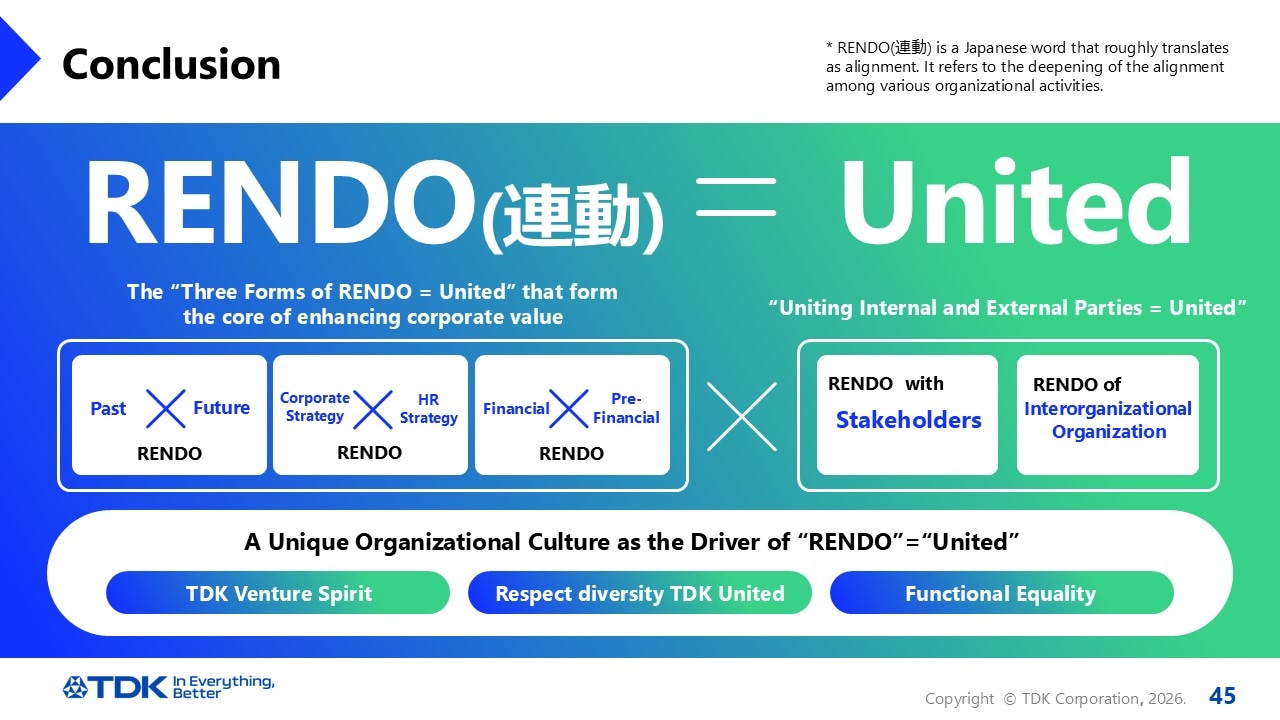
Finally, the word “RENDO (連動)” was mentioned several times during today's presentation. In connection with this, we have chosen "RENDO" as the theme for this year’s TDK United Report (Integrated Report). This reflects our intention to transform the concept of "United" from mere YUGO* to active “RENDO”. While “RENDO” encompasses various forms of alignment as shown on the slide, what we aim to accelerate the most going forward is our alignment with shareholders, investors, and analysts through constructive dialogue and collaboration. By reflecting and linking the insights and advice we receive from all of you into our management, we will strive to further enhance our corporate value.
We kindly ask for your continued support. Thank you very much for your time today.
*Note: “YUGO(融合/Fusion)” is a Japanese word and the concept that preceded "RENDO" within the "TDK United" framework. Instead of an "integration" that forces companies acquired through M&A to assimilate into a single corporate identity, "YUGO" signifies uniting together while respecting each company's unique culture.


