
Meta-Optic Mirror: Bringing Smart Glasses into Everyday Life
Smart glasses are generating considerable excitement as a next-generation information device that could one day replace the smartphone. Working in tandem with AI, they have the potential to bring new value to everyday life, from navigation to real-time translation. Yet, it is still rare to see anyone wearing smart glasses on the street. TDK’s newly developed meta-optic mirror uses nanoscale structures to manipulate light with remarkable flexibility. This innovative device could fundamentally alter our understanding of smart glasses.

Related Story:
Physical AI Augments Human Perception, Transforming Smart Glasses into Action Partners
Table of Contents
Key Takeaways
- Despite their promise as next-generation devices, smart glasses have faced obstacles including bulky components that compromise their appearance, privacy concerns, and high costs.
- Meta-optics is a technology that manipulates light using nanostructures arranged on a flat surface. TDK’s meta-optic mirror applies this technology to reproduce the function of a curved mirror in an ultrathin, 150-nm structure that can be embedded in an eyeglass lens.
- With 80% visible-light transmittance, the meta-optic mirror offers a clear view while preventing the rainbow-like patterns visible to people facing the wearer. Its commonality with semiconductor manufacturing processes also holds promise for mass production and lower costs.
- Meta-optics could transform conventional mirrors and lenses, with potential applications extending beyond smart glasses to photoelectric conversion devices and other technologies that could bring significant benefits to society.
Role of smart glasses in the age of AI
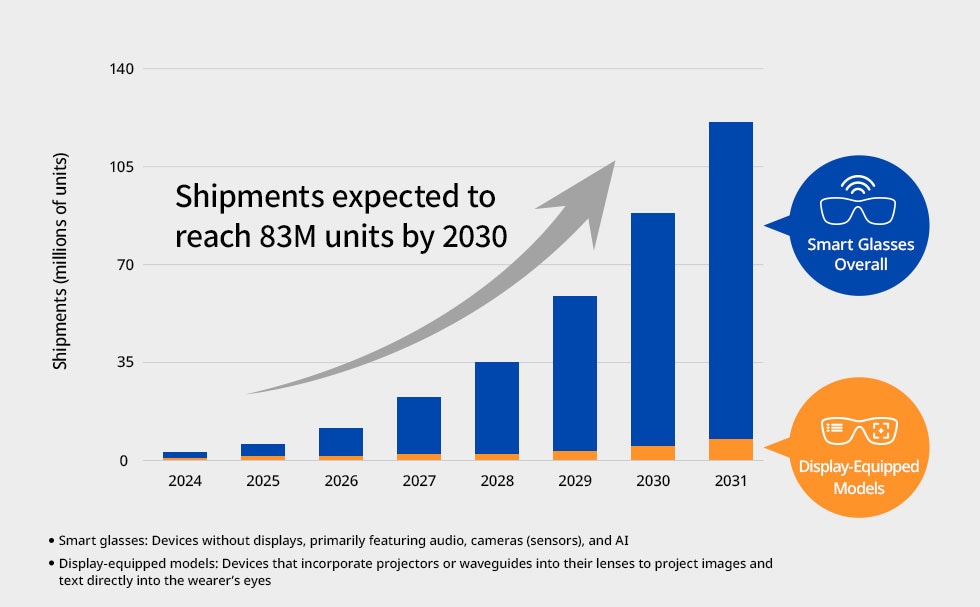
As AI data centers and robotics continue to advance rapidly, smart glasses are emerging as a promising interface for physical AI, bridging the physical and digital worlds. Global shipments are projected to reach 83 million units by 2030, raising expectations that smart glasses could eventually become as ubiquitous as smartphones.
For now, however, display-equipped models account for only about 5% of the smart glasses market. Beyond cost, one of the biggest obstacles to wider adoption is their appearance: they simply do not blend into everyday life. No matter how impressive their features—whether displaying crisp images or providing instant access to information—devices that look unnatural are unlikely to win broad acceptance as something people wear every day.

Projected smart glasses shipments
Making smart glasses commonplace
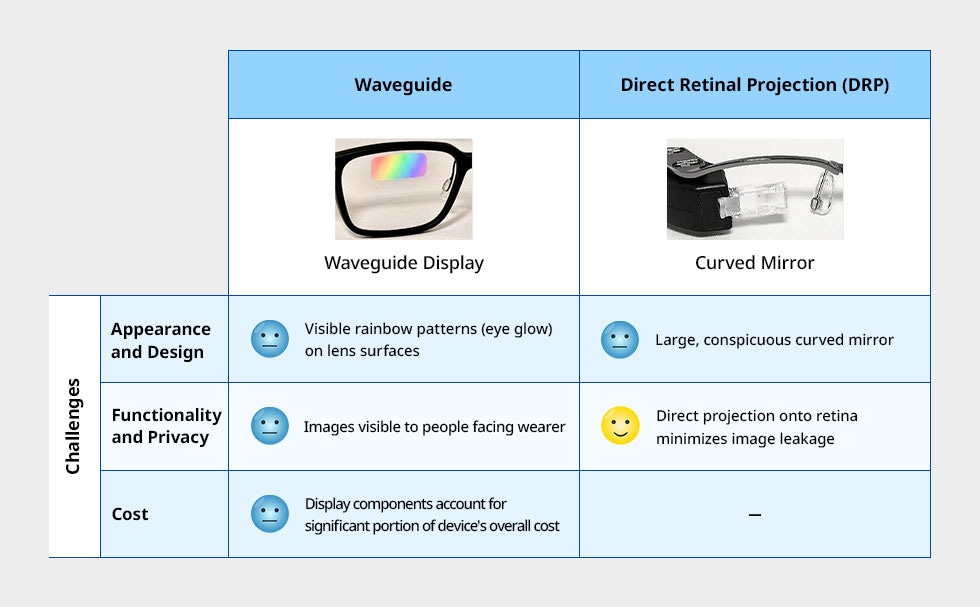
The predominant approach to displaying images in smart glasses today is the waveguide method. Light from a projector enters a thin light-guiding layer within the eyeglass lens, where it is reflected internally to present an image in front of the wearer’s eyes.
But this approach has drawbacks. Rainbow-like patterns, sometimes referred to as eye glow, can become conspicuous on the lens surface, and projected images may be visible to people nearby, raising privacy concerns. The complex combination of optical components also makes waveguide displays difficult and expensive to manufacture.
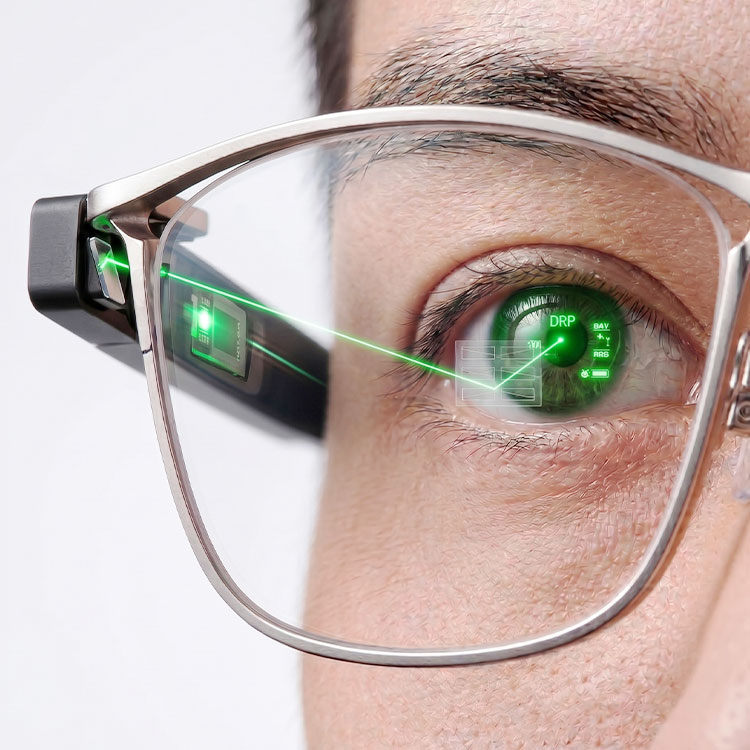
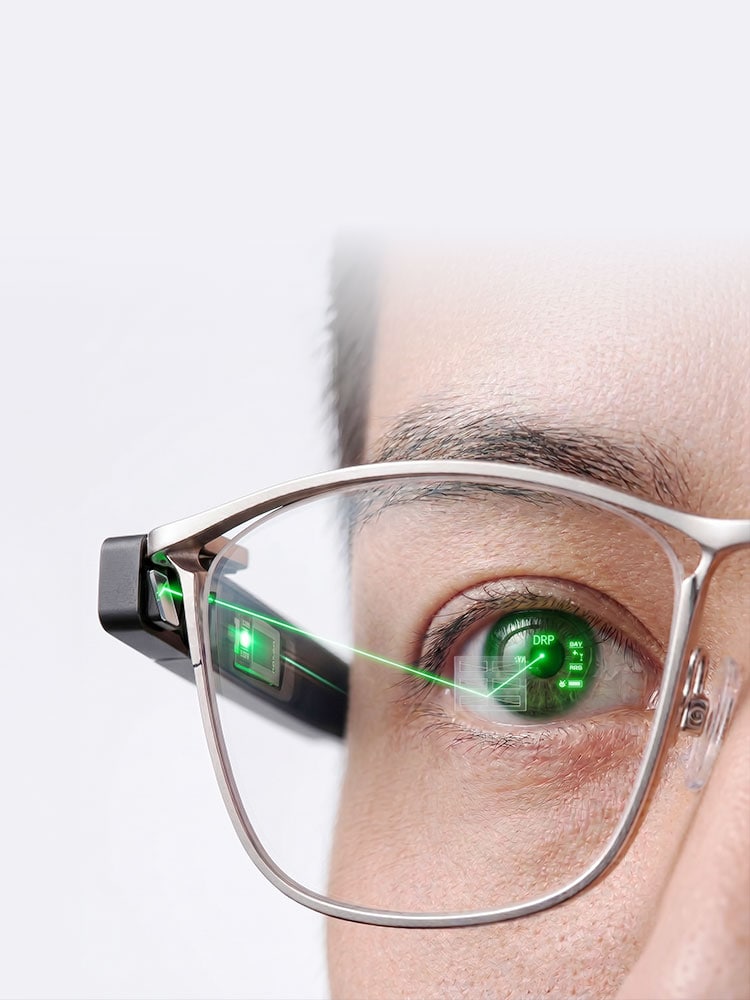
Another promising approach is direct retinal projection (DRP). Rather than presenting an image in front of the eye, DRP directs laser light onto the retina at the back of the eye. It offers the advantage of sharp images regardless of the wearer’s visual acuity, with relatively little image leakage. However, directing light precisely onto the retina has required a thick, curved mirror, leaving smart glasses with a conspicuous component protruding in front of the lens.
Developers have long sought to fuse an advanced augmented reality (AR) experience with a lightweight, natural-looking design suitable for everyday wear—but neither conventional display approach has made it easy to achieve both.
Challenges facing display technologies in conventional smart glasses
Meta-optic mirror upends conventions about light
Overcoming the limitations of conventional optics, TDK has successfully demonstrated the world’s first DRP display using a meta-optic mirror. By eliminating the need for both a waveguide and a bulky, curved mirror, the technology offers what could be described as a third approach to smart glasses displays.
Meta-optics is a technology that uses nanoscale structures arranged on a flat surface to manipulate how light is reflected, refracted, and focused—with remarkable flexibility. By placing structures as small as one ten-thousandth of a millimeter in carefully designed patterns across a transparent substrate, it becomes possible to steer light in precisely controlled directions.
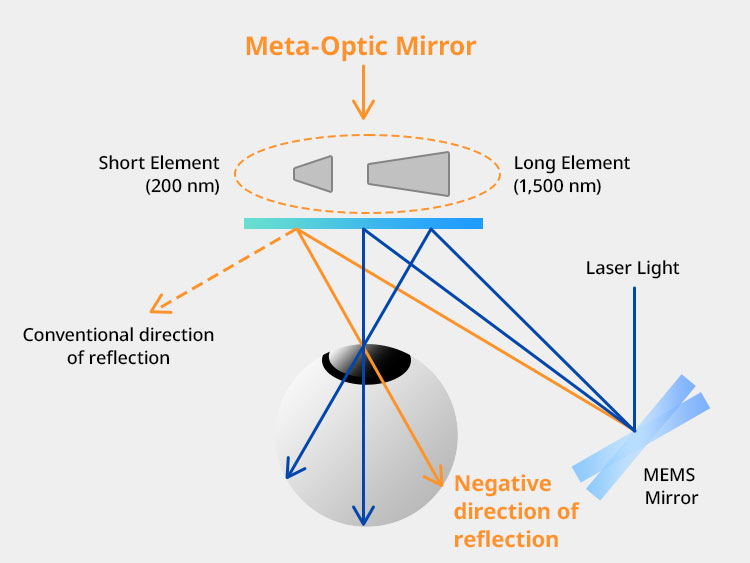
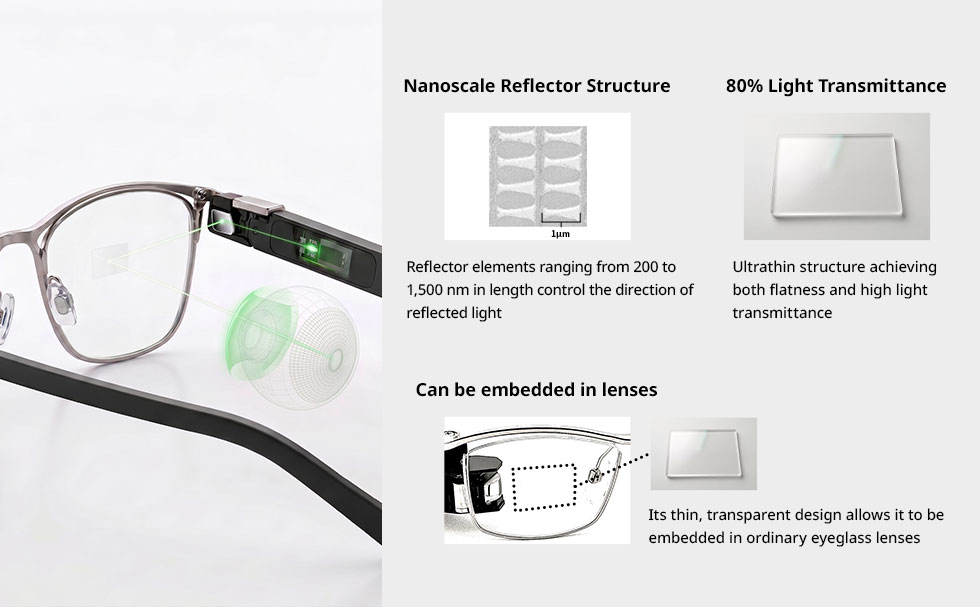
Conventional optical components rely on the thickness and curvature of glass or plastic to redirect light. The meta-optic mirror instead uses nanostructures to achieve what is known as a negative reflection angle, directing light in a direction that differs from ordinary reflection. This makes it possible to create an ultrathin mirror just 150 nanometers thick—thin enough to embed in a smart glasses lens—that reproduces the function of a bulky curved mirror atop a thin, flat lens surface.
Features of meta-optic mirror
Designs indistinguishable from ordinary eyeglasses
The meta-optic mirror promises to solve several longstanding challenges in smart glasses design, including appearance, privacy, and cost.
Despite its extraordinary thinness, the mirror achieves 80% visible-light transmittance, allowing it to be embedded directly into an ordinary-looking eyeglass lens. It eliminates the need for parts like a curved mirror protruding from the front and removes the rainbow-like patterns associated with waveguide displays. Combined with DRP, the technology also prevents projected images from leaking outward, allowing wearers to use their glasses on trains or city streets without worrying about what others can see.
Meta-optics also holds considerable potential for reducing costs. Instead of relying on expensive waveguide displays or assembling complex optical components, the meta-optic mirror can be fabricated using wafer-processing techniques familiar to semiconductor manufacturing. This substantially simplifies the module structure, opening a path toward mass production and significant cost reductions.
TDK’s breakthrough behind a world first

Meta-Optics Section, Photonics Development Dept.
Advanced Products Development Center
Technology & IP HQ
TDK Corporation
The development of this innovative device brought together expertise and technologies TDK has cultivated over many years. Tomohito Mizuno of TDK Corporation’s Advanced Products Development Center, Technology and IP HQ, recalls how the project began.
“The starting point came in July 2022, when we began discussing internally how to improve the usability of DRP smart glasses by eliminating the reflective mirror positioned in front of the eye. With no precedent to follow, we started from scratch, exploring the possibility of developing a thin mirror that could be embedded in an eyeglass lens. From 2023, we worked with QD Laser and carried out repeated prototyping at TDK Group companies SAE in Hong Kong and Headway in the United States. By drawing on TDK’s thin-film process technology, we ultimately created our own original meta-optical element. In the early stages, we struggled for quite some time to produce an image, but we overcame those difficulties with support from colleagues and external partners. We will continue to accelerate development toward commercialization.”
TDK is now conducting primary evaluations of smart glasses equipped with the meta-optic mirror and plans to demonstrate the technology at CEATEC 2026. While the current system supports monochrome images, the company is accelerating preparations to demonstrate full-color operation and achieve mass production within the next few years.
The potential applications of meta-optics extend well beyond smart glasses. The technology could also play an important role in photoelectric conversion devices, which convert electrical signals into optical signals to enable high-speed, energy-efficient communications in AI data centers handling vast volumes of data. Such applications could make meta-optics a foundational technology for the next generation of digital infrastructure.
More than simply making components smaller and thinner, the meta-optic mirror challenges conventional assumptions about how optical systems are designed. Smart glasses that deliver digital information while letting users see the world around them can become an interface connecting everyday life with AI. Through its technologies, TDK aims to help create a future in which people and information coexist more seamlessly.
Summary
Smart glasses hold promise as next-generation information devices, but their adoption has been hampered by unnatural-looking designs, privacy concerns, and high costs. Developed by TDK, the meta-optic mirror uses nanostructures arranged on a flat surface to control the direction of light, reproducing the function of a curved mirror within a thin, transparent lens. Allowing stylish designs to coexist with clear fields of view, the technology offers significant potential for smart glasses and future photoelectric conversion devices alike.

- For more details, please visit the CEATEC AWARD 2026 website.
Related Links