Inspecting 2,000 Parts a Minute with AI-powered “Eyes”—Edge AI Solution Takes Production Lines into the Future
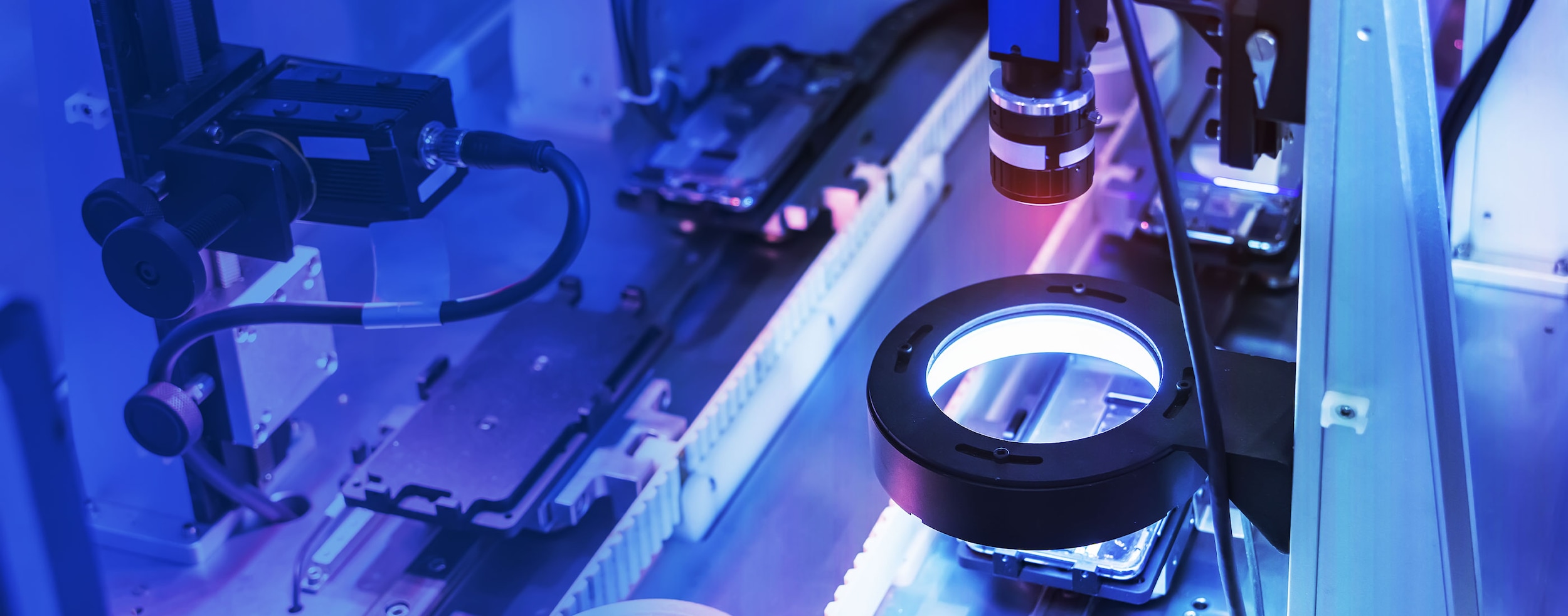
In manufacturing, visual inspection—checking a product’s appearance to prevent defective items from leaving the factory—is an essential part of the process. As labor shortages deepen and quality requirements become increasingly demanding, automated optical inspection (AOI) systems using cameras are seeing wider adoption. But as production lines speed up, inspections must become not only faster but more accurate as well. edgeRX VISION by TDK SensEI, a TDK Group Company, brings innovation to visual inspection through a flexible AI-powered solution that can integrate with existing camera systems while evolving to meet each manufacturer’s unique inspection requirements.

Table of Contents
Key Takeaways
- As labor shortages deepen and production lines speed up, manufacturers are increasingly seeking the automation of visual inspection to reduce defects and improve product quality.
- Conventional rule-based inspection systems can mistake dust, minor misalignment, and other harmless variations for product defects, making it hard to balance catching faulty products with avoiding unnecessary production line halts.
- By adding edge AI to existing camera systems, edgeRX VISION can reduce false positives while enabling high-speed, high-precision inspection at 2,000 parts per minute.
Visual inspection: The technology safeguarding product quality through images
From machinery and electronic components to food and pharmaceuticals, factories produce an enormous range of products at scale. Visual inspection is the process of checking those products for scratches, chips, deformation, foreign matter, and other abnormalities. It is an essential safeguard against defective products reaching the market, helping protect quality while keeping production running smoothly and consistently.
Yet on high-speed production lines, where large volumes of products move in rapid succession, it is becoming impractical for human inspectors alone to examine every item. Manufacturers need a different kind of “eye”: one that can see faster, more consistently, and with greater precision.
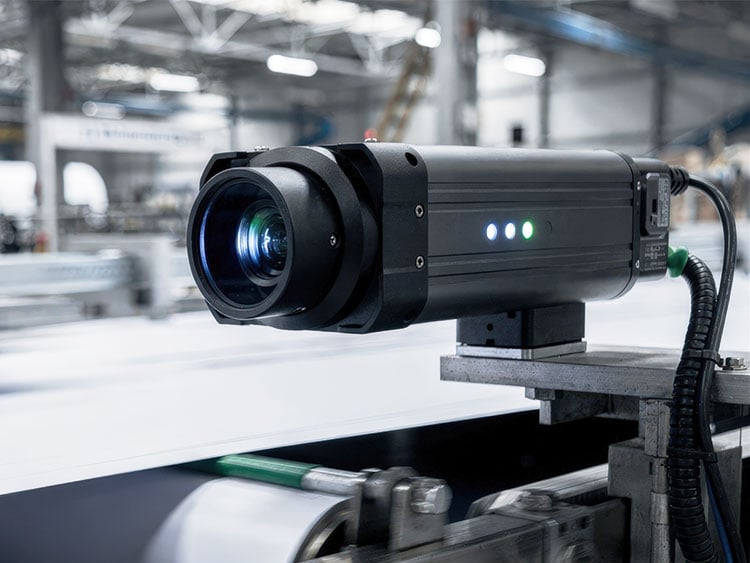
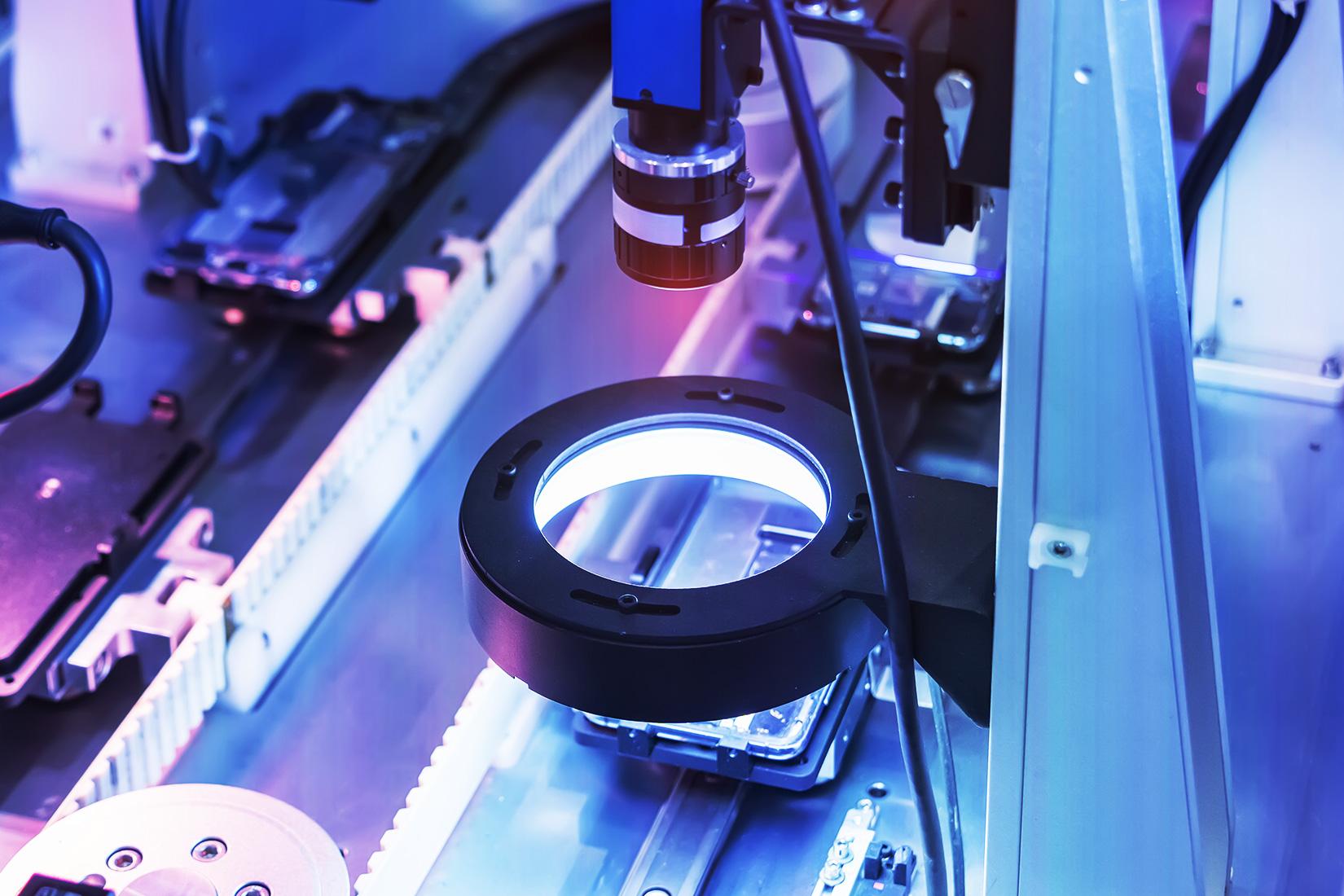
This is why automated optical inspection (AOI) systems using cameras have become commonplace in many manufacturing environments. In a conventional AOI system, a camera captures images of a product, which are then compared against predefined standards or rules. Anything that falls outside those parameters is identified as an anomaly. Compared with visual inspection by human operators, this approach can deliver faster and more consistent results. But this rules-based approach has a major shortcoming: a product that is slightly misaligned—or even a speck of dust—may be erroneously classified as defective and unnecessarily bring the production line to a halt.
Tightening defect criteria can reduce missed faulty products, but also increases false positives. Loosening those criteria can reduce halts, but at the cost of increasing the risk of defective products slipping through. Manufacturers therefore face a difficult balancing act: catching defects while minimizing unnecessary downtime. Even a brief interruption can reduce productivity and result in significant losses. Achieving both objectives has become one of the central challenges in modern manufacturing.
Adding AI-based detection capabilities to existing cameras
TDK SensEI, a TDK Group Company, developed edgeRX VISION squarely to address these challenges. One of the defining benefits of edgeRX VISION is its ability to integrate AI-based image recognition with cameras already being used for visual inspection. This lets manufacturers deploy AI capabilities without large-scale infrastructure replacements and with minimal disruption. Because every manufacturing environment is different, TDK SensEI tailors each deployment by selecting and optimizing the AI models best suited to the customer’s inspection challenges while continually refining model performance as production conditions evolve.
While conventional rule-based inspection makes relatively simple comparisons against predetermined values or patterns, edgeRX VISION takes a different approach using AI models trained to recognize the characteristics of both normal and defective products. This allows the system to make more flexible evaluations, distinguishing genuine defects from conditions unrelated to the product itself, such as slight misalignment, dust, or debris.
Leveraging its agile development approach, TDK SensEI continuously incorporates advances in AI technology to improve performance and accelerate deployment. For example, large language models (LLMs)*1 can help streamline data collection and labeling workflows, enabling faster model development and ongoing optimization for customer applications.
edgeRX VISION also uses edge computing*2 to process data directly alongside the production line. Because it does not require cloud communication, it can return inspection results quickly, making it ideal for high-volume production environments that require rapid decisions.
Through its group company TDK SensEI, TDK has been offering edgeRX, a platform designed to promote digital transformation in manufacturing by using edge AI to analyze data from production equipment and improve productivity. edgeRX VISION extends the concept into the field of visual inspection through image analysis.
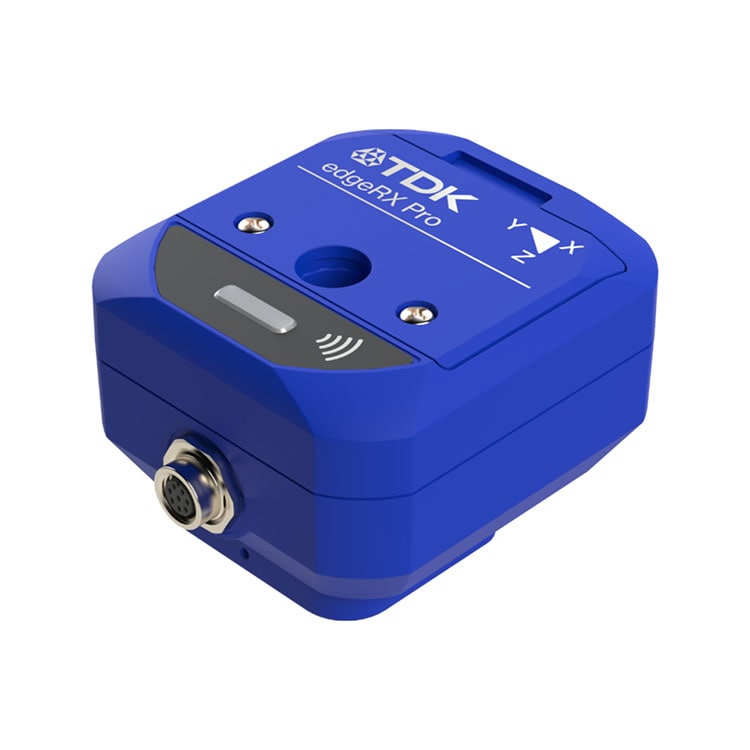
In August 2026, TDK SensEI also began offering edgeRX PRO, a high-performance sensor module that further expands the edgeRX platform’s capabilities.
How edgeRX VISION is configured
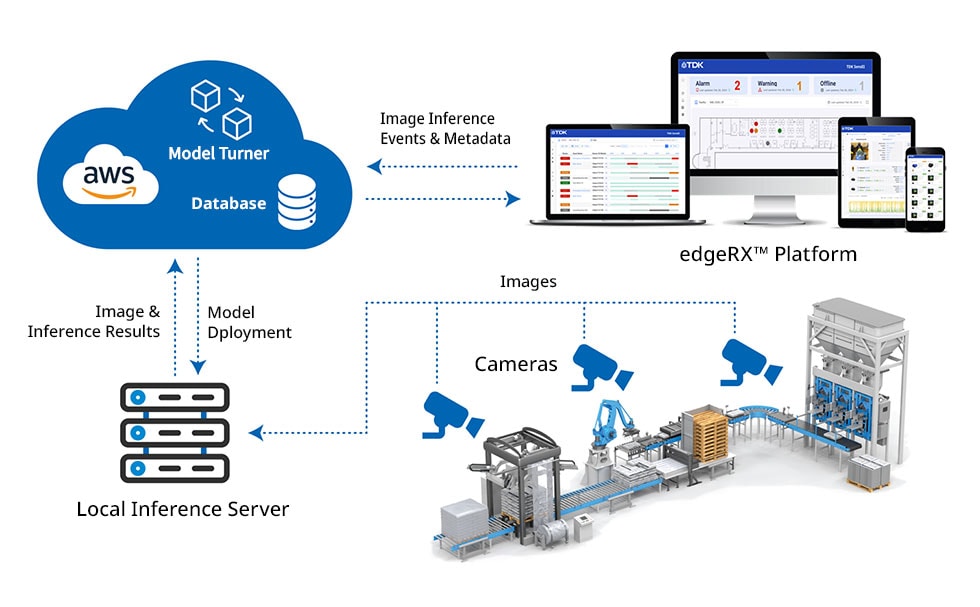
AI-powered “eyes” capable of inspecting up to 2,000 parts a minute

TDK SensEI
edgeRX VISION offers remarkable processing speed, capable of processing up to 2,000 parts per minute. Even on high-volume production lines where products arrive in rapid succession, it can perform visual inspections without slowing the pace of production. The system can also handle extremely small products measuring as little as 1 mm by 0.5 mm, detecting scratches, chips, foreign matter, and other abnormalities that can be difficult to identify with conventional inspection methods.
Manufacturing customers are seeking smarter operations, and edgeRX VISION can play a significant role in improving quality, productivity, and process optimization,” says Sandeep Pandya, CEO of TDK SensEI, the company developing edgeRX VISION. “Going forward, we plan to expand the platform’s capabilities through enhanced analytics, greater automation, and deeper integration with manufacturing environments, helping our customers extract even more value from their visual inspection data.”
Transforming the manufacturing process with inspection data
The value of visual inspection extends well beyond finding defective products quickly. By accumulating and analyzing the types and frequency of defects, when they occur, and their relationship to equipment operation or materials, manufacturers can identify patterns in how defects arise. Such insights can help identify the underlying causes of defects. For example, they may discover that defective products occur more frequently when a particular material is used, or that defects increase when certain equipment is in operation. Manufacturers can then review their processes, materials, or equipment conditions—not merely to detect faulty products after the fact, but to reduce the likelihood of defects occurring in the first place.
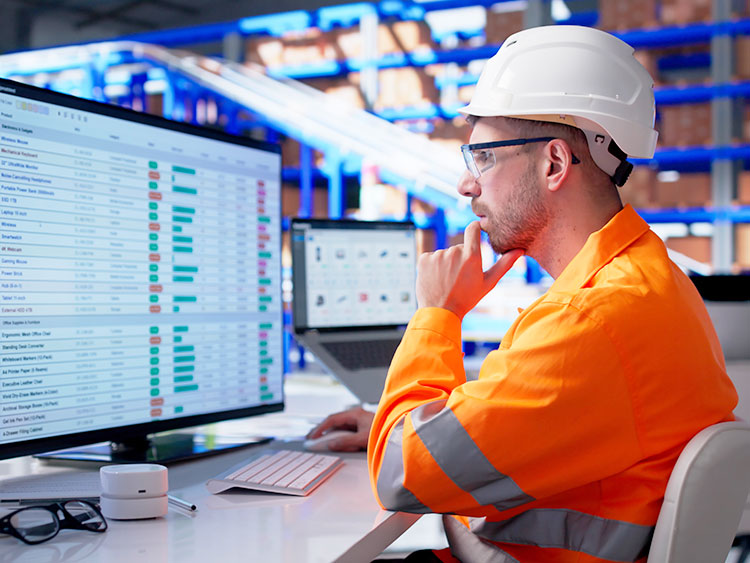
edgeRX VISION is designed to serve as an AI-powered set of “eyes” for the manufacturing process, adding analytical capability and intelligent decision-making to visual inspection. In the future, the possibilities may extend beyond detecting anomalies to identifying their causes, recognizing early warning signs before problems emerge, and ultimately enabling manufacturing lines to improve their processes autonomously based on data. edgeRX VISION represents an important first step toward that future of smarter manufacturing. For more information about the product, please visit the TDK SensEI product page.
Summary
In modern manufacturing, where high-volume production and uncompromising quality must go hand in hand, the speed and precision of visual inspection can directly impact productivity. With edgeRX VISION, TDK is taking visual inspection to a new level through a flexible AI-powered solution that can integrate with existing inspection infrastructure today while supporting a future vision of comprehensive AOI solutions that combine intelligent software, inspection hardware, and continuous optimization services. The technology can be a powerful tool for addressing persistent challenges on the factory floor and improving production efficiency.
Terminology
- Large language models (LLMs): AI models that learn from vast amounts of text data to understand and generate language like humans.
- Edge computing: The deployment of AI models directly on edge devices, allowing data to be processed in real time without sending it to the cloud.