

Management and Execution Structure and Audit System
- Organization Chart
- Overview of Current System and Reason for adoption
- Skills Matrix
- Status of audit by Audit & Supervisory Board Members
- Status of internal audit
- Status of accounting audit
- Audit fees, etc.
Last-update : June, 2026
Organization Chart
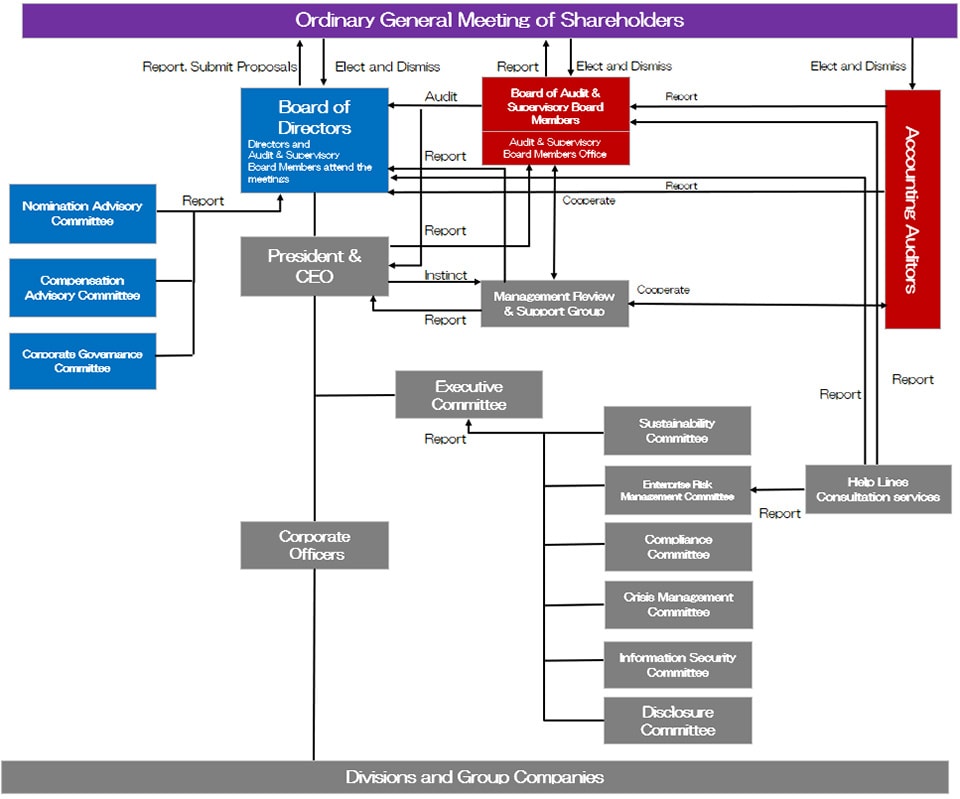
Overview of current system and reason for adoption
The Company is a company with an Audit & Supervisory Board and has implemented various measures to strengthen its corporate governance. In 2002, efforts to reform governance included the introduction of a Corporate Officer system along with a significant reduction in the number of Directors for the purpose of clearly separating management’s monitoring and execution functions. In addition, to fortify the system for boosting shareholders’confidence, we shortened the term of office of Directors from 2 years to 1 year and actively invited the participation of Outside Directors.
In addition, the Company has established 3 committees acting as advisory organizations tothe Board of Directors (the Nomination Advisory Committee, the Compensation Advisory Committee, the Corporate Governance Committee) to strengthen our management supervision functions.
Further, TDK established “TDK Basic Policy on Corporate Governance” . The policy request to elect Independent Outside Directors which account for the majyority of the Directors and to assign an Independent Outside Director as the chair of the Board of Directors in principle. TDK complies them.
In short, the Company has always believed it can realize a system to continuously ensure sound, compliant and transparent management through the introduction of a new framework that strengthens corporate governance based on its Audit & Supervisory Board System.
-
a. Organization of the Board of Directors
The Company has a small number of Directors to expedite the management decision-making process. At the same time, the Company appoints disinterested, independent Outside Directors in order to enhance the supervision of the Company’s management. In addition, the Company’s basic policy is to elect independent Outside Directors which account for the majyority of the Directors and from the perspective of ensuring clear separation between management oversight and business execution, an independent Outside Director serves as the Chair of the Board of Directors in principle. Furthermore, the Directors’terms of office are set at one year to give shareholders an opportunity to cast votes of confidence regarding Directors’performance every fiscal year.
- Organization of the Board of Directors
Position and Duties, etc. at the Company Name Representative Director, President & CEO
General Manager of Humidifier Countermeasures HQNoboru Saito Representative Director & Senior Executive Vice President
CFO (Chief Financial Officer)Tetsuji Yamanishi Director & Corporate Officer
CTO (Chief Technology Officer) and General Manager of Technology & Intellectual Property HQShuichi Hashiyama Outside Director Kozue Nakayama Chair of the board Outside Director Mutsuo Iwai Outside Director Shoei Yamana Outside Director Toru Katsumoto - Number of the Board of Directors meetings and attendance status (FY 2026):
-
Position at the Company Name Attendance Status Representative Director Noboru Saito 13 out of 13 meetings (100%) Representative Director Tetsuji Yamanishi 13 out of 13 meetings (100%) Director Shuichi Hashiyama 10 out of 10 meetings (100%) * Outside Director Kozue Nakayama 13 out of 13 meetings (100%) Chair of the board Outside Director Mutsuo Iwai 12 out of 13 meetings (92.3%) Outside Director Shoei Yamana 13 out of 13 meetings (100%) Outside Director Toru Katsumoto 13 out of 13 meetings (100%) - Operating Policy of the Board of Directors (FY 2026):
-
T130
Basic Policy for the operation of Board of DirectorsDirectors, Audit & Supervisory Board Members, and executive officers work together towards the common goal of TDK's sustainable growth and the improvement of its medium to long-term corporate value.
In the first year of the new medium-term management plan, T130, the Board of Directors will engage in discussions regarding the business portfolio strategy and risk management, which are crucial elements for achieving the medium-term plan. They will also consider the optimal governance structure in line with the medium-term period.T130
Key Discussion Items of Board of Directors- 1. Business Portfolio Strategy
- 2. Strengthening Corporate Functions
- 3. Enterprise Risk Management
- 4. Group Governance
- 5. Pre-Financial Capital (especially Human Capital themes)
- Main agenda items in the Board of Directors (FY 2026):
-
Management Strategy - ・Business Portfolio Management
- ・Progress/validation of medium-term and current-term management plan (Company-wide and major business units)
- ・Financial strategy, fund plan
- ・Pre-Financial Capital strategy
- ・Human Capital strategy
- ・Technology development strategy (included Production engineering and IP strategy)
Governance - ・Effectiveness evaluation of the Board of Directors
- ・Group governance, Compliance management
- ・Group risk management (Supply chain management ,etc.)
- ・Internal audit report
- ・Internal control system and state of operation
As well as the above, the Board of Directors discussed business matters, capital investment, business tie-up, etc.
* After his appointment as a director in June 2025
-
b. Organization of the Audit & Supervisory Board
The Company has adopted the Audit & Supervisory Board Member System pursuant to the Companies Act of Japan and has appointed independent Outside Audit & Supervisory Board Members who are disinterested in the Company to strengthen the supervision of the Company’s management.
(The status of audit by Audit & Supervisory Board Members is as described in (3) [Status of Audit].)- Organization of the Audit & Supervisory Board
Position at the Company Name Chairperson Full-Time Audit & Supervisory Board Member Takakazu Momozuka Full-Time Audit & Supervisory Board Member Masato Ishikawa Outside Audit & Supervisory Board Member Douglas K. Freeman Outside Audit & Supervisory Board Member Chizuko Yamamoto Outside Audit & Supervisory Board Member Takashi Fujino -
c. Overview of advisory organizations to the Board of Directors
〈The Nomination Advisory Committee〉
The Nomination Advisory Committee is chaired by an Independent Outside Director of the Company and a majority of the members are Independent Outside Directors. The said Committee reviews the conditions expected for the post of Director, Audit & Supervisory Board Member, and Corporate Officer and makes nominations. In this way, the Nomination Advisory Committee ensures the appropriate election of Directors, Audit & Supervisory Board Members and Corporate Officers and provides transparency in the decision-making process. In addition, the said Committee confirms the positions of Outside Directors and Outside Audit & Supervisory Board Members held at other companies every term, and investigates and examines the independence of candidates of Directors and Outside Audit & Supervisory Board Members (including cases where the status of independence changes during the term of office). After deliberating and comprehensively judging the content, the said Committee report the deliberation results to the Board of Directors.
- Organization of the Nomination Advisory Committee
Position and Duties, etc. at the Company Name Chair of the committee Outside Director Kozue Nakayama Outside Director Mutsuo Iwai Outside Director Shoei Yamana Outside Director Toru Katsumoto Representative Director, President & CEO
General Manager of Humidifier Countermeasures HQNoboru Saito - Number of the Nomination Advisory Committee and attendance status (FY 2026):
-
Position at the Company Name Attendance Status Chair of the committee Outside Director Kozue Nakayama 10 out of 10 meetings (100%) Outside Director Mutsuo Iwai 10 out of 10 meetings (100%) Outside Director Shoei Yamana 10 out of 10 meetings (100%) Outside Director Toru Katsumoto 10 out of 10 meetings (100%) Representative Director Noboru Saito 10 out of 10 meetings (100%) - Main agenda items in theNomination Advisory Committee (FY 2026):
-
Officer structure - ・Selection of Director candidates
- ・Organization of Board Advisory committees for the next term
- ・Organization of Corporate Officers for the next term
Governance - ・Succession planning
- ・Skill matrix
〈The Compensation Advisory Committee〉
The Compensation Advisory Committee is chaired by an Independent Outside Director of the Company and a majority of the members are Independent Outside Directors. The said Committee contributes to the securement of the transparency of remuneration decision-making process and the reasonableness of individual remunerations in light of corporate business performance, individual performance and general industry standards by deliberating and reporting to the Board of Directors on the remuneration system and the level of remuneration pertaining to Directors and Corporate Officers.
- Organization of the Compensation Advisory Committee
Position and Duties, etc. at the Company Name Chair of the committee Outside Director Shoei Yamana Outside Director Kozue Nakayama Outside Director Mutsuo Iwai Outside Director Toru Katsumoto Representative Director & Senior Executive Vice President
CFOTetsuji Yamanishi - Number of the Compensation Advisory Committee and attendance status (FY 2026):
-
Position at the Company Name Attendance Status Chair of the committee Outside Director Shoei Yamana 6 out of 6 meetings (100%) Outside Director Kozue Nakayama 6 out of 6 meetings (100%) Outside Director Mutsuo Iwai 6 out of 6 meetings (100%) Outside Director Toru Katsumoto 6 out of 6 meetings (100%) Representative Director Tetsuji Yamanishi 6 out of 6 meetings (100%) - Main agenda items in the Compensation Advisory Committee (FY 2026):
-
Remuneration of Directors and Corporate Officers - ・Corporate Officer performance-linked bonuses for the current term
- ・Executive compensation table for the next term
- ・Corporate Officer performance-linked bonus target value for the next term
Executive remuneration of major subsidiaries ・Executive remuneration of overseas subsidiaries
〈The Corporate Governance Committee〉
The Corporate Governance Committee conducts deliberations on TDK's medium- to long- term corporate governance way and system, policy for TDK's corporate governance and matters to be consulted by the Board of Directors, etc. and continuously strives to enhance corporate governance for TDK’s sustainable growth and increase of its corporate value over the mid- to long-term.
- Organization of the Corporate Governance Committee
Position and Duties, etc. at the Company Name Chair of the committee Representative Director & Senior Executive Vice President
CFOTetsuji Yamanishi Outside Director Kozue Nakayama Outside Director Mutsuo Iwai Outside Director Shoei Yamana Outside Director Toru Katsumoto Representative Director, President & CEO
General Manager of Humidifier Countermeasures HQNoboru Saito Director & Corporate Officer
CTO (Chief Technology Officer) and General Manager of Technology & Intellectual Property HQShuichi Hashiyama Corporate Officer, General Manager of Corporate Strategy
HQTaro Ikushima - Number of the Corporate Governance Committee and attendance status (FY 2026):
-
Position at the Company Name Attendance Status Chair of the committee Representative Director Tetsuji Yamanishi 5 out of 5 meetings (100%) Outside Director Kozue Nakayama 5 out of 5 meetings (100%) Outside Director Mutsuo Iwai 5 out of 5 meetings (100%) Outside Director Shoei Yamana 5 out of 5 meetings (100%) Outside Director Toru Katsumoto 5 out of 5 meetings (100%) Representative Director Noboru Saito 5 out of 5 meetings (100%) Corporate Officer, General Manager of Corporate
Strategy HQTaro Ikushima 5 out of 5 meetings (100%) - Main agenda items in the Corporate Governance Committee (FY 2026):
-
Governance - ・TDK's corporate governance ideals and policies
- ・Operating Policy of the Board of Directors
- ・Annual agenda for the Board of Directors meetings
- ・Evaluation of the effectiveness of the Board of Directors
- ・Internal control system and its operational status
- ・Compliance status with Corporate Governance Codes
Skills Matrix
| Name | Position | Corporate Management |
Global Business Experience |
Sales/ Marketing |
ESG/ Sustainability |
Technology/ Research & Development |
Manufacture/ Production Technology |
Finance/ Accounting |
Legal/ Compliance/Risk Management |
|
|---|---|---|---|---|---|---|---|---|---|---|
| Directors | Noboru Saito | Representative Director, President & CEO |
● | ● | ● | ● | ||||
| Tetsuji Yamanishi | Representative Director, Senior Executive Vice President |
● | ● | ● | ● | |||||
| Shuichi Hashiyama | Director Corporate Officer | ● | ● | ● | ● | |||||
| Kozue Nakayama | Outside Director | ● | ● | ● | ● | |||||
| Mutsuo Iwai | Outside Director | ● | ● | ● | ||||||
| Shoei Yamana | Outside Director | ● | ● | ● | ● | |||||
| Toru Katsumoto | Outside Director | ● | ● | ● | ● | |||||
| Audit & Supervisory Board Members | Takakazu Momozuka | Full-time Audit & Supervisory Board Member |
● | ● | ● | ● | ||||
| Masato Ishikawa | Full-time Audit & Supervisory Board Member |
● | ● | ● | ||||||
| Douglas K. Freeman | Outside Audit & Supervisory Board Member |
● | ● | |||||||
| Chizuko Yamamoto | Outside Audit & Supervisory Board Member |
● | ● | ● | ||||||
| Takashi Fujino | Outside Audit & Supervisory Board Member |
● | ● | ● | ● | |||||
Note: “Global business experience” includes practical experience in global business as well as experience related to overseas business.
[Fields where the Company especially expects Directors and Audit & Supervisory Board Members to demonstrate their skills]
| Skills the Company expect | Reasons for selecting the skills in question |
|---|---|
| Corporate Management | To contribute to a sustainable society and increase corporate value, the ability to perform in corporate management and to manage and supervise executive divisions is required. |
| Global Business Experience | Experience and knowledge in global business are essential in TDK where over 90% of net sales is recorded outside of Japan. |
| Sales/Marketing | Sales and marketing skills are necessary to understand market demands and create new business opportunities from the conception of both technology-out and market-in. |
| ESG/Sustainability | In order to align and advance both the sustainability of society and the sustainability of TDK (i.e., the long-term enhancement of corporate value), an adequate understanding of ESG and sustainability is an essential element in the effective oversight of corporate management. |
| Technology/Research & Development | As under the Corporate Motto “Contribute to culture and industry through creativity”, the Company aims to be a company that contributes to the realization of a sustainable future by accelerating the advancements in technology and the transformation of society. |
| Manufacture/Production Technology | An adequate understanding and passion for monozukuri (i.e., manufacturing experience) is required as quality and reliability of products are the foundation of TDK’s business. |
| Finance/Accounting | To aim for sustainable growth and carry out necessary investments, knowledge in finance and accounting, which supports a sound and solid financial basis, is required. |
| Legal/Compliance/Risk Management | Legal, compliance and risk management skills are necessary to respond to the trust of all stakeholders and to enhance corporate value in a sound and sustainable manner. |
Status of audit by Audit & Supervisory Board Members
The Company’s Audit & Supervisory Board consists of two Full-time Audit & Supervisory Board Members and three Outside Audit & Supervisory Board Members. The Board audits the execution of duties by Directors, as well as the business operations and financial status of the Company and its domestic and overseas Group companies.
Among the members, Full-time Audit & Supervisory Board Member Takakazu Momozuka has many years of experience in the Company’s accounting and finance operations; Outside Audit & Supervisory Board Member Chizuko Yamamoto is a qualified Certified Public Accountant; and Outside Audit & Supervisory Board Member Takashi Fujino possesses extensive knowledge in accounting, finance, IR, and corporate management at global companies. Each of these three members possesses a considerable degree of knowledge regarding finance and accounting.
Furthermore, Full-time Audit & Supervisory Board Member Sho Ishikawa has extensive experience through his many years of involvement in manufacturing and information systems operations, and Outside Audit & Supervisory Board Member Douglas K. Freeman is a qualified attorney.
During the fiscal year under review, the Company held meetings of the Audit & Supervisory Board generally once a month (14 times in total). The attendance records of individual Audit & Supervisory Board Members and the key agenda items of the Board are as follows.
| Position | Name | Attendance (Attendance ratio) |
|---|---|---|
| Full-Time Audit & Supervisory Board Member | Takakazu Momozuka | 14 of the 14 meetings (Attendance ratio: 100%) |
| Full-Time Audit & Supervisory Board Member | Masato Ishikawa | 14 of the 14 meetings (Attendance ratio: 100%) |
| Outside Audit & Supervisory Board Member | Douglas K. Freeman | 14 of the 14 meetings (Attendance ratio: 100%) |
| Outside Audit & Supervisory Board Member | Chizuko Yamamto | 14 of the 14 meetings (Attendance ratio: 100%) |
| Outside Audit & Supervisory Board Member | Takashi Fujino | 14 of the 14 meetings (Attendance ratio: 100%) |
| Key Agenda Items | Formulation of audit policies, audit plans, and the allocation of audit duties,Selection of the Chairman of the Audit & Supervisory Board and Full-time Audit & Supervisory Board Members, Decisions regarding the Audit & Supervisory Board’s audit report, Decisions regarding the appointment and non-reappointment of the Accounting Auditor, Evaluation of the Accounting Auditor and consent to audit remuneration, Remuneration for Audit & Supervisory Board Members, Agenda items of Board of Directors meetings, Contents of reports from the Management Committee, Reports from the internal audit department, Results of onsite audits of global locations, Prior consent of the Audit & Supervisory Board regarding non-assurance services provided by the Accounting Auditor, etc. | |
The Audit & Supervisory Board Members timely collect information regarding management policies of TDK and conditions of business execution by Corporate Officers, etc. by attending the Board of Directors meetings as well as through regular attendance at the Executive Committee meetings, business plan review meetings and other important meetings and inspection of management reports and applications for internal decision-making. The Audit & Supervisory Board Members share and deliberate such information among themselves. The full-time Audit & Supervisory Board Members established the audit policy and key audit items as follows. They conducted hearings from operating department managers and headquarter function managers regarding the conditions of business execution and conducted audit of the Company’s operating departments and headquarters and the subsidiaries selected based on their importance.
| Audit policy | 1. The audit activities are carried out with the aim of contributing to the enhancement of the company's social trust by establishing a corporate governance system that ensures sound and sustainable growth, while closely collaborating with the internal audit department and external auditors to understand the status of group governance and internal control operations. 2. In conducting the audit, the Audit & Supervisory Board Members will focus on key audit items based on the audit plan, engage in sufficient exchange of opinions, and enhance the effectiveness of the audit. |
| Key audit items | 1. Group Governance System 2. Status of Compliance 3. Enterprise Risk Management (ERM) System 4. Initiatives to Strengthen the Management Foundation |
The full-time Audit & Supervisory Board Members shared the extracted issues with the relevant business units and the headquarters and confirmed the countermeasures. Furthermore, the full-time Audit & Supervisory Board Members regularly had meetings and shared information with the Audit & Supervisory Board Members of the company’s subsidiaries and exchanged opinions with them on important issues and findings for auditing the entire TDK Group. The Outside Audit & Supervisory Board Members held regular meetings for information sharing with the Outside Directors to exchange opinions, and received briefings from relevant operating departments and headquarters, etc. to confirm the status of responses to major issues, etc.
The Audit & Supervisory Board establishes the Company’s audit policy and annual audit plan, confirms the Company’s business conditions through regular meetings with the Board of Directors and Representative Director, etc., and expresses opinions and provides recommendations from time to time regarding tasks to be addressed by TDK (including matters concerning corporate governance and compliance), development and operation status of internal control, risks surrounding TDK, important issues in the Audit & Supervisory Board Members’audit and other issues. Also, the Audit & Supervisory Board receives the internal audit report from the internal audit department and promote information sharing and collaboration with them through establishing regular meetings. A summary of These audit results, identified issues and risks, confirmed countermeasures and internal audit status are shared among all Audit & Supervisory Board Members at the Audit & Supervisory Board meetings, and the issues are deliberated at the Audit & Supervisory Board meetings and reported to the Directors when appropriate. The Audit & Supervisory Board Members have meetings from time to time with an attorney with whom it has entered into an advisory contract and receive legal advice regarding Audit & Supervisory Board Members’duties timely, and thereby improve the effectiveness of Audit & Supervisory Board Members’duties.
The Audit & Supervisory Board consulted with the Accounting Auditor regarding the audit plan and held multiple meetings, including reporting sessions for audit results and liaison meetings. Regarding Key Audit Matters (KAM), the Board exchanged opinions on several occasions throughout the various stages — including the audit planning stage, interim review reporting, and fiscal year-end audit reporting — concerning candidates proposed by the Accounting Auditor, such as the valuation of goodwill and property, plant and equipment. Through these processes, the Board confirmed that there were no disagreements and worked to ensure close collaboration.
As a support system for the Audit & Supervisory Board, the Company has established the Audit & Supervisory Board Office. This office consists of dedicated staff independent from business execution functions and supports the administration of the Board and the execution of duties by each Audit & Supervisory Board Member.
Specific activities of the Audit & Supervisory Board during the fiscal year under review are as follows. (○: Full attendance, □: Partial attendance)
| Main activities | Number of attendances / items |
Full-time Audit & Supervisory Board Member |
Outside Audit & Supervisory Board Member |
|
|---|---|---|---|---|
| ① | Attendance at Board of Directors meetings | 13 | ○ | ○ |
| ② | Attendance at important meetings, such as Management Committee and Business Plan Review meetings |
24 | ○ | |
| ③ | Audits of business divisions, head office departments, and domestic and overseas subsidiaries |
68 | ○ | □ |
| ④ | Interviews with heads of business units and head office functions |
9 | ○ | □ |
| ⑤ | Meetings with Outside Directors | 4 | ○ | ○ |
| ⑥ | Meetings with Representative Directors | 2 | ○ | ○ |
| ⑦ | Meetings with the internal audit department | 13 | ○ | □ |
| ⑧ | Meetings with the Accounting Auditor | 10 | ○ | ○ |
| ⑨ | Meetings with Audit & Supervisory Board Members of domestic subsidiaries |
1 | ○ | |
| ⑩ | On-site inspections of domestic and overseas locations | 3 | □ | □ |
Status of internal audit
The Management Review & Support Group, the Company’s internal audit department, consists of 19 members. During the fiscal year under review, the group verified the status of compliance with laws, regulations, and internal rules, as well as the efficiency and effectiveness of operations at business divisions and major subsidiaries. These activities included conducting interviews on the status of various committees reporting directly to the Management Committee. Furthermore, regarding the "effectiveness of internal control over financial reporting" under the Financial Instruments and Exchange Act, the group conducted risk-based on-site evaluations of key domestic and overseas locations and major subsidiaries in accordance with the annual audit plan. The status of these activities is reported periodically to the President, the Board of Directors, Audit & Supervisory Board Members, and the Audit & Supervisory Board.
The Management Audit Group and Full-time Audit & Supervisory Board Members maintain close communication through information sharing. Specifically, the Management Audit Group submits internal audit reports to the Full-time Audit & Supervisory Board Members, who in turn provide their audit results to the group, thereby enhancing the efficiency of internal audits.
With respect to the Accounting Auditor, the group regularly confirms the status of audits through quarterly financial results reporting and other sessions. In addition, they regularly exchange opinions regarding the evaluation of the "effectiveness of internal control over financial reporting" under the Financial Instruments and Exchange Act.
Status of accounting audit
- Name of auditor
KPMG AZSA LLC - Continuing Auditing Period
23 years - Certified public accountants who conducted the accounting audit
Mr. Michitaka Shishido
Mr. Michiaki Yamabe
Mr. Ryoma Dodo - Constitution of assistant in conducting the accounting audit
Working to assist the above accountants in conducting the accounting audit of the Company were 33 certified public accountants, 11 assistant certified public accountants, and 104 other people. - Select standard and reason of auditor
The Audit & Supervisory Board prescribes procedures and standards for Appointment, Dismissal, and Reappointment of Accounting Auditors in the Regulations of the Audit & Supervisory Board and Standards for Appointment, Dismissal, and Reappointment of Accounting Auditors and selects the Company’s Accounting Auditor based on these procedures and standards. When judging selection, the Audit & Supervisory Board evaluates appropriateness of the quality control organization of the audit firm to be accounting auditor, rationality and validity of conducting the audit by the audit team and judges comprehensively considering the validity of the audit fee as well. In addition, the accounting auditor could be non-reappointed in a case where there is any item that does not meet the standard of Reappointment.
If all of the Audit & Supervisory Board Members acknowledge that the Company’s Accounting Auditor falls under any of the conditions set forth in Article 340 paragraph 1 of the Companies Act of Japan and it is difficult for the Accounting Auditor to properly execute auditing, the Company shall dismiss the Accounting Auditor by a unanimous resolution of the Audit & Supervisory Board. In addition to cases falling under any of the statutory reasons for dismissal of accounting auditors, if any fact occurs that is recognized as casting doubt upon important factors relating to the Accounting Auditor’s execution of duties, such as the Accounting Auditor’s qualifications, independency and ethics, the Audit & Supervisory Board will, in accordance with the Regulations of the Audit & Supervisory Board and Standards for Appointment, Dismissal, and Reappointment of Accounting Auditors, decide as to whether the Accounting Auditor shall be dismissed or shall not be re-appointed, comprehensively taking the facts into account. - The Audit & Supervisory Board evaluated the status of audit activity of the accounting auditor for the previous fiscal year. The objects of evaluation are appropriateness of the quality control organization of the accounting auditor and rationality and validity of conducting the audit by the audit team, mentioned above. The Audit & Supervisory Board has decided to reappoint KPMG AZSA LLC as accounting auditor for FY2026 based on these results of evaluation for the fiscal year under review.
Audit fees, etc.
- Details of fees to auditors
Category Fiscal year ended March 31, 2025 Fiscal year ended March 31, 2026 Audit fees Fees for non-attest service Audit fees Fees for non-attest service Filing company 439 - 437 13 Consolidated subsidiaries 47 - 49 - Total 486 - 486 13 In fiscal 2026, the content of non-attest service that TDK Corporation will pay to KPMG AZSA LLC, TDK Corporation’s auditors, is for the production of comfort letters related to the preparation of comfort letters for the issuance of bonds and support services for the introduction of SSBJ.
-
Details of fees to member firms to which auditors belong (member firms of KPMG) (excluding a.)
Category Fiscal year ended March 31, 2025 Fiscal year ended March 31, 2026 Audit fees Fees for non-attest service Audit fees Fees for non-attest service Filing company - 82 70 55 Consolidated subsidiaries 960 171 1,112 157 Total 960 253 1,182 212 In fiscal year ended March 31, 2025 and 2026, the content of non-attest service that TDK Corporation and consolidated subsidiaries will pay to member firms of KPMG is mainly tax related.
- Details of other material audit fees
(Fiscal year ended March 31, 2025)
TDK Electronics AG, consolidated subsidiary of TDK Corporation, has paid ¥261 million to Ernst & Young as audit fees.
(Fiscal year ended March 31, 2026)
Information on the details of other material audit fees is omitted, because there are no such fees. - Policy of deciding audit fees
TDK Corporation carefully considers the independence of auditors and decides the audit fees by resolution of the Board of Directors. - Reason of agreeing audit fees by the Audit & Supervisory Board
Audit & Supervisory Board consented to audit fees for fiscal year ended March 31, 2026, after examining the Accounting Auditor’s audit plan, the status of duties conducted in previous fiscal years, and the basis for calculation of the remuneration estimate by receiving the necessary materials and hearing reports from Directors, relevant in-house departments, and the Accounting Auditor.


