
Sustainability | EnvironmentEnvironmental Policy and Environmental Vision
- Our Approach
- Looking Ahead to 2050
- TDK Environmental Vision 2035
- Basic Environmental Action Plan “TDK Environment, Health and Safety Action 2025”
Our Approach
The TDK Group Occupational Health/Safety and Environmental Charter
To unify policies relating to health/safety and the environment throughout the entire TDK Group, TDK formulated the TDK Group Occupational Health/Safety and Environmental Charter consisting of two aspects—basic principles and basic policies on health/safety and the environment.
Looking Ahead to 2050
One key issue (materiality) that TDK will be addressing to achieve its TDK Transformation long-term vision is “implementing solutions to social and environmental issues.”
TDK is promoting net-zero CO2 emissions from the perspective of the entire supply chain. Specifically, we are strengthening our activities for the reduction of greenhouse gas emissions, including further expansion of the scope of coverage to include emissions in other Scope 3 categories as well as Scope 1, Scope 2, and Scope 3 Category 11 and the setting of key performance indicators and monitoring indicators, toward the realization of a society with net-zero CO2 emissions by 2050. In addition, in 2025 we achieved a renewable energy adoption rate of 58.6% at our manufacturing sites, meeting the target of 50% set in our medium-term action policy, “TDK Environmental Action 2025."
As proclaimed in the TDK Environmental Charter, TDK recognizes the importance of adopting measures to counter climate change and respecting biodiversity and the limited resources of the Earth. Under the slogan of “Eco TDK,” TDK will further promote related activities, including the realization of a circular economy.
TDK Environmental Vision
TDK Environmental Vision Three ZERO for the planet
Striving to achieve:
- • Zero GHG emission
- • Zero resource loss
- • Zero damage to the ecosystem
throughout the product lifecycle.
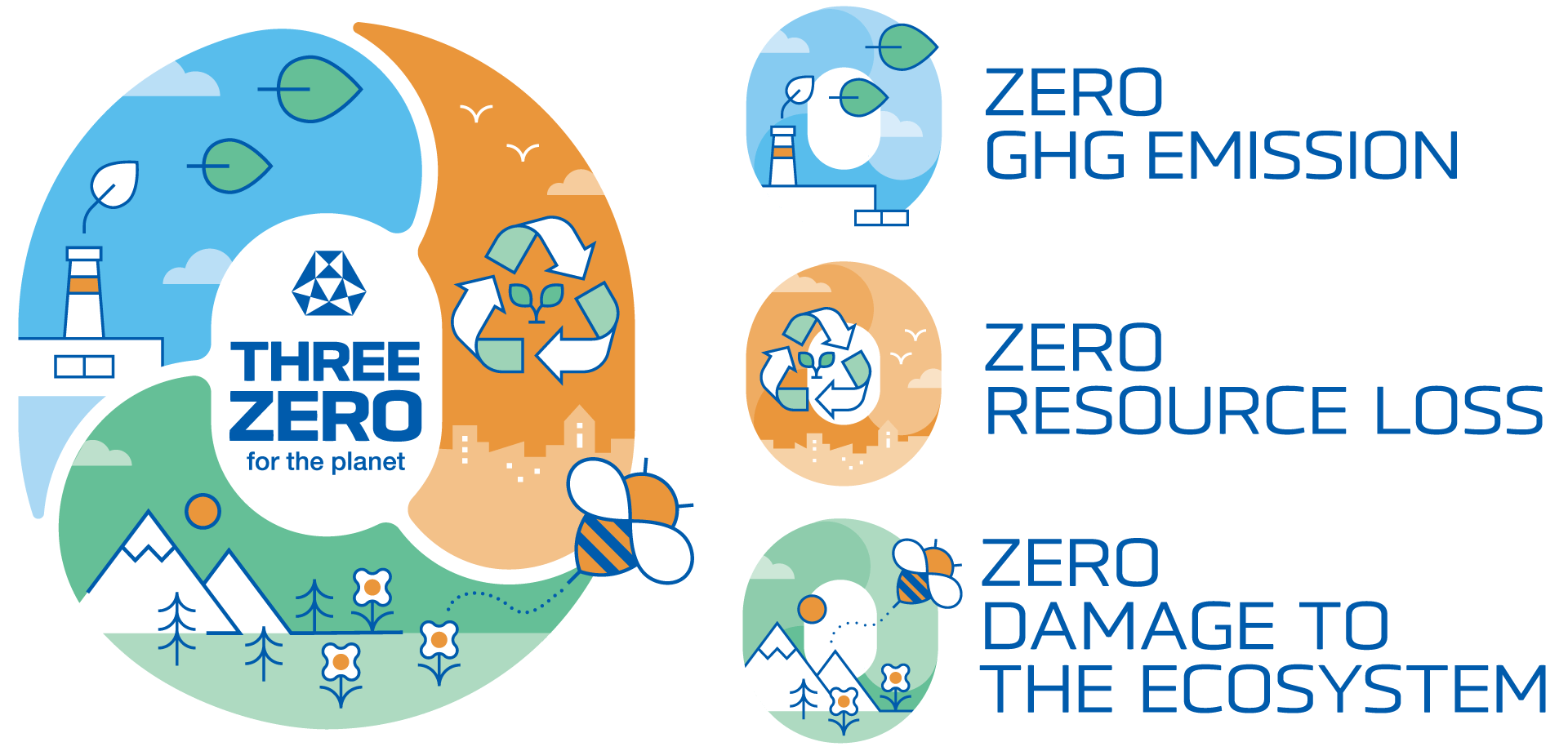
Pursue the three zeros throughout the entire life cycle from the perspective of entire supply chain.
In FY March 2015, the TDK Group achieved, ahead of the schedule, the target of realizing carbon neutrality that had been set in TDK Environmental Action 2020, the group’s third environmental master plan. Having achieved this goal, TDK went on to formulate a new environmental vision—Vision 2035—which was announced in 2015, and which looked ahead to the year that would mark the 100th anniversary of TDK’s founding. In 2024, a new long-term vision—TDK Transformation: Accelerating Transformation for a Sustainable Future—was formulated to replace Vision 2035. As part of TDK Transformation, we announced the TDK Environmental Vision 2035 (defined as “The operation under the environmental load within natural circulation,” and setting a target of “Halve the CO2 emissions intensity from a life-cycle perspective by 2035”), which would enable us to work together effectively as a group to address the issue of climate change. As of April 2026, we had already achieved this CO2 emissions intensity reduction target (in terms of Scope 1 and 2 emissions). To help realize the transformation to a sustainable society, taking into account the shift toward seeking a reduction in CO2 emissions in absolute terms, we have now formulated a new environmental vision: Three ZERO for the planet. Under this new vision, besides reducing the negative impact that our business activities have on the global environment to zero, we will also be striving to reduce the burden on the environment on a perpetual basis (Zero Carbon*). We are also expanding the scope of application, aiming to achieve “Three ZERO for the planet” throughout the product lifecycle and the whole supply chain: zero emissions, zero resource loss, and zero damage to the ecosystem.
To realize the sustainable future envisioned by our corporate philosophy, we will be sharing TDK’s approach to environmental activities with all TDK Group employees, and proceeding with related initiatives.
- *TDK supports the Paris Agreement adopted at the UN Climate Change Conference (COP21) in 2015, and also supports the G7 2030 Nature Compact, and will continue working to help achieve these goals.


