
Sports Tech@TDK
How do Breaking balls work? Why Do Breaking Balls Curve? Curves, Shoot, and Sliders...

There are various theories as to the origins of baseball but it is widely believed it originated from the game of ‘rounders’ which was brought to the U.S. in the 18th century and then developed into a national sport, with more detailed rules being established later in the 19th century. Rounders itself was derived from cricket, an old English aristocratic game. The first professional baseball league, Major League Baseball, was founded in 1903, and since 2006 the World Baseball Classic has been held every four years to determine the world's top national baseball team.

Key Takeaways
1. Breaking balls curve due to aerodynamic forces, primarily the Magnus effect, where ball rotation creates a pressure difference between the two sides of the ball.
2. The diagrams on page 1 show how pitch types (curve, slider, shoot, rise) differ based on spin axis, direction, and velocity.
3. Stitches play a critical role by disturbing airflow asymmetrically, enhancing lift or turbulence and contributing to pitch deviation.
4. The page 1 airflow illustrations demonstrate how lift forms when airflow speeds differ around the ball surface, causing break direction and magnitude.
5. The transition into HDD technology on page 2 draws a parallel: HDD magnetic heads fly using lift generated by air pressure at high speed, similar to how spinning balls experience lift forces.
6. TDK’s magnetic head design shown on page 2 highlights slider structure, air bearing surfaces, and precise floating height—an engineered analogy to aerodynamic lift principles seen in sports physics.
Aerodynamics Explain the Mechanism Behind Breaking Balls
What is a breaking ball? In modern breaking balls baseball, the breaking ball is a necessary component of pitching strategy. While speed is vital (pitches often exceed 90 mph), high velocity alone is insufficient to defeat skilled batters. This is why pitchers rely on mixing fastballs with various breaking pitches to disrupt timing. Mastering different types of balls in baseball is essential for a pitcher's success in controlling the game.
The wide variety of breaking ball pitches can be broadly categorized into vertical and horizontal movement. Vertical breaking pitches include forkballs and change-ups, designed to drop sharply. Horizontal breaking pitches (or curving pitches) include the shoot and the slider ball, often characterized by a noticeable horizontal break baseball movement. When comparing a curveball vs breaking ball, the curve ball's distinct, sharp drop and bend sets it apart, though the underlying physics is similar. Understanding the difference between slider and curve is a fundamental step for anyone learning how to throw breaking pitches.
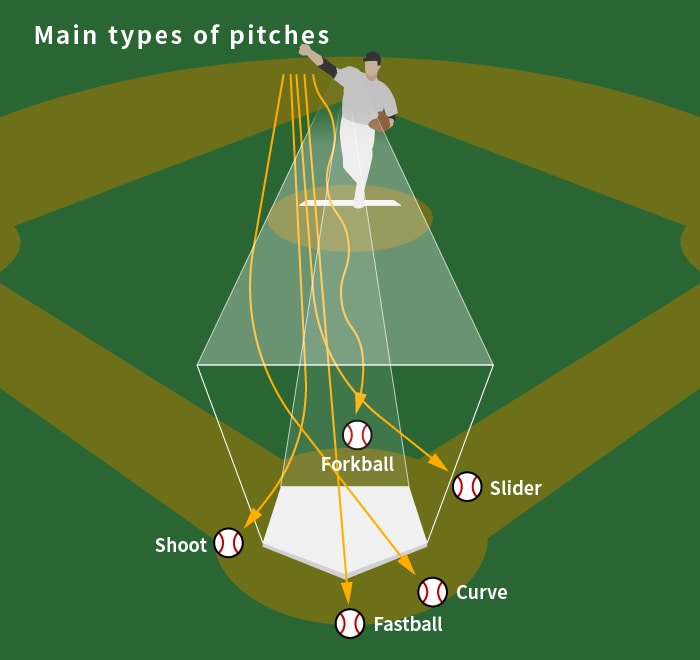
By giving the ball a rotation, a variety of changes can be created. The way the ball changes also has to do with the stitching of the ball.
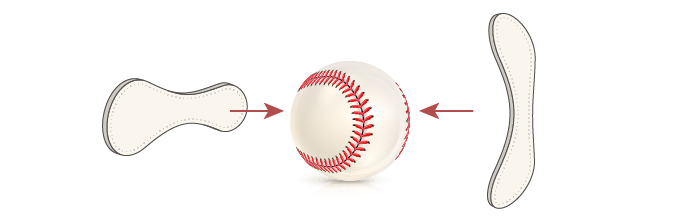
The ball is made of cork or rubber, wound with several thick layers of wool yarn, wrapped in two gourd-shaped skins, and then sewn together with thread. Not only are the size and weight of the ball strictly regulated, but the seams are also set to consist of exactly 108 stitches.
Ball stitches are also related to Breaking Balls
The core mechanism of a breaking ball in baseball is rotation, which answers the question of how does a baseball curve. When the ball spins, it creates an asymmetrical airflow, resulting in a pressure difference (lift) according to Bernoulli's theorem, causing the dramatic ball breaking or deflection. This force, which generates the required pitch break for any breaking ball pitch, is formally known as the Magnus effect. Additionally, air turbulence behind the ball plays a secondary role in changing the direction of the breaker ball. Mastering this spin is crucial for pitchers learning how to throw breaking ball effectively.
Turbulence is a collection of small eddies of air, which have less pressure than their surroundings and act as a brake on the thrown ball. When rotation is applied, the turbulence behind the ball is displaced from the direction of the ball's travel, which can result in a curveball or a shoot. This effect that bends the path of the ball is called the Magnus effect. For pitchers, the aerodynamic drag present by the ball's design is not necessarily a nuisance, but rather utilized to make use of turbulence. Understanding breaking ball vs curveball performance reveals an interesting aerodynamic detail: the Magnus effect is stronger at lower speeds (around 100 km/h). This explains why do curveballs curve in such a large, looping arc and provides insight into how do balls drop so dramatically. The question of why do balls drop is often explained by either spin (Magnus effect) or lack of spin (turbulence). For baseball throw types without spin, like the knuckleball, the slow speed causes the ball to sway and stall, creating the drop. This highlights that what does a curveball do (use max spin) is the opposite of a knuckleball (use zero spin) to achieve deception.
The seams on the ball also subtly change the degree of turbulence generated, resulting in a wide variety of breaking balls and other pitches. For example, the term "two-seam" comes from the fact that the ball is thrown by placing one's fingers over two of the ball’s seams.
So now you know, breaking pitches are a complex combination of the amount of rotation on a ball, the direction and axis of the rotation, the orientation of the seams, and the velocity of the ball.
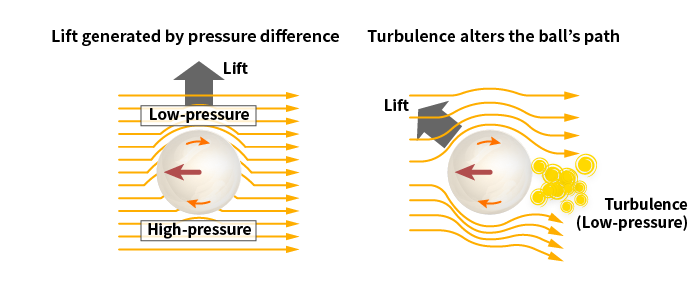
On one side of the spinning ball the air velocity is low, where the streamlines are dense, and on the other side the air velocity is high, where the streamlines are sparse. According to Bernouli’s theorem this difference in pressure results in a lifting force that accounts for the balls’ change in trajectory. The turbulence created at the rear of the ball plays a large role in altering the trajectory of the ball. With this spinning ball, the angle of turbulence is at an angle to the direction of travel. According to the Magnus effect the side with turbulence has less air pressure so force is generated that bends the trajectory.
How HDD Magnetic Heads Fly with Lift
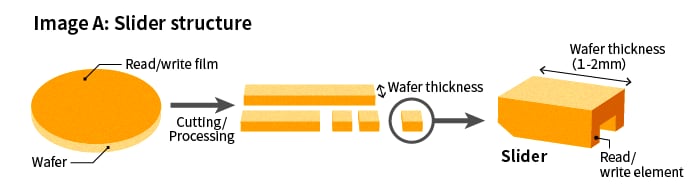
HDD magnetic heads are also related to aerodynamics and lift. The read and write functions of a magnetic head are formed from the combination of many thin-film elements on a wafer using advanced thin-film process technology similar to that used in semiconductor manufacturing. These are cut and processed into chips that are 1 to 2 mm square, which are called sliders (Figure A). The magnetic head is made by attaching the slider to a head gimbal assembly (HGA).
The read/write coils are at the edge of the slider, which read and write while maintaining a very slight amount of levitation (flying) over the disk (platter), which rotates at high speed (Figure B).

As storage capacity improves, levitation gets narrower year by year, and is down to about 10nm (nanometers) or less in recent magnetic heads. To put this into perspective, that’s the equivalent of a jumbo jet flying at top speeds less than 1mm off the runway. This jumbo jet, which weighs several hundred tons, can fly because it gets lift from the air. One side of the slider is cut at an angle in order to allow for smooth air flow generated by disk rotation to reach the bottom of the slider.
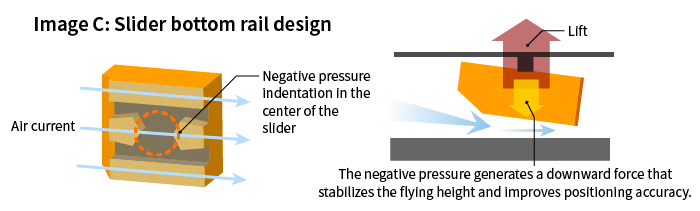
In addition, grooves are carved on the bottom surface of the slider to enhance its aerodynamic characteristics, stabilize the amount of slider lift, and improve positioning accuracy (Figure C). The slider, which also serves as the wing of an aircraft, can thus fly just above the surface of the platter.
TDK’s Magnetic Head

TDK's magnetic head combines a high-sensitivity TMR element and a perpendicular magnetic recording PMR element that enables HDDs to have higher storage capacities and smaller form factors. It is used in PCs and HDD drives, as well as in magnetic heads for nearline storage HDDs, which is used in magnetic heads for near-line HDDs, the data center's mainstay storage, while incorporating new technologies to increase capacity.
Conclusion
Breaking balls curve because rotation reshapes airflow. The combination of spin rate, spin axis, and seam orientation manipulates pressure around the ball, producing lateral or vertical movement. The stitched surface amplifies these effects, allowing pitchers to generate a wide variety of trajectories—sliders with sharp lateral break, curves with downward arc, or shoots that run arm-side.
The article also ties this sports physics to TDK’s domain: the lift mechanism that governs ball movement mirrors the aerodynamic principles used in HDD magnetic head technology. Just as a spinning baseball generates pressure differences that alter its path, the slider structure of a magnetic head rides an air bearing, maintaining a controlled floating height with extreme precision. This parallel underscores how understanding airflow behavior enables advancements both in athletic performance and in high-precision electronic engineering.
FAQ
Q: What physical force makes a curveball break?
A: The Magnus effect—spin creates a pressure imbalance around the ball, pulling it toward the lower-pressure side.
Q: Why do stitches matter for breaking pitches?
A: Seams disrupt airflow differently on each side of the spinning ball, enhancing lift, turbulence, and overall movement.
Q: Why do sliders move differently from curveballs?
A: Sliders use a different spin axis and tighter gyro-like rotation, producing lateral break rather than a deep downward arc.
Q: Does ball speed affect how much a pitch moves?
A: Yes. Higher speed reduces total break time, while slower pitches allow aerodynamic forces to bend the trajectory more noticeably.
Q: How is HDD technology related to breaking balls?
A: Both rely on controlled lift. HDD magnetic heads float above spinning disks using engineered air pressure, similar to how spinning baseballs experience lift-induced movement.
Q: What determines the direction of the break?
A: The orientation of the spin axis—tilt it, and the ball moves toward the side where airflow is slower and pressure is lower.
TDK is a comprehensive electronic components manufacturer leading the world in magnetic technology
Share Share this article
RecommendedPeople who viewed this article also viewed here

Sports Tech@TDK
Making the World Cup More and More Exciting with the VAR System and Football Sensor Technology - Offsides determined by VAR-

Sports Tech@TDK
Importance of Muscle Strength and Oxygen in Basketball Jump Performance
Bridging the Past, Present, and Future of Tech
Quantum Computing Explained: How It Works, Real-World Applications, and Industry Impact
PickUp Contents