


Bridging the Past, Present, and Future of Tech
Quantum Computing Explained: How It Works, Real-World Applications, and Industry Impact
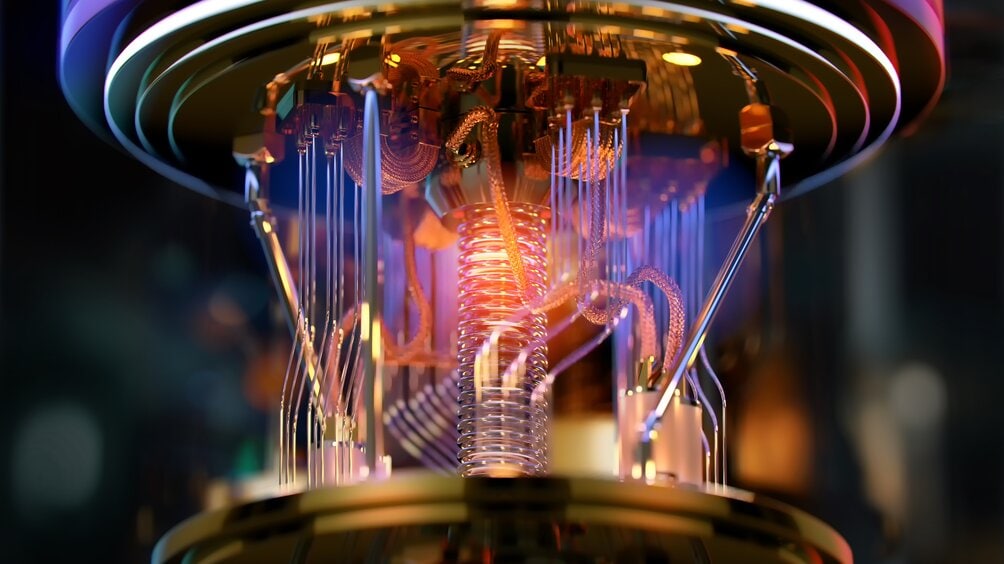
For decades, the “Silicon Age” has been defined by a simple rule: make transistors smaller, and computers get faster. But as we approach the physical limits of the atom, classical chips are hitting a wall. We are now entering the era of quantum computing engineering, a shift that doesn’t just represent a faster computer, but a fundamentally different way of processing the universe.
- Key Takeaways

- The Limit of the Silicon Age
- What Is Quantum Computing?
- How Does Quantum Computing Work?
- Quantum Computing Architecture and the Infrastructure of Cold
- Real-World Applications: What Can Quantum Computing Do?
- The Road Ahead: How Close Are We?
- Conclusion: Engineering a Human-Centered Future
- FAQ
Key Takeaways
1. Classical bits are either 0 or 1. Qubits use superposition and entanglement to hold far more information and work together as one synchronized system.
2. Qubits are extremely fragile. Vibration, heat, or a stray magnetic field causes decoherence, so stability engineering and magnetic shielding are essential.
3. A quantum computer is a hybrid system: a classical computer manages a Quantum Processing Unit (QPU) that is cooled to millikelvin temperatures inside a cryogenic dilution refrigerator.
4. The strongest near-term applications are simulation-heavy problems such as materials discovery, drug development, and large-scale optimization.
5. We are in the NISQ era. Quantum error correction is the next milestone, and TDK’s cryogenic microwave isolators and materials expertise support the infrastructure that makes it possible.
The Limit of the Silicon Age
In classical computing, information is binary. A bit is like a light switch: it is either On (1) or Off (0). As we try to pack billions of these switches into smaller spaces, we run into heat and “tunneling” issues where electricity leaks.
To understand explaining quantum computing to a non-expert, imagine a spinning coin on a table. While it is spinning, it isn’t “Heads” or “Tails,” rather, it is a blur of both. This is the quantum state. A classical computer can only see the coin after it has landed; a quantum computer works with the coin while it’s still spinning.
At TDK, we know that to keep a coin spinning, you need a perfectly stable surface. In the quantum world, TDK’s mastery of magnetic shielding and materials science provides the “steady table” that allows these fragile quantum states to exist without collapsing.
What Is Quantum Computing?
To truly understand what quantum computing does, we have to look at the three pillars of quantum mechanics: qubits, superposition, and entanglement.
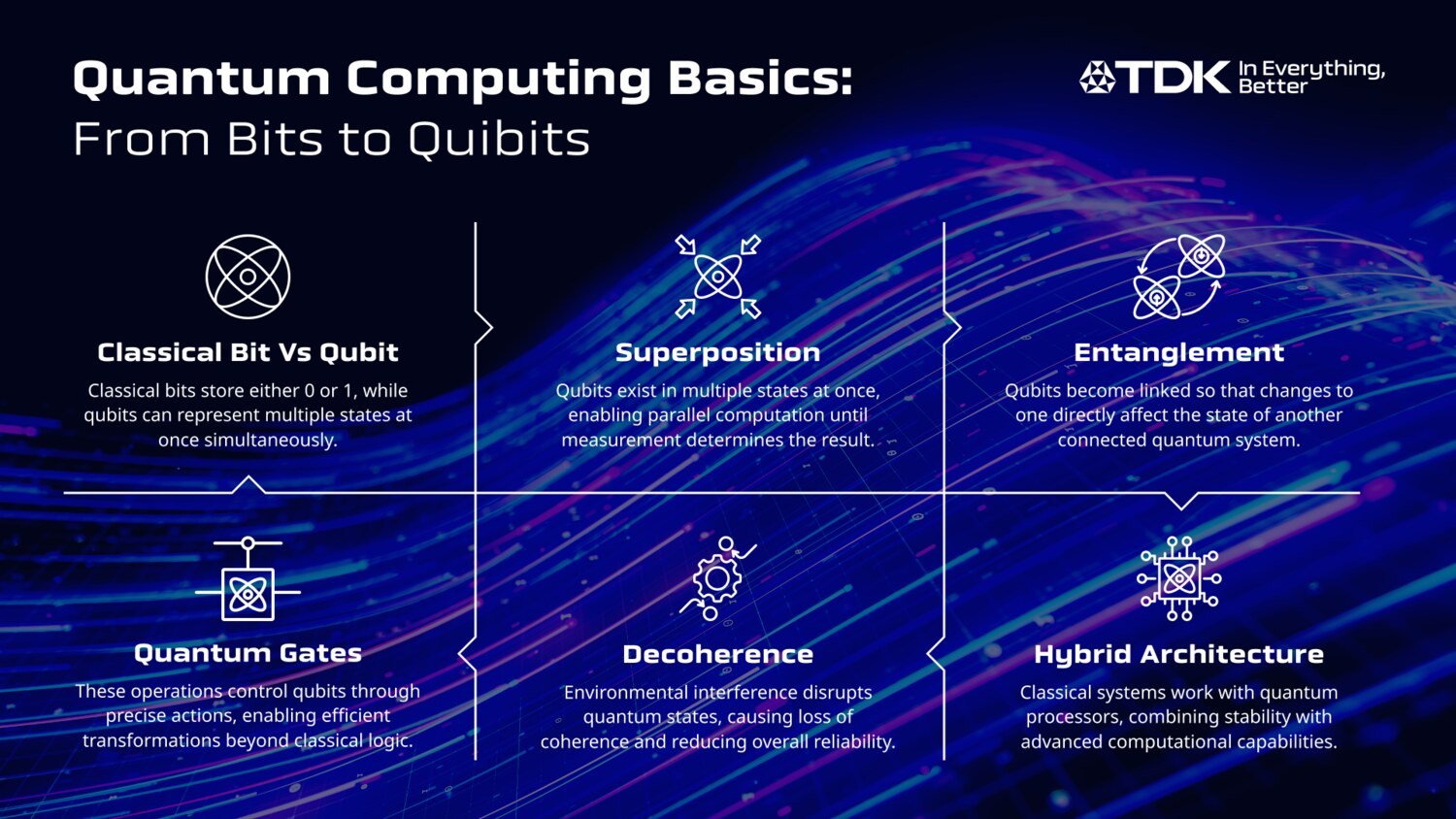
Quantum Computing Basics: From Bits to Qubits.
What is a Qubit in Quantum Computing?
The qubit (quantum bit) is the heart of the system. While a classical bit is stuck in one of two positions, a qubit uses a property called superposition to exist in a linear combination of both states simultaneously. This allows a quantum system to hold more information than a classical one.
Quantum Entanglement
This is what Albert Einstein called “spooky action at a distance.” Quantum entanglement is a unique form of correlation in which two qubits become linked. If you change the state of one, the other changes instantly, no matter how far apart they are. In terms of quantum computing architecture, this allows qubits to work together in a massive, synchronized web rather than processing data one piece at a time.
Quantum Gates and Logic
In quantum computing, we use quantum gates. These are operations that rotate the state of the qubit to steer the probability toward a correct answer. By using quantum algorithms, we can find shortcuts to problems that would take a classical supercomputer thousands of years to solve.
How Does Quantum Computing Work?
Many people ask, “how does quantum computing work?” in a practical sense. It isn’t a standalone box; it is a hybrid architecture. A classical computer acts as the “manager,” while the Quantum Processing Unit (QPU) acts as the specialized engine for complex math.
The Fragility of the State: Quantum Decoherence
The biggest challenge in quantum computing engineering is stability. Qubits are incredibly sensitive. A tiny vibration, a change in temperature, or even a stray magnetic field from a nearby smartphone can cause quantum decoherence. This is when the “spinning coin” hits a microscopic bump and stops spinning, causing the data to vanish.
Quantum Computing Architecture and the Infrastructure of Cold
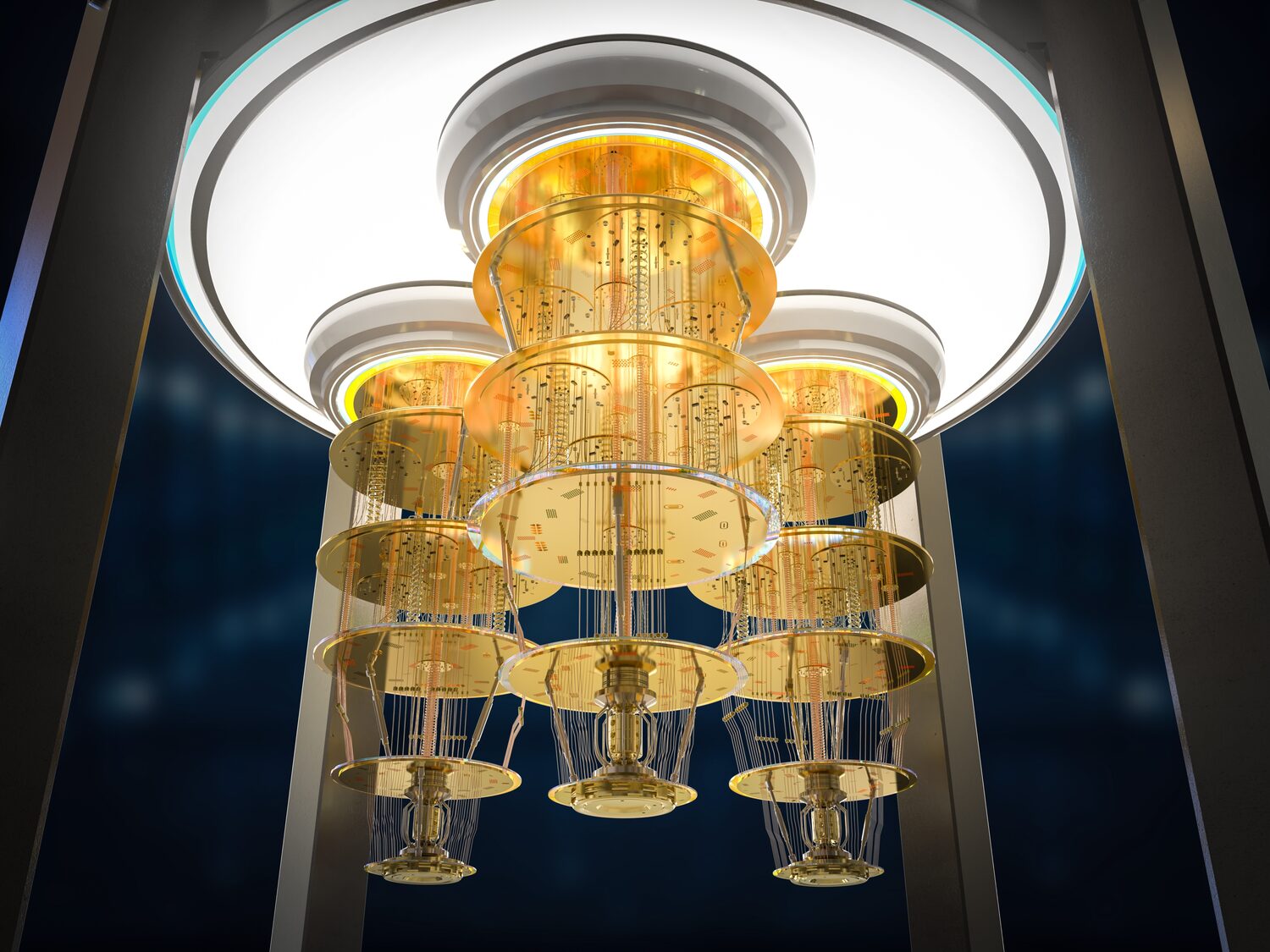
A cryogenic dilution refrigerator, the gold-plated “chandelier” that keeps qubits near absolute zero.
If you’ve ever seen a photo of an IBM quantum computer or a Google quantum processor, you’ve likely seen a gold-plated “chandelier.” This is actually a Cryogenic Dilution Refrigerator.
The Cryogenic Chandelier
Most qubits only work at Millikelvin temperatures, just fractions of a degree above absolute zero, roughly -273°C. This is colder than deep space. The “chandelier” architecture uses cryogenic stages to gradually remove heat until the QPU reaches a state of near-perfect stillness.
Quantum Computing Energy Consumption
There is a common misconception about the energy consumption of these systems. The qubits themselves use almost no power. However, the infrastructure required to keep them cold, and the microwave control lines used to manipulate them require significant energy. As we move toward the future of quantum computing, engineering more efficient cooling systems is a top priority for sustainability.
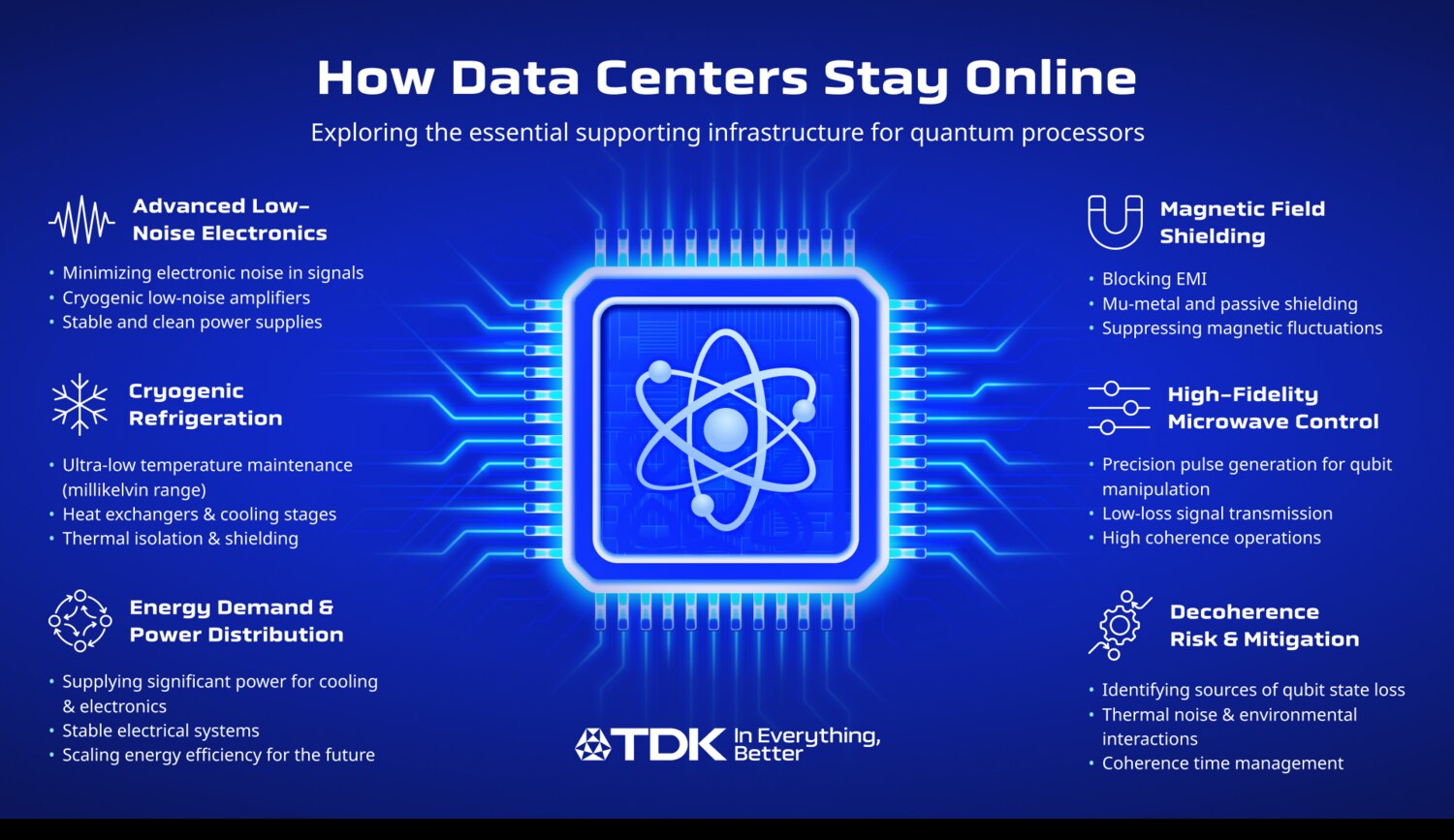
How Data Centers Stay Online: the essential supporting infrastructure for quantum processors.
Real-World Applications: What Can Quantum Computing Do?
Quantum computers are not meant to replace your laptop or smartphone. Instead, they are specialized tools for “Big Math”; problems so complex that the number of possible outcomes grows exponentially, making them impractical for even the most powerful classical computers. Examples include simulating molecular interactions for drug discovery, optimizing global supply chains with millions of variables, and solving large-scale cryptographic or financial models.
Materials Science & Energy
This is a core focus for TDK. Quantum computing architecture allows us to simulate chemistry at the atomic level. We can use these simulations to discover new solid-state battery materials or more efficient materials for magnets. Instead of years of “trial and error” in a physical lab, we can simulate the “perfect” material in a quantum environment.
Quantum Computing in Drug Discovery
Developing a new medicine today involves years of testing how molecules bind together. Many wonder, “What will quantum computing be used for?” in terms of medical discovery. It will allow scientists to simulate molecular bonds with 100% accuracy, potentially reducing the time for pharmaceutical breakthroughs from a decade to just a few weeks.
The Road Ahead: How Close Are We?
We are currently in what researchers call the NISQ era (Noisy Intermediate-Scale Quantum). Nowadays devices have enough qubits to perform impressive feats, sometimes reaching quantum supremacy, where they outperform classical computers at specific tasks, but they are still “noisy” and prone to errors.
The Path to Fault Tolerance
The next major milestone in quantum computing engineering is Quantum Error Correction (QEC). This involves using multiple “physical qubits” to act as a single, stable “logical qubit.”
How to learn about quantum computing: If you are an engineer looking to enter the field, focus on linear algebra and microwave engineering.
Conclusion: Engineering a Human-Centered Future
Quantum computing explained simply is about more than just bits and bytes; it is about unlocking the secrets of the natural world. Whether it is discovering a new life-saving drug or creating a battery that lasts ten times longer, the purpose of quantum computing is to solve the “unsolvable.”
TDK has made great strides in developing and demonstrating cryogenic microwave isolators. These are key components in quantum computing systems built around superconducting qubits. We are proud to provide foundational materials that make this impossible technology a reality. The quantum era is here, and it is being built on a foundation of precision engineering.
FAQ
How much faster is quantum computing?
For specific mathematical tasks, like factoring large numbers or simulating molecules, it is exponentially faster. However, for everyday tasks like browsing the web, it offers no advantage.
Is there a quantum computing for dummies version?
Think of a classical computer as a librarian who reads every book in a library one by one. A quantum computer reads all the books at the same time to find the answer.
How will quantum computing change the world?
By accelerating breakthroughs in sustainable energy, personalized medicine, and artificial intelligence.
Will it replace my PC?
No. Quantum computers will likely remain as cloud-based “accelerators” that handle the world’s most difficult calculations while your classical PC handles the user interface.
TDK is a comprehensive electronic components manufacturer leading the world in magnetic technology
Share Share this article
RecommendedPeople who viewed this article also viewed here
Electronics ABC
Inductors―Part 1 The Basics of Inductors ①
Electronics ABC
Inductors―Part 2 The Basics of Inductors ②
Bridging the Past, Present, and Future of Tech