
Electronics ABC
Inductors―Part 2 The Basics of Inductors ②


Key Takeaways
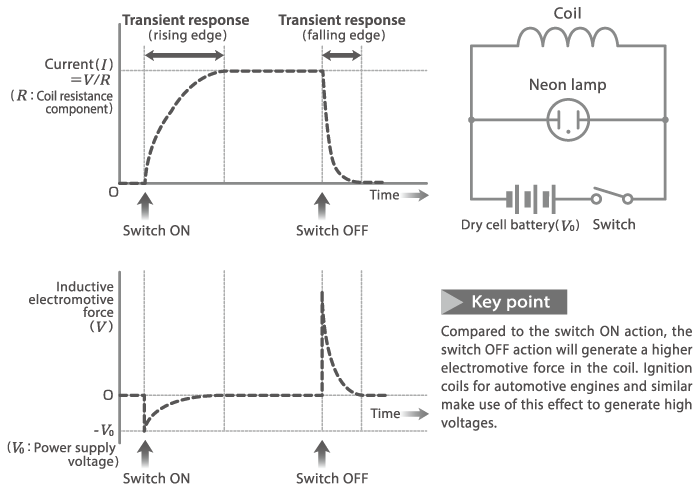
1. Flyback Voltage: Coils oppose current change; at switch-off they can produce a high flyback voltage.
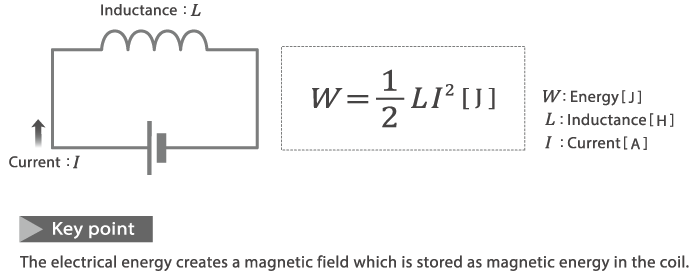
2. Energy Storage: Magnetic energy is stored as W = (1/2) * L * I^2 [J] when current is interrupted, that energy is released.
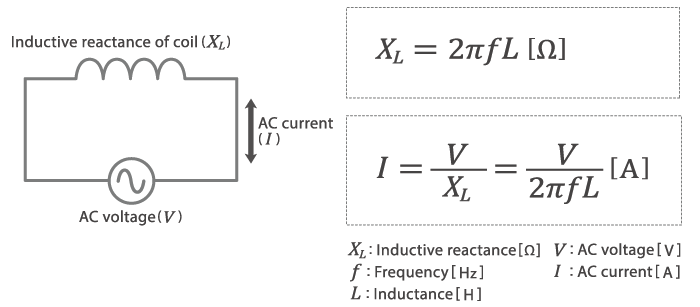
3. Inductive Reactance: Inductive reactance XL = 2πfL rises with frequency-DC passes, AC increasingly resists.
4. Phase Shift (AC): In ideal AC, current lags voltage by ~90° because self-induction opposes change.
5. Cores and Saturation: Cores raise inductance but can saturate; permeability peaks (μₘ) then falls near Bₘ.
6. Energy Loss: Eddy currents waste power as heat; laminations and ferrites curb these losses.
Behavior of an inductor with direct current
Coil transient response
Due to the self induction effect, coils (inductors) produce an electromotive force (inductive electromotive force) that is oriented so as to oppose a change in current. Consequently, when a voltage is applied to a coil, the current does not begin to flow immediately, and when the voltage is removed, the current does not stop immediately. The irregular current or voltage change that occurs for example at the switch ON or OFF point is called the transient response (transient phenomenon) of the coil. For example, in a circuit such as shown below, where a coil and a neon lamp (discharge start voltage at least several tens of volts) are connected in parallel, simply closing the switch of the battery (voltage only a few volts) will not cause the neon lamp to light. But if the switch is opened while a current is flowing through the coil, the neon lamp will light. The electromotive force (V) generated by the coil due to the self induction effect is proportional to the current change ratio (ΔI/Δt). When the switch is set to ON, the current increases gradually, and the electromotive force therefore does not exceed the voltage of the power supply. But when the switch is set to OFF, the flowing current is cut off instantly, which means that the current change ratio is large, causing a large electromotive force to be generated which is sufficient to ignite the neon lamp.
Energy stored by a coil
In the above circuit, the neon lamp can be ignited because the coil stores energy. This energy is proportional to the coil inductance and the square of the current. When the switch is set to OFF, the stored energy is instantly released, creating a high electromotive force.
Behavior of a coil with alternating current
Inductive reactance (XL)
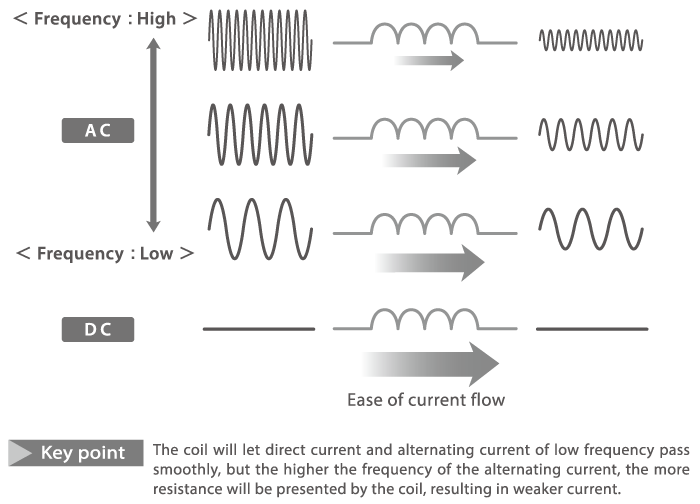
A coil (inductor) passes direct current smoothly, but presents a resistance to alternating current. The resistance increases towards higher frequencies. This effect is called the inductive reactance (XL) of the coil. The following relationship exists between the alternating current frequency (f) and the inductance (L).
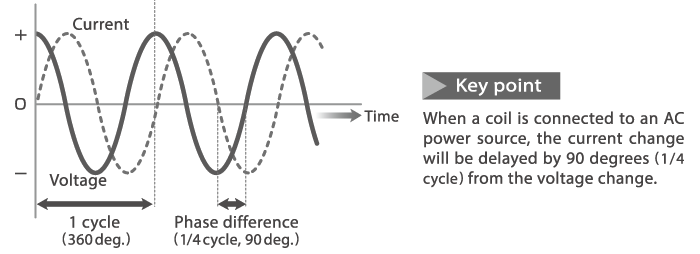
Voltage waveform and current waveform of AC circuit with a coil
The alternating current from a commercial AC outlet has a sine waveform. When a coil is connected to an AC power source, the self induction effect will produce an electromotive force that is oriented so as to oppose a change in current. The change of the current therefore is delayed by 90 degrees (1/4 cycle) with relation to the change in voltage.
Core magnetization and magnetic permeability
Magnetization curve and magnetic saturation
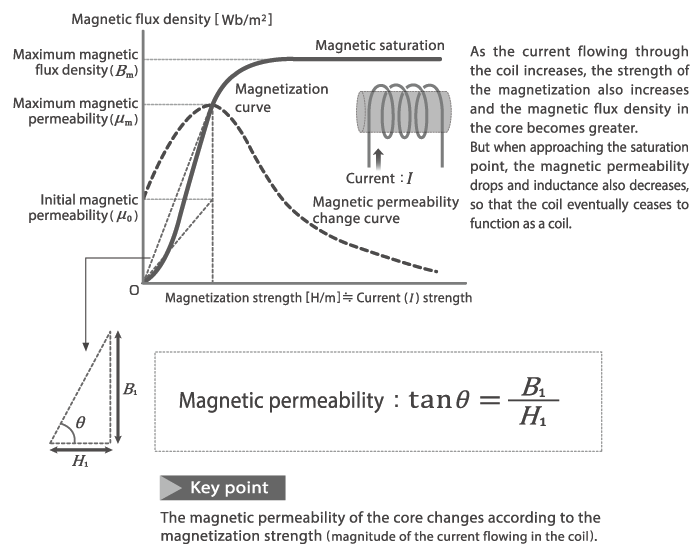
The magnetic flux (Φ) generated in the coil is proportional to the inductance (L) and the flowing current (I). Because the inductance is proportional to the magnetic permeability, using magnetic material with high magnetic permeability and applying a large current will result in a stronger magnetic flux being generated. However, there are limits to the capability of the magnetic material to collect magnetic flux, and when the current is increased past a certain point, the core will reach magnetic saturation. The magnetic flux density (B) at this point is called the maximum magnetic flux density (Bm).
Core magnetization process and change in magnetic permeability
As the core gets magnetized, the magnetic permeability of the core changes. As shown in the graph below, the magnetic permeability (μ) is expressed by the gradient of the core's magnetization curve (θ). The initial gradient near the origin of the curve is the initial magnetic permeability (μ0). This initial magnetic permeability is what is generally called the magnetic permeability, and it also is the value that is noted in catalogs for ferrite materials. Increasing the current in the coil and thereby increasing magnetization will eventually cause magnetic permeability to reach its maximum possible value. This is called the maximum magnetic permeability (μm), beyond which the value falls again.
Eddy current loss in core
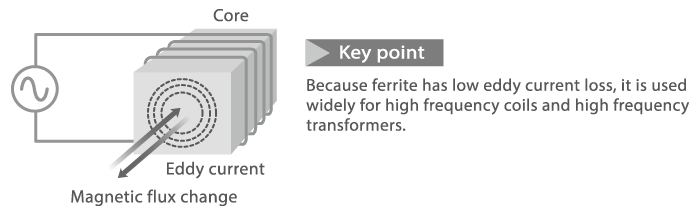
When an AC current is supplied to a coil, an electromotive force is generated which opposes change in the magnetic flux, and a concentric current flows in the core. This is called the eddy current, and it deprives the system of the power RI2 (R: resistance, I: current) which escapes as Joule heat. This is called the eddy current loss. With metal cores whose electric resistance is low, the eddy current loss is more pronounced. The laminated cores used for power transformers are an attempt to reduce eddy current losses. However, losses will increase towards higher frequencies, causing more heat to be produced. Because ferrite has high specific resistance, eddy current losses are low, making the material suitable for many applications such as high frequency coils and high frequency transformers.
Conclusion
Inductors store energy in magnetic fields and fight fast current changes, which explains both flyback spikes at turn-off and rising opposition to AC with frequency. Cores boost inductance but bring real-world limits: permeability varies with magnetization and collapses at saturation, while eddy currents waste power unless managed. Understanding these behaviors-transients, Xₗ, μ, and losses-is the foundation for choosing coil geometry and core material that behave as intended across DC and AC conditions.
FAQ
What is the transient response of a coil?
The brief, non-steady behavior when switching. On turn-off, ΔI/Δt is large, inducing a high voltage.
Why can a low-voltage battery light a neon lamp when the switch opens?
The coil’s induced EMF at turn-off can exceed the supply, briefly creating a high enough voltage to strike the lamp.
How does an inductor behave with AC vs DC?
It passes DC once the current stabilizes, but resists AC with reactance XL = 2πfL, which increases with frequency.
Why does current lag voltage in an inductor?
The induced EMF opposes changes in current, delaying the current waveform about a quarter cycle.
What is magnetic saturation?
A core’s limit: increasing current no longer yields proportional flux; permeability drops after peaking near μₘ.
Why use ferrite or laminated cores?
To cut eddy-current loss-laminations raise path resistance in metals; ferrites have intrinsically high resistivity.
What sets the energy a coil can release at turn-off?
Inductance and current: W = (1/2) * L * I^2 [J] Higher L or I means a larger stored—and suddenly released—energy.
TDK is a comprehensive electronic components manufacturer leading the world in magnetic technology
Share Share this article
RecommendedPeople who viewed this article also viewed here
Electronics ABC
Inductors―Part 3 Inductor Types and Manufacturing Methods
Electronics ABC
Capacitors, Part 1 The Basics of Capacitors
Bridging the Past, Present, and Future of Tech
Quantum Computing Explained: How It Works, Real-World Applications, and Industry Impact
PickUp Contents