
The Wonders of Electromagnetism
What is Ballast, and How Has it Shaped the Automotive and Other Industries?
The ballast, an indispensable component in fluorescent and other lighting fixtures, ensures stable illumination by suppressing rapid voltage increases. Ballasts tailored for discharge lamps, including fluorescent lamps, neon tubes, and HID lamps, have undergone extensive research and evolution. The field of lighting holds promising prospects, with expectations centered around energy and resource efficiency, environmental friendliness, and longer service lives.
- Key Takeaways

- Ballast is a crucial counterweight that ensures ship stability
- Gas-discharge lamps require ballasts for current stabilization
- The role of ballasts for fluorescent lights
- High-intensity discharge lamps need electronic ballasts to fire up
- TDK’s compact, high-performance switching spark gap (SSG)
- LED technology: the fourth generation of lighting
- Conclusion
- FAQ
Key Takeaways
1. The term ballast originated in shipping—denoting counterweight water that stabilizes unloaded vessels—and was later applied metaphorically to devices that stabilize electric currents.
2. In gas-discharge lamps (fluorescent, neon, HID), ballasts regulate current flow; without them, current would rise uncontrollably once discharge begins, destroying the lamp.
3. Traditional choke ballasts used iron-core coils to stabilize AC current and provide startup voltage by releasing stored magnetic energy.
4. The shift to electronic ballasts, using ferrite-core transformers, enabled compact, lightweight lighting systems with improved efficiency and reduced flicker.
5. HID automotive lamps (metal-halide types) rely on advanced electronic ballasts integrating DC–DC converters, inverters, control, and ignition circuits to deliver stable, high-voltage startup.
6. TDK’s Switching Spark Gap (SSG) serves as a high-performance igniter component—faster, longer-lasting, and more reliable than traditional glow starters—used in headlights, projectors, and gas igniters.
7. LEDs, the “fourth generation” of lighting, surpassed HID in efficiency and durability. Although they require lower voltage, precise current control via dedicated LED drivers (power supplies) remains essential.
8. Lighting technology continues evolving toward OLEDs and other advanced materials, where uniform light emission and flexible form factors define the next phase of illumination.
Ballast is a crucial counterweight that ensures ship stability
The weight of a ship, exemplified by the expression “a 300,000-ton tanker,” is calculated through its displacement tonnage, a concept rooted in Archimedes’ principle. It states that a ship’s weight is equal to the weight of the water displaced when the ship is afloat, making displacement a practical indicator for expressing a ship’s weight.
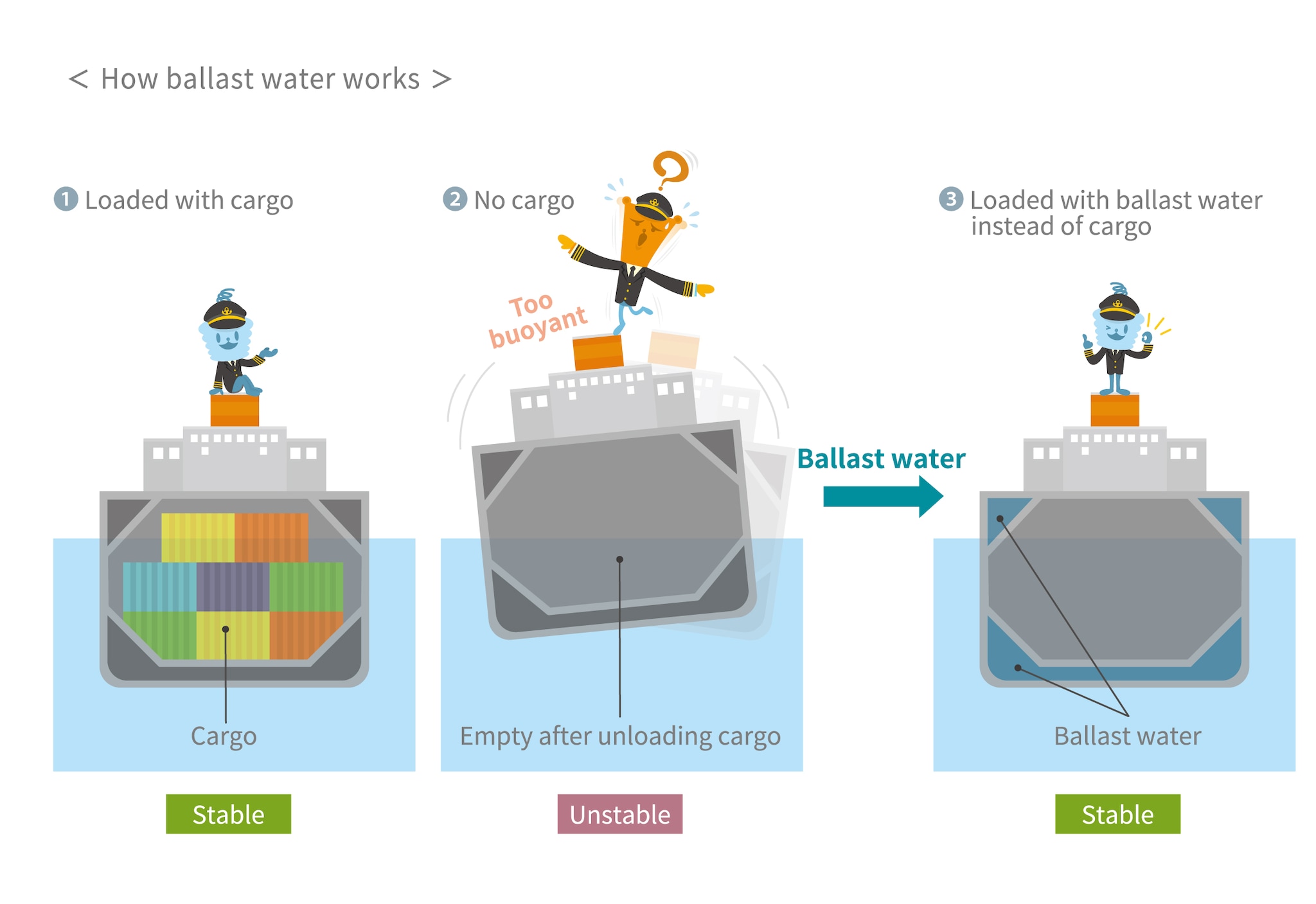
Tankers and cargo ships are designed to be stable when loaded with cargo. Once they are unloaded, they rise higher on the water surface due to buoyancy and become less stable. To counter this problem, seawater is pumped into ballast tanks located at the bottom or under the vessel to serve as weight to maintain stability. This water is commonly known as ballast water.
Gas-discharge lamps require ballasts for current stabilization
A gas-discharge lamp illuminates by generating an electric discharge within a sealed glass tube containing a mixture of gases, such as neon and xenon, along with metal vapors like mercury and sodium. The lamp is started up by applying a high voltage to the electrodes. But once the process begins, an unlimited amount of current will flow if left uncontrolled, which could lead to the lamp’s destruction. To prevent this, gas-discharge lamps have a component called an electrical ballast, named in analogy to weight stability on ships.
The role of ballasts for fluorescent lights
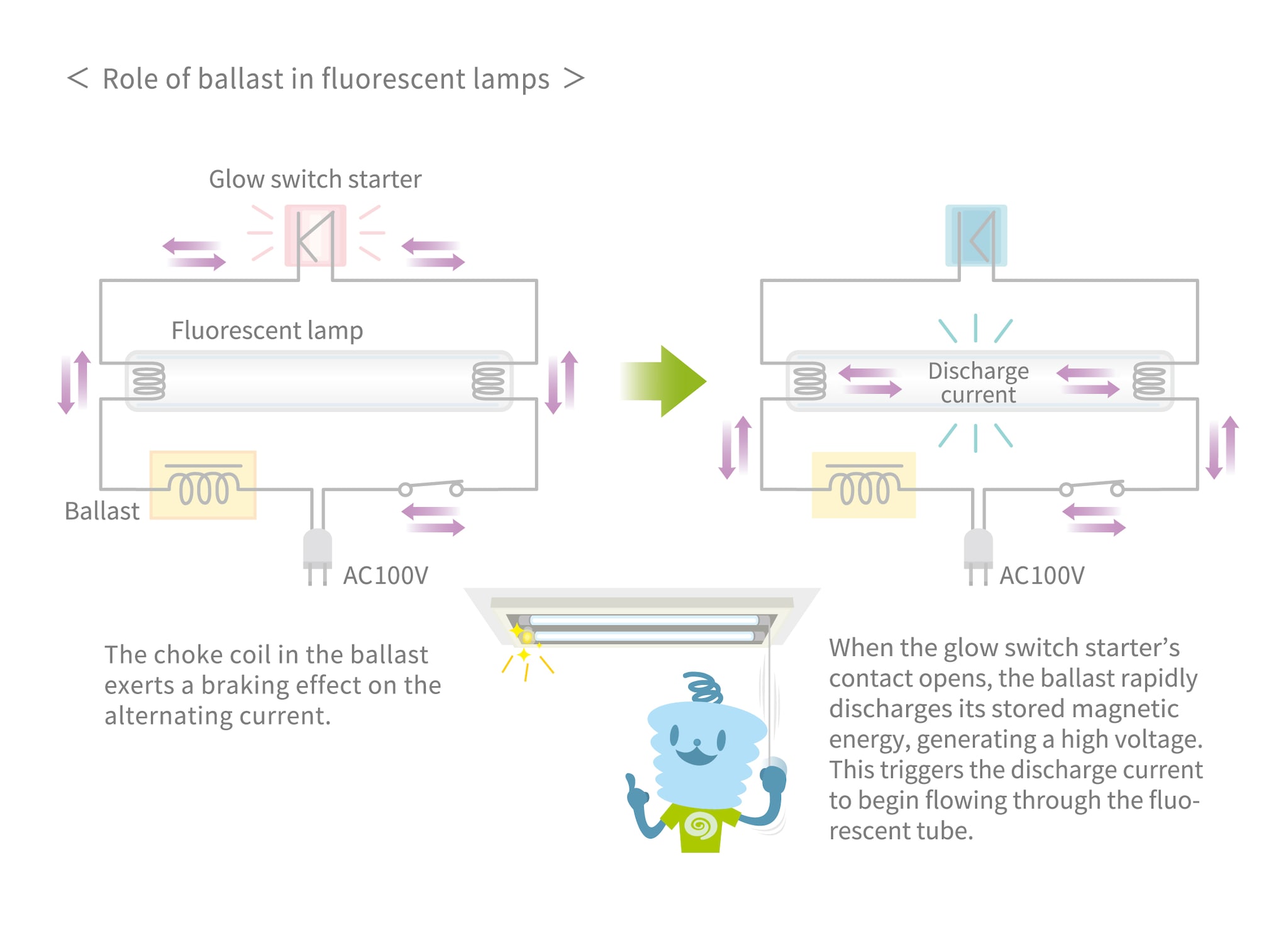
Discharge lamps and fluorescent lamps share similar characteristics. Traditionally, choke ballasts, which are inductors made of coils wound around iron cores, have been used with fluorescent lamps. Coils are effective in stabilizing current and preventing it from fluctuating or spiraling out of control. When a coil applies a braking effect on alternating current, it stores electrical energy in the form of magnetic energy. The high voltage required to turn on fluorescent lamps is conveniently supplied by rapidly releasing this stored magnetic energy.
High-intensity discharge lamps need electronic ballasts to fire up
There are three basic types of fluorescent lights, distinguished by their starting methods: electronic ballast (also known as an inverter), rapid start, and glow switch. Electronic ballasts, commonly found in rapid start fixtures, are compact and lightweight. They use transformers constructed with ferrite cores instead of heavy choke coils wound around iron cores.
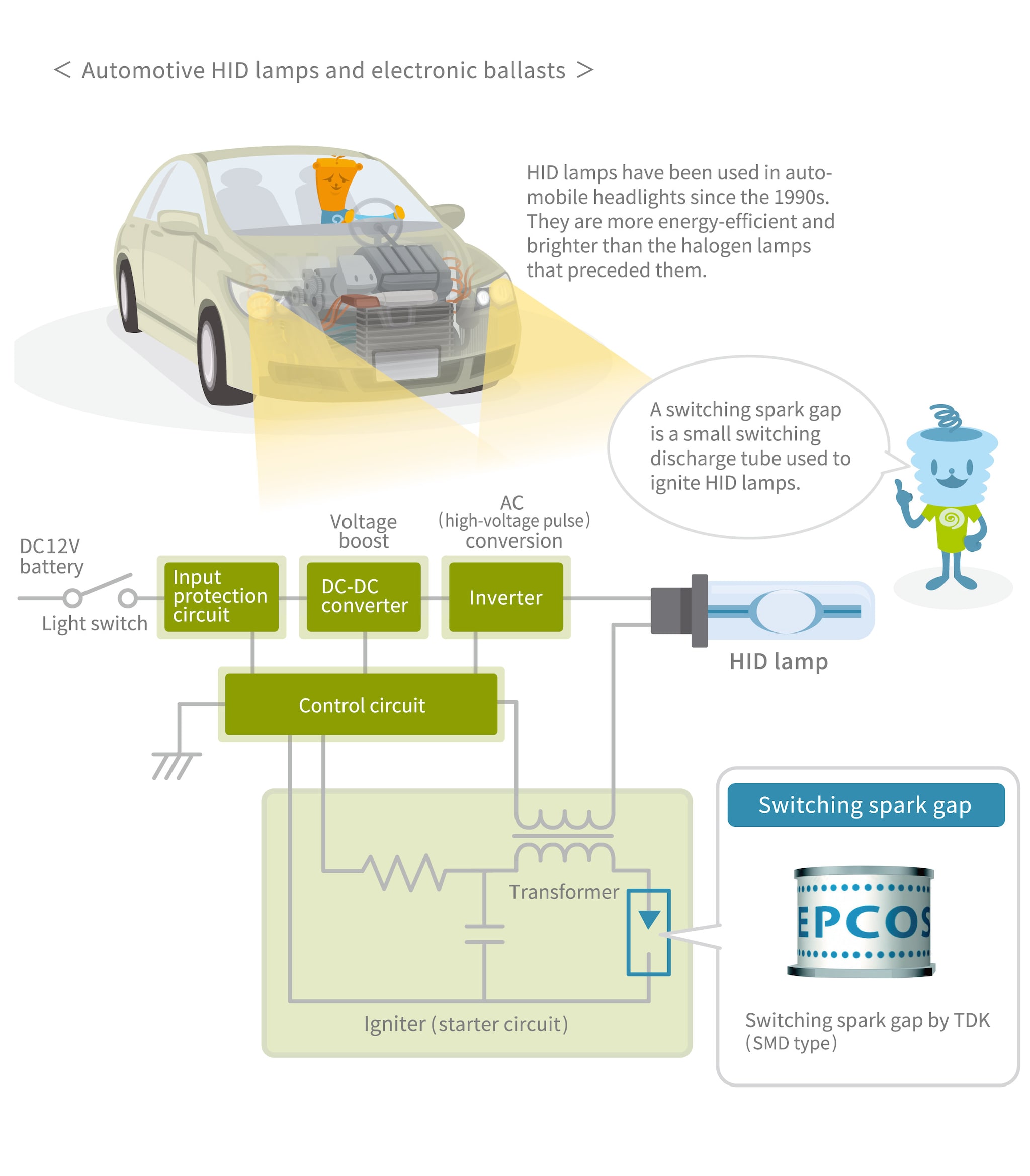
High-intensity discharge (HID) lamps, such as metal-halide (MH) lamps, are commonly used in automotive headlight systems and require electronic ballasts. Halogen lamps, which came before HIDs, were enhanced versions of incandescent bulbs. They emit light by simply passing a current through a filament and do not require a complex electronic circuit. HID lamps, on the other hand, are gas-discharge lamps that require high voltages and the use of electronic ballasts. Despite the increased costs, the benefits of this technology—including high luminous efficiency, energy efficiency, and long service life—have led HID lamps to become popular in the automotive headlight industry since the 1990s, replacing halogen lamps.
An electronic ballast for starting an automotive HID lamp consists of multiple components, including a DC-DC converter to boost the battery’s 12-volt voltage, an inverter to convert the boosted DC into high-voltage pulses, a control circuit to maintain stable lighting conditions, and an igniter circuit to initiate the discharge by applying a high voltage to the HID lamp’s electrodes.
The igniter circuit incorporates an electronic component known as a switching spark gap (SSG), the equivalent of a glow switch starter used in fluorescent light fixtures.
TDK’s compact, high-performance switching spark gap (SSG)
The SSG, like the glow switch starter, is a small discharge tube. It is a switching element with a simple structure consisting of electrodes facing each other within a gas-filled container. When a certain voltage level is applied to the electrodes, a discharge occurs, releasing a burst of current. This current generates a high-voltage starting pulse on the secondary side of a connected transformer, which initiates the discharge and ignition of the HID lamp. SSGs have several advantages over glow switch starters. They feature minimal power loss during discharge, sustain long service lives, and exhibit exceptional stability. Because of these qualities, their applications are not only in automotive headlights and HID lamps in LCD projectors but also in devices like gas stove igniters. TDK offers a variety of compact, high-performance SSGs, including lead-type and SMD-type variants. For additional information, please visit the Product Center.
LED technology: the fourth generation of lighting
LED technology, known for even better energy efficiency than HID, has gained significant traction in hybrid electric vehicles (HEVs). Since LEDs are point sources of light, they must be structured in arrays to be used in headlights. This paradox has actually led to more freedom in lamp shapes, enabling innovative headlight designs that were previously unthinkable.
LEDs are diodes that emit light when a voltage above a certain threshold is applied, allowing current to flow. Although LEDs do not require high voltages like HID lamps, they do require a dedicated power supply to regulate voltage and current effectively. Otherwise, the LEDs may experience shorter service lives or outright failure.
Many applications rely on LEDs, such as billboards and illumination. Quality power supplies are crucial for maximizing the advantages of LEDs, like energy efficiency and longevity. TDK offers a broad selection of LED power supplies, including products specifically designed for outdoor LED devices.
LED bulbs are replacing incandescent bulbs in homes, as they consume less power and last longer. With built-in power supplies and bases adhering to existing socket standards, transitioning to LED lighting is as simple as swapping incandescent bulbs with their LED counterparts. Other forms of lighting like ceiling lights can be shifted to LED technology by replacing the entire fixture. However, replacing conventional linear fluorescent tubes with LED versions requires caution, as wiring specifications may differ. While some products can be used without modifying the existing fluorescent fixture, they usually require installation by a qualified electrician.
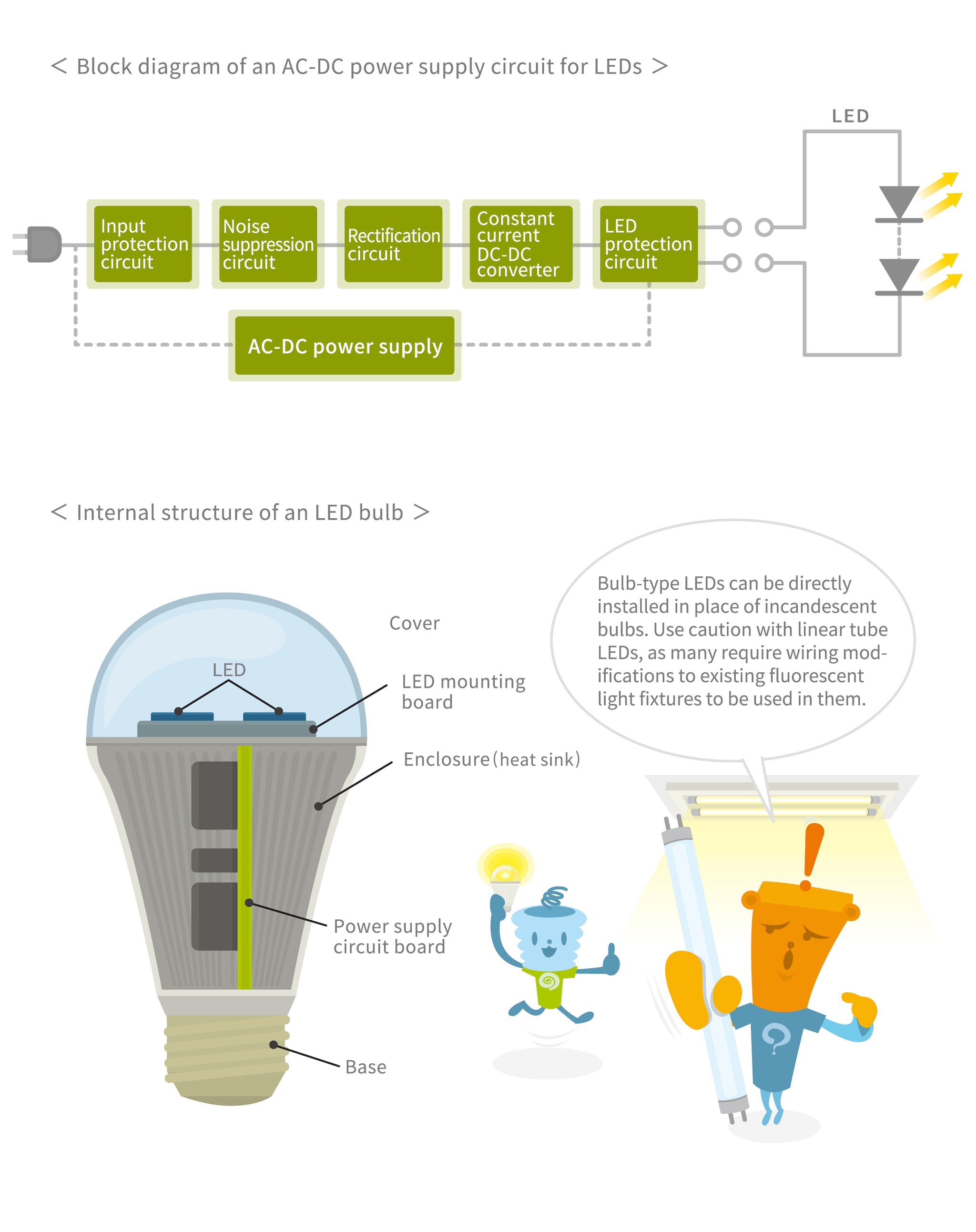
LED lighting is often considered to represent the fourth generation of illumination, succeeding candles and kerosene lamps (first generation), incandescent lamps (second generation), and fluorescent lamps (third generation). The lighting based on organic light-emitting diode (OLED) technology is the next generation after LEDs. The entire surface of OLEDs glow, in contrast to LEDs, which shine as points of light. The evolution of lighting continues, promising even more innovation and possibilities in the landscape ahead.
Conclusion
From ship stabilization to current regulation in lighting systems, the concept of ballast has evolved from maritime mechanics to electrical engineering. Traditional inductive ballasts paved the way for electronic circuits and, later, precision power control in HID and LED systems. TDK’s innovations—especially compact ferrite-core transformers and switching spark gaps—have powered this evolution, improving energy efficiency, miniaturization, and reliability. As lighting enters its OLED era, the ballast’s legacy lives on in every circuit that balances energy, ensuring stable, efficient illumination for a connected world.
FAQ
Q: Why are ballast devices named after ship ballast?
A: The term was borrowed because both perform stabilizing functions: ship ballast maintains physical balance; electrical ballast maintains current stability in discharge lamps.
Q: What happens to a fluorescent or HID lamp without a ballast?
A: Once ionized, gas in the lamp would draw uncontrolled current, overheating and destroying the electrodes. The ballast limits and regulates this current.
Q: What distinguishes choke ballasts from electronic ballasts?
A: Choke ballasts rely on heavy iron-core inductors operating at mains frequency, while electronic ballasts use ferrite-core transformers at higher frequencies, making them lighter, more efficient, and flicker-free.
Q: How do HID headlight systems start?
A: They use an electronic ballast with a DC–DC booster, inverter, and igniter circuit to produce high-voltage pulses that initiate gas discharge and maintain steady light output.
Q: What is a Switching Spark Gap (SSG)?
A: A compact discharge tube that generates high-voltage ignition pulses when triggered. TDK’s SSGs are efficient, durable, and used beyond automotive lighting—in projectors and ignition systems.
Q: Do LEDs need ballasts?
A: No, but they require constant-current drivers that serve a similar stabilizing purpose—regulating voltage and current to protect LEDs and ensure consistent brightness.
Q: How has LED lighting influenced design?
A: LEDs’ compact, point-source nature allows for creative headlight and architectural designs, while arrays or panels can produce high-lumen outputs in smaller, flexible spaces.
TDK is a comprehensive electronic components manufacturer leading the world in magnetic technology
Share Share this article
RecommendedPeople who viewed this article also viewed here
Intro to EMC Topics
The Basics—Part 1: What is Noise? What is EMC? The Noise Problem is an Electronic Affliction in Modern Society
Intro to EMC Topics
The Basics—Part 2: Tracing the Invisible—The Roots and Types of Noise
Bridging the Past, Present, and Future of Tech
Quantum Computing Explained: How It Works, Real-World Applications, and Industry Impact
PickUp Contents