
Sports Tech@TDK
Essential Technology for Accurate Hot Air Ballooning

Hot air ballooning relies on a simple principle: heat the air inside the envelope and ride the surrounding wind currents. This basic idea forms the foundation of modern balloon technology and explains what powers a hot air balloon at its core. While many people associate hot air ballooning with sightseeing, the sport has evolved into a highly technical discipline.
Today, various hot air balloon sports involve precision flying, where pilots adjust altitude to catch the right winds and approach a designated target. These events highlight the practical uses of hot air balloons beyond tourism and show how balloon tech has advanced to support navigation, measurement, and accuracy during flight.
- Key Takeaways

- A Competition to See How Close To the Target You Can Drop a Marker
- Maneuver by Adjusting Altitude and Riding the Wind
- Evolution of Barometric Pressure Sensors
- Miniature Pressure Sensor Using Piezoresistive Effect
- Pressure Sensors in a Wide Variety of Products
- TDK's SmartPressure™ Series of Barometric Pressure Sensors
- Conclusion
- FAQ
Key Takeaways
1. Hot air balloon competitions require precise altitude control, since even small vertical shifts allow pilots to enter different wind layers and change horizontal direction.
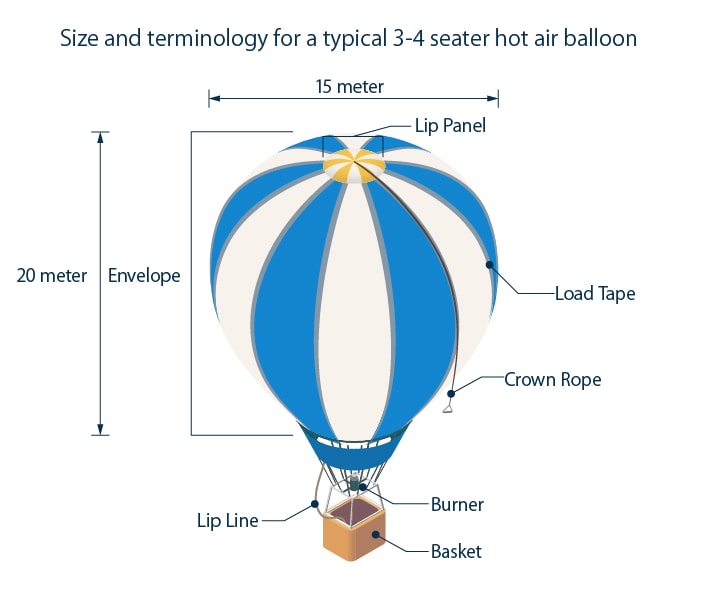
2. The diagrams on page 1 show balloon structure (envelope, burner, basket, rip panel) and illustrate competitive tasks where pilots drop markers as close as possible to a ground target.
3. Successful maneuvering depends on understanding how wind direction varies with altitude; ascending and descending strategically lets pilots ride different air currents to reach a chosen path.
4. Barometric pressure sensors enable accurate altitude estimation by detecting subtle changes in atmospheric pressure—a critical requirement for balloon navigation.
5. Page 2 explains the evolution of pressure sensors toward piezoresistive MEMS structures, which measure minute diaphragm deformation caused by pressure differences.
6. TDK’s SmartPressure barometric sensor lineup provides high-resolution, low-noise altitude data for use not only in ballooning but also in drones, wearables, smartphones, and industrial devices.
A Competition to See How Close To the Target You Can Drop a Marker
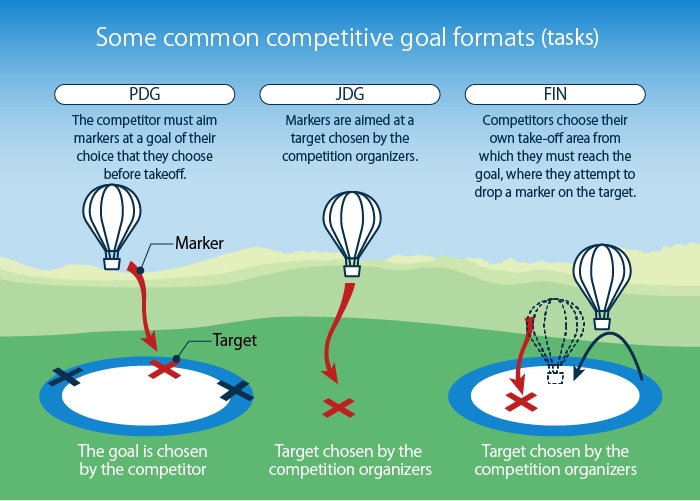
Some hot-air balloon competitions consist of contestants who race to see who can arrive at the designated destination first. However, most competitions are more about seeing how close they can get to a given goal when piloting their hot-air balloon. In most formats a marker (a small bag of sand) is dropped from the air aimed at the finish line, the distance between the marker and the goal is then measured and standings are determined based on the order of proximity to the goal.
A typical three- or four-passenger balloon stands around 20 meters tall with a diameter of roughly 15 meters. These numbers represent the most common hot air balloon dimensions and give a clear sense of how big modern hot air balloons are. Structurally, the system is divided into several essential components: the envelope, the burner, and the basket.
These core parts of a hot air balloon work together to generate lift, control altitude, and provide space for passengers and equipment. Whether examining different types of hot air balloons or comparing hot air balloon sizes, the fundamental layout remains the same across most recreational and competitive models
The guidelines for when a competitor gets into the basket and drops a marker on a target are called “tasks.” There are 20 different types of tasks, the most common of which are listed below.
・PDG:Competitors drop markers at a “goal” they choose before takeoff
・JDG:Competitors drop markers at a “target” determined by the competition organizers
・FIN:Competitors choose their own takeoff spot and then must drop a marker at the goal or target
Maneuver by Adjusting Altitude and Riding the Wind
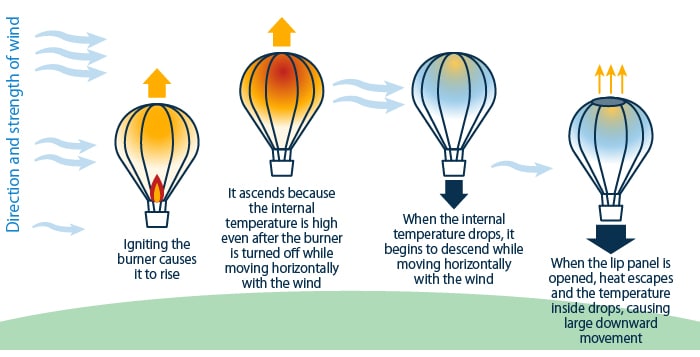
So how do hot air balloons maneuver toward their destination? Because hot air balloons have no engines or propellers, they cannot steer like conventional aircraft. Instead, pilots rely on altitude changes to catch wind layers moving in different directions. This technique forms the basis of the science of hot air balloons, showing how do hot air balloons use temperature and wind rather than powered thrust.
This vertical control is also central to the working of hot air balloon systems. Heating the air increases lift and allows the balloon to climb, while releasing hot air lowers altitude. Competitive flights often depend on keeping a precise hot air balloon height, adjusting it repeatedly to ride the most favorable currents and approach a target with accuracy. This is how altitude is controlled, by adjusting the temperature inside the balloon.
Since it is necessary to know about the surrounding conditions, hot air balloons are equipped with an array of instruments such as altimeters, ascent/descent gauges, balloon-cover thermometers and GPS.The altimeter indicates the current flight altitude, while the ascent/descent indicator shows whether the balloon is ascending or descending and the speed at which it is moving. The balloon-cover thermometer is a sensor attached to the top of the balloon that measures the balloon's temperature. GPS receives radio signals from satellites to determine the latitude and longitude and display the balloon's current position.
Of these instruments, the altimeter is the most important piece of equipment for finding and riding the desired winds. The key component of the altimeter is the barometric pressure sensor. By measuring the atmospheric pressure, which changes with altitude, the accurate altitude of the balloon can be calculated.
Evolution of Barometric Pressure Sensors
Barometric pressure sensors, which can measure the atmospheric pressure that changes with altitude, have a long history. It is said that the origin of the barometric pressure sensor was a mercury barometer made by Italian physicist Torricelli in 1643, which contained mercury in a glass tube. Incidentally, a torr, a unit of pressure still used today, is named after Torricelli.
With the invention of the barometer, it was learned that atmospheric pressure changes daily. It was also learned that atmospheric pressure correlates with weather conditions, such as an increase in atmospheric pressure on sunny days and a decrease in atmospheric pressure on rainy days. When voyages from Europe to the Pacific and Indian Oceans became popular, barometers became indispensable tools for sailors to predict stormy weather and avoid dangers such as capsizing.
Miniature Pressure Sensor Using Piezoresistive Effect
Currently, the most widely used barometric pressure sensors are semiconductor pressure sensors that utilize the piezoresistive effect. It is based on the phenomenon that, when pressure is applied to a certain type of semiconductor, its electrical resistance changes. Piezo is a Greek word meaning to push or compress.
Many of the pressure sensors used in smartphones, altimeters in wristwatches, and diver's watches that display water depth are of this piezoresistive type. The major difference from conventional pressure sensors is that a large number of sensor elements are formed on a wafer to make a chip, similar to ICs and other types of sensors. The manufacturing method and the principle of the sensor are briefly summarized here.
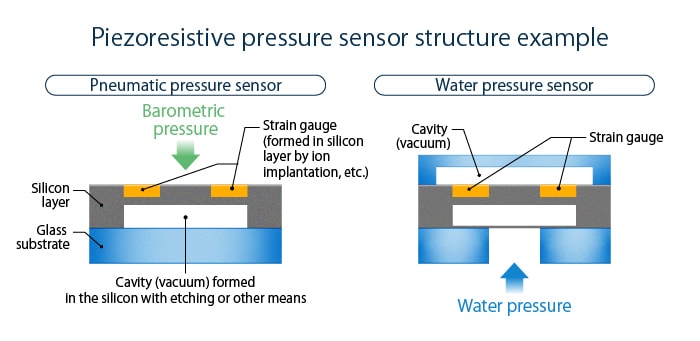
First, a layer of silicon with small cavities etched into it is placed on top of a glass substrate. This cavity serves as a diaphragm that expands and contracts with changes in atmospheric pressure. Next, a piezoresistive part (or rather a strain gauge) is formed on the thin silicon surface that is the roof of the cavity. The piezoresistive pressure sensor is also called a diffusion resistive pressure sensor because the semiconductor process technology that injects (diffuses) impurity ions into the silicon layer is the mainstream method for this process. When the thin silicon surface above the cavity (diaphragm) deflects due to changes in atmospheric pressure, the electrical resistance changes due to the piezo-resistance effect of the strain gauge. This is processed and amplified by an electronic circuit to display the pressure.
Pressure Sensors in a Wide Variety of Products
Piezoresistive pressure sensors are applied not only in smartphones and wearable devices, but also in automobiles, factory automation equipment and other home appliances. For example, in air conditioners and vacuum cleaners, air pressure is controlled to achieve energy-saving and efficient operation. They are also used in rice cookers to cook fluffy and tasty rice with fine pressure detection. Barometric pressure sensors are also indispensable for drones that fly freely in the sky to detect altitude. MEMS, which has been attracting attention in recent years, is a technology that integrates sensors, electronic circuits, and actuators on a substrate by applying semiconductor manufacturing technology. In addition to advanced MEMS barometric pressure sensors, TDK offers an extensive lineup of various pressure sensors that can be applied to a wide range of applications.
TDK's SmartPressure™ Series of Barometric Pressure Sensors
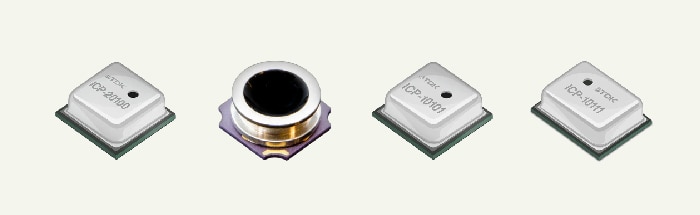
Our barometric pressure sensor is made with innovative capacitive MEMS architecture, featuring low power consumption and low noise compared to competitors' products. It has extremely high sensitivity and accuracy, and can detect a difference in height of as little as 5 cm, which is less than the height of a single stair step. It is used in various mobile devices such as smartphones, tablets, wearables, and drones.
Conclusion
Precise altitude control is the core of competitive and recreational hot air ballooning. Because wind direction changes at different heights, balloon pilots rely on vertical movement—ascending into one air stream or descending into another to navigate horizontally without steering mechanisms. This makes accurate pressure-based altitude measurement essential. The article’s illustrations show how altitude shifts align with strategic goals during competitions and how barometric sensors enable consistent, real-time altitude tracking.
The page also outlines how sensor technology has evolved from simple mechanical approaches to advanced piezoresistive MEMS designs capable of detecting extremely small pressure variations. TDK’s SmartPressure series brings this capability into a compact, stable form suitable for a wide range of consumer and industrial applications, reinforcing how high-precision environmental sensing underpins both sports navigation and modern electronic ecosystems.
FAQ
Q: Why can’t hot air balloons steer like airplanes?
A: Balloons lack horizontal thrust or control surfaces. Direction depends entirely on following wind currents at different altitudes.
Q: How do pilots navigate without steering?
A: By changing altitude. Each altitude band may have wind blowing in a different direction, allowing pilots to “ride” the desired air stream.
Q: Why are barometric sensors critical for ballooning?
A: Altitude must be controlled within fine margins to enter the correct wind layers. Barometric sensors detect tiny pressure changes that correspond to altitude shifts.
Q: What is a piezoresistive pressure sensor?
A: A MEMS sensor that measures diaphragm deformation caused by atmospheric pressure. The deformation changes electrical resistance, which is converted to pressure data.
Q: Where else are barometric sensors used?
A: Drones, smartphones, wearables, automotive systems, indoor navigation, altitude-based step counting, and environmental monitoring.
Q: How do pressure changes translate into altitude?
A: Atmospheric pressure decreases predictably with height. Sensors measure this pressure drop and calculate the corresponding altitude using standard atmospheric models.
TDK is a comprehensive electronic components manufacturer leading the world in magnetic technology
Share Share this article
RecommendedPeople who viewed this article also viewed here

Sports Tech@TDK
The Art of Precise Attachment: What Do Boccia and Magnets Have in Common?

Sports Tech@TDK
Unexpected Relation Between Blind Soccer and Self-Driving Cars, Perceiving Surroundings with Sound
Bridging the Past, Present, and Future of Tech
Quantum Computing Explained: How It Works, Real-World Applications, and Industry Impact
PickUp Contents