
The Wonders of Electromagnetism
When Were Coils and Magnets Born?

TVs, radios, computers, and smartphones, as well as refrigerators and microwave ovens, medical and industrial equipment, trains, cars, satellites, and even rockets. Through all these things, electricity and magnetism play an integral role in our everyday lives.
However, as technologies become more advanced, the inner workings of devices and their underlying principles become increasingly opaque and harder to comprehend. These “black boxes” are tightly packed with discoveries and inventions—and leaving them unopened would be a sorely missed opportunity.
This series of articles, named The Wonders of Electromagnetism, will pry open these black boxes and shed light on the wisdoms hidden inside. We hope it will help reinvigorate people’s curiosity in science and technology.

Key Takeaways
1. Electromagnetic induction—the principle behind wireless charging, contactless cards, and mobile payments—emerges from Faraday’s discovery that changing magnetic fields induce electric currents (page 1 diagrams illustrate this interaction).
2. The page 1 NFC/payment illustration shows how a smartphone coil and a reader coil exchange data and power wirelessly through magnetic field coupling.
3. Passing current through a coil generates a magnetic field, forming the basis of electromagnets; page 2 includes clear visual explanations of magnetic field lines and coil polarity.
4. Oersted’s experiment, shown on page 2, demonstrated that electric current deflects a compass needle, proving the connection between electricity and magnetism and opening the path to electromagnetism.
5. The diagrams on page 2 explain clockwise vs counterclockwise winding and how coil direction affects the orientation of magnetic fields.
6. The “right-hand rule,” illustrated on page 2, provides a simple method for identifying electromagnet polarity, showing how thumb direction (current flow) determines north–south orientation.
7. Page 3 demonstrates how magnetic field lines intensify when coils are wound more densely, forming stronger electromagnets used in motors, sensors, and digital devices.
Wireless communication using electromagnetic induction enables mobile payments
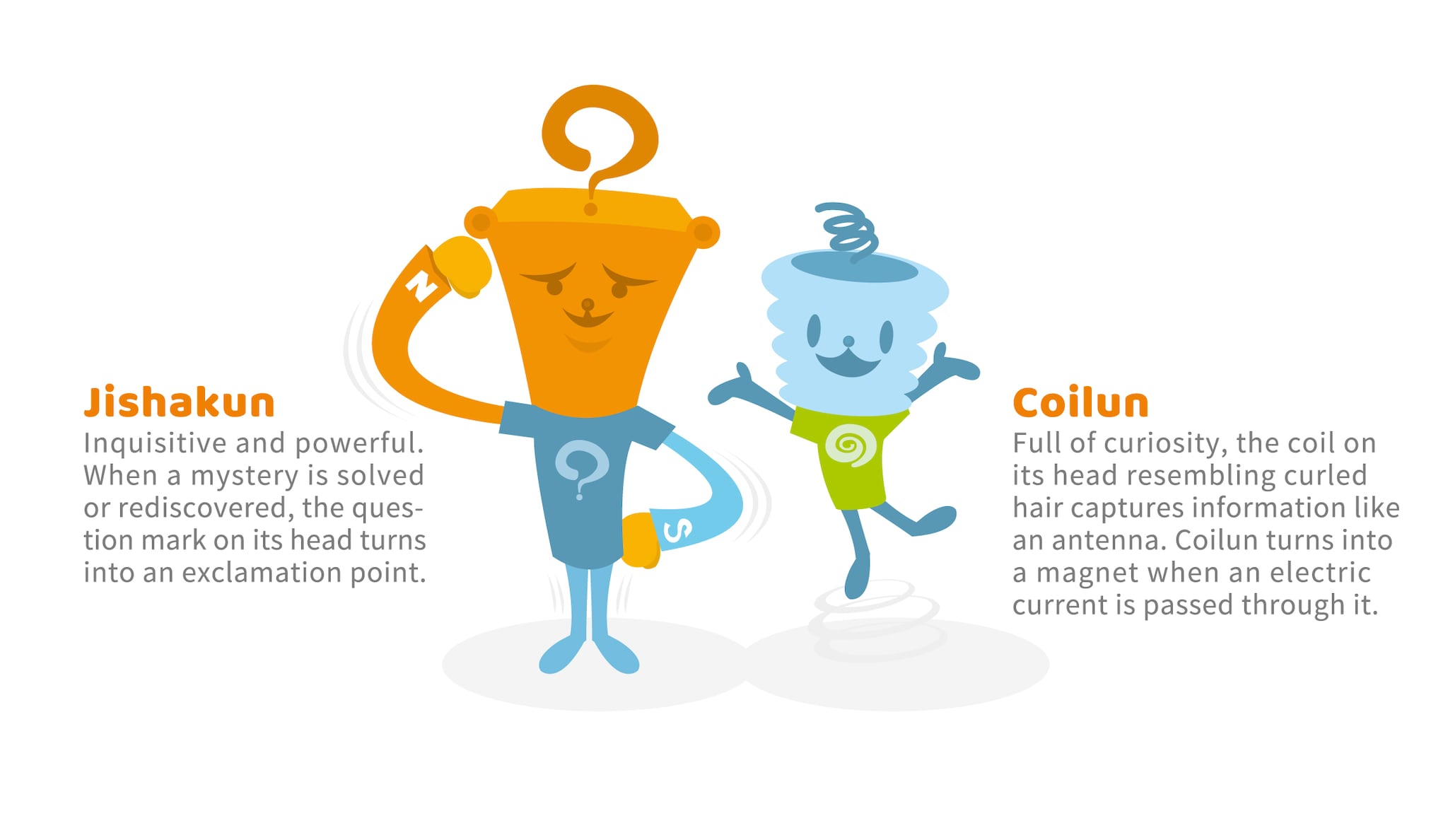
Before we begin, meet the mascots that will be appearing throughout the series. First, we have the inquisitive Jishakun, who wears a question mark on its hefty-looking head, always pondering, “What? Why? How?” Then we have the constantly curious Coilun, who is always on the lookout for information using a coil worn on its head like an antenna. The mascots are named after magnets and coils. Whenever the two are together, something intriguing seems to happen. With these companions at our side, let’s uncover the many mysteries of electricity and magnetism that surround us.
When a magnet moves near a coil of wire, it generates an electric current inside the loop. This demonstrates electromagnetic induction and shows how do magnets and electricity work together at the most basic level. The changing magnetic field produces electricity from magnet and coil, which is why this interaction between magnets and coils of wire forms the foundation of motors, generators, and many other devices.
Most modern smartphones come equipped with wallet features like Apple Pay and Google Pay, allowing payments to be made by simply hovering it over a reader. Users can manage multiple payment methods with just one smartphone by registering credit cards, digital currencies, and public transit passes in the virtual wallet. The convenience of handling both shopping and train station gates on a single device is remarkable. Many people have streamlined their bulky wallets by consolidating the excess of plastic cards and passes into their smartphones.
Contactless smart card systems represent a practical electromagnetism application, using induction to transfer data between a card and a reader. This wireless exchange is one of the clearest electromagnetic devices examples, showing how magnetic fields enable modern payment and transit systems. Both the card and the reader include small coils that exchange magnetic fields to communicate. These coils power the chip wirelessly, making the card a clear example of devices that use electromagnets. This mechanism represents accessible, consumer-level electromagnetism technology, operating reliably without internal batteries.Coils can generate magnetic fields and can also capture and store magnetic energy.
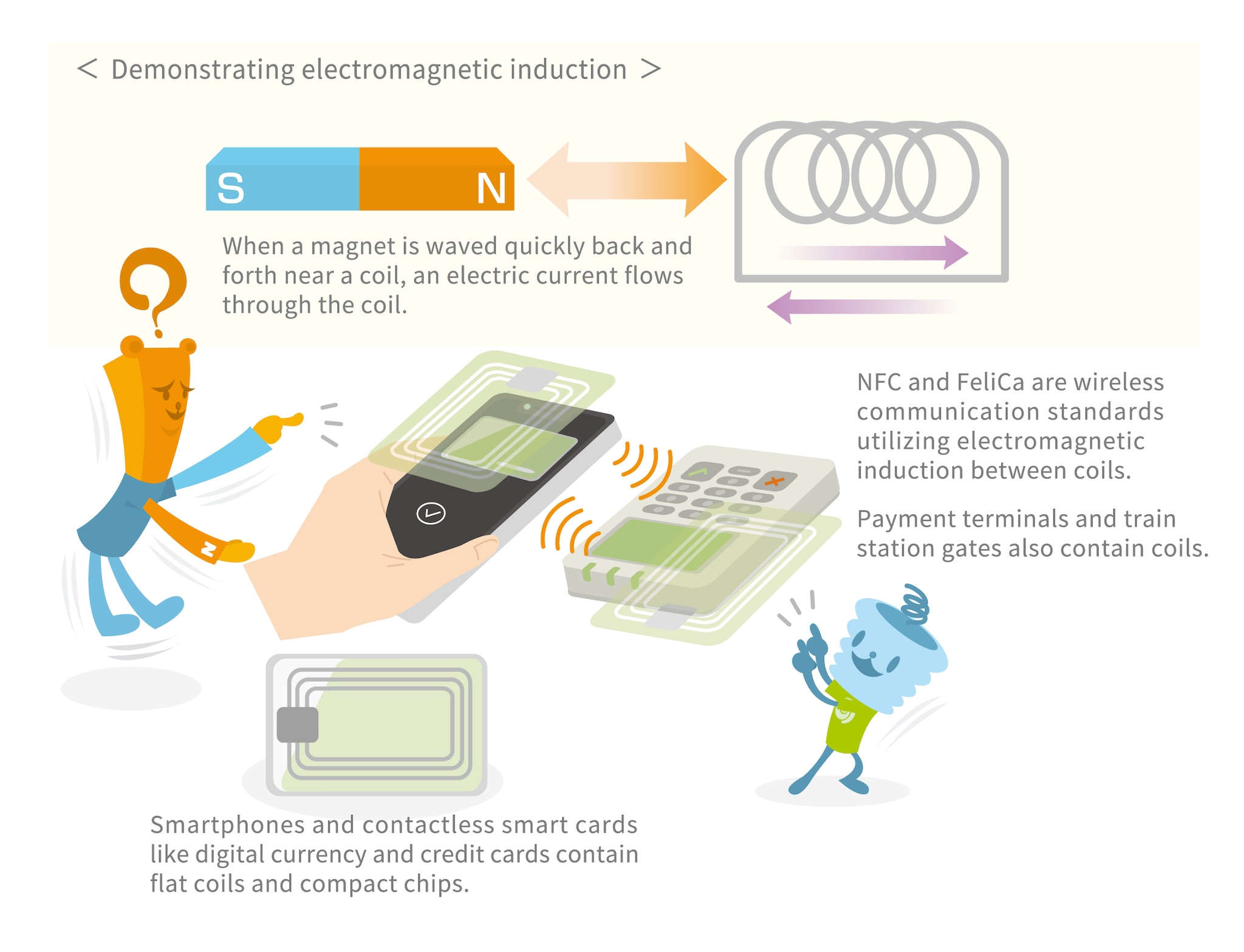
NFC and FeliCa are widely used electromagnetic devices examples, enabling fast, secure exchanges of data using short-range magnetic fields. Their adoption in payments, retail, and transit illustrates how deeply magnets and technology are integrated into daily digital interactions.
Wallet-enabled smartphones are a prime example of magnets in our everyday life, relying on magnetic field communication for payments. By supporting multiple standards, they function as universal devices using magnets, replacing physical cards with a single digital interface.
Passing an electric current turned a coil into a magnet
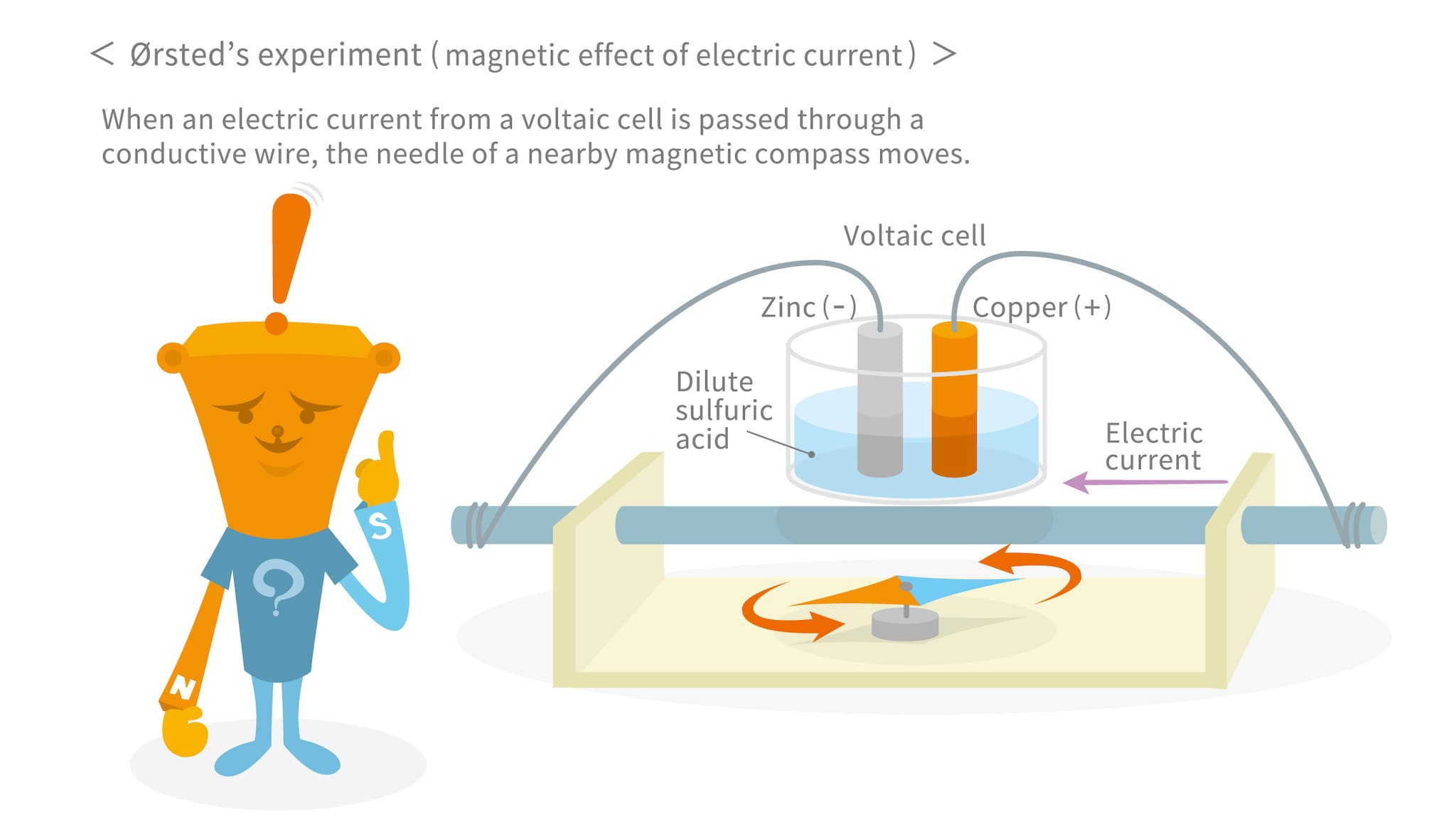
A kick-off of this series of articles would be incomplete without exploring the origins of magnets and coils. Michael Faraday’s discovery of electromagnetic induction dates back to 1831. However, a groundbreaking moment in electromagnetics occurred more than a decade earlier during a famous experiment by Hans Christian Ørsted in July 1820. Ørsted was passing an electric current through a platinum wire using a voltaic cell when he (or initially his student or assistant, according to some accounts) noticed a slight deflection of the needle of a magnetic compass coincidentally situated near the wire.
After Ørsted’s findings, researchers began conducting large-scale electromagnetism experiments, winding wire into loops and driving current through them. These tests showed how magnets and current interact and demonstrated that additional turns amplify the coil electromagnetic field, forming the basis of modern inductive components.
Shortly after, Joseph Louis Gay-Lussac, known for his work on gases, discovered that an electric current flowing through a conductor could transform a steel needle into a magnet without direct contact. Placing steel inside a coiled wire and passing an electric current through it would turn the steel into a permanent magnet. This magnetization method, still in use today, was devised by François Arago, known for Arago’s disk.
Following the introduction of coils, artificially produced magnets also made their debut in the nineteenth-century European scientific community. Of course, natural magnets had been discovered during the BC eras, and the method of rubbing natural magnets against iron to create artificial magnets had been known for ages. But no one had even thought of passing electricity through coils, nor was it experimentally feasible until the nineteenth century (the voltaic pile battery was invented in 1800). The term “coil” is also not new. A piece of thread or string wound around had long been called a coil.
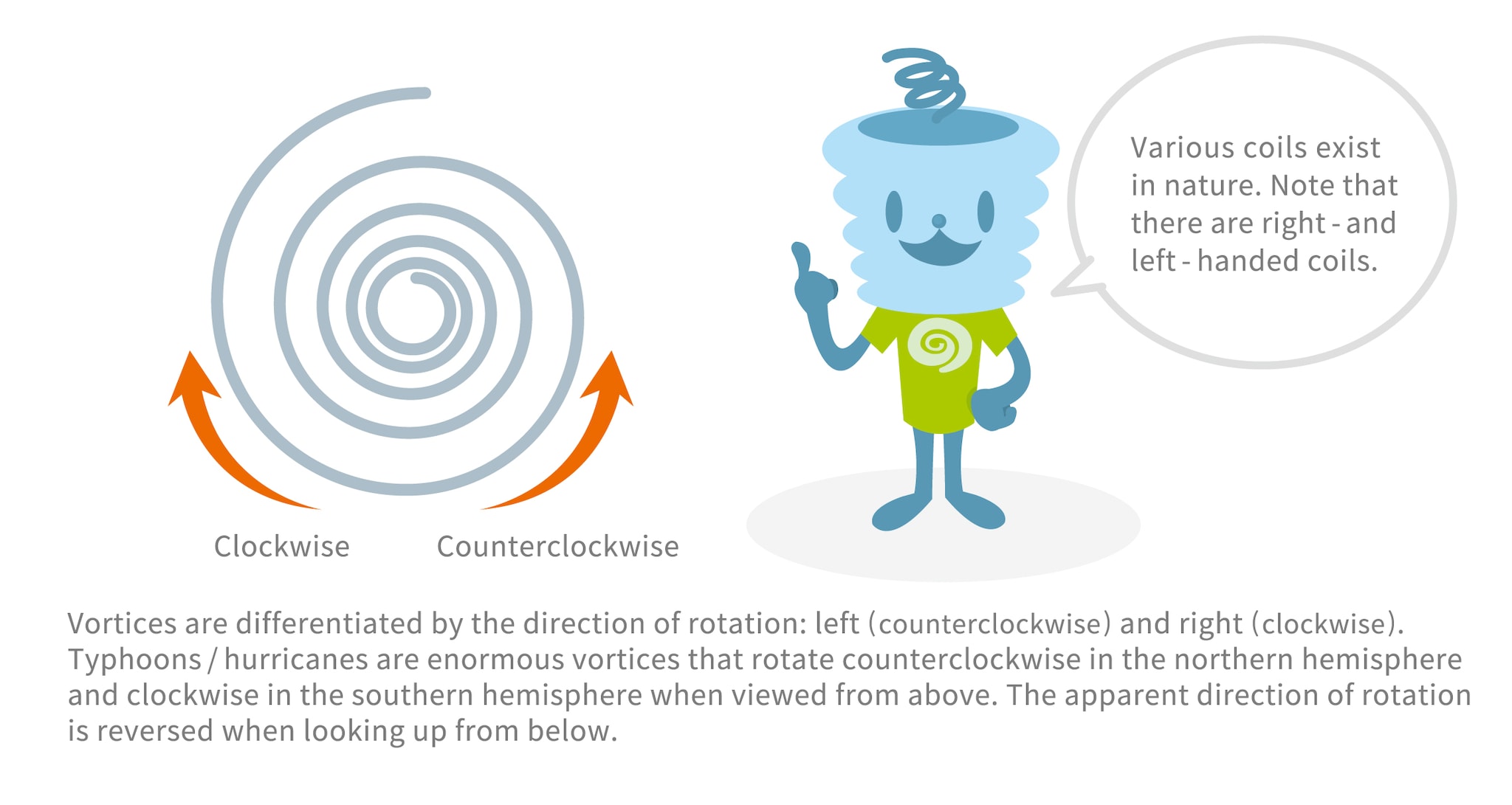
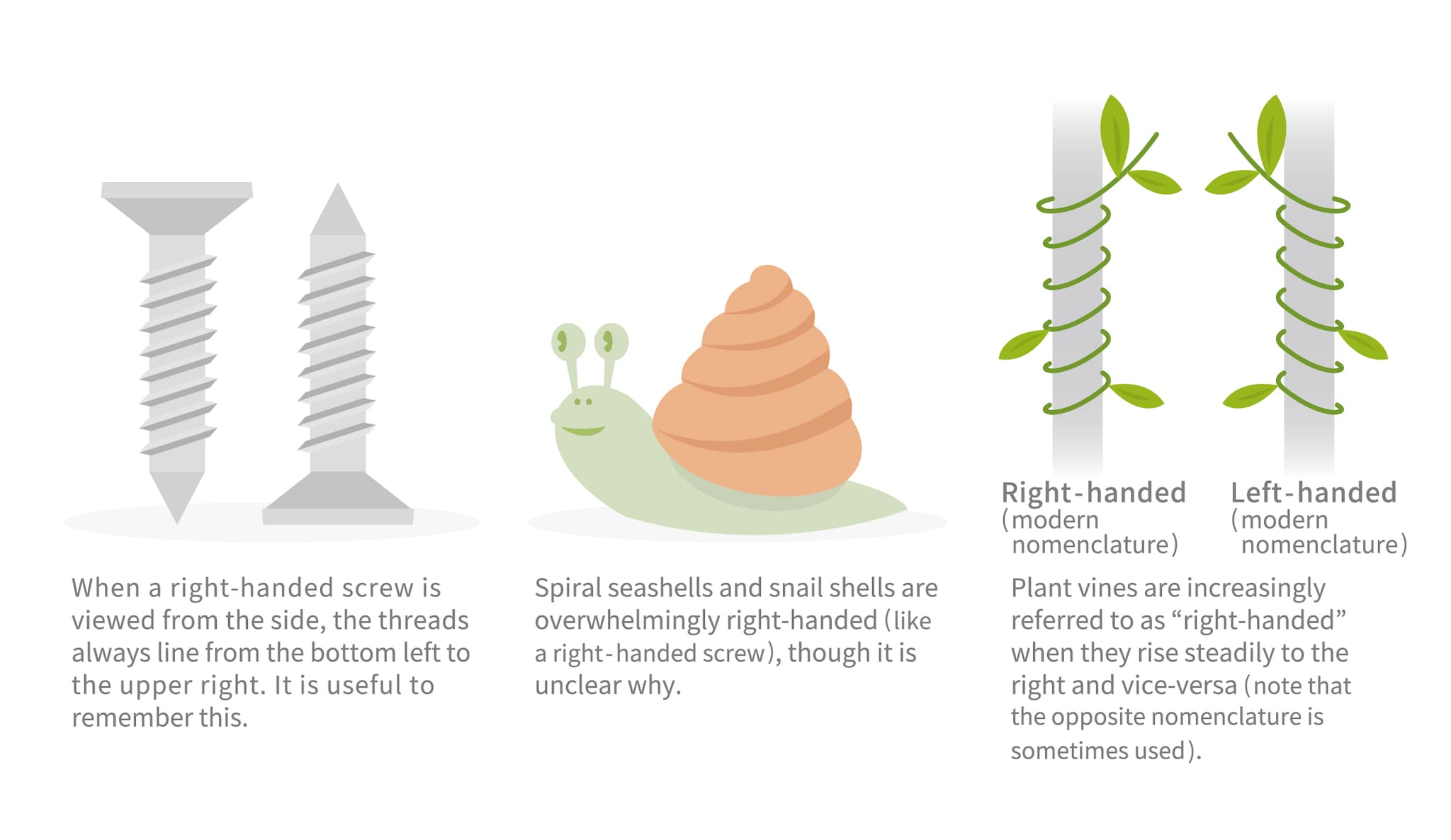
Many forms of coils exist in nature, including vortices, hurricanes, spiral seashells, and plant vines. Even animal fur and human hair exhibit some degree of curliness. Incidentally, the popular Winter Olympic sport of curling involves sliding a stone on ice, giving it a clockwise or counterclockwise spin, and gently “curling” it to the desired position. The sport derives its name from this action.
Because a perfectly straight line or a perfect circle is virtually nonexistent in nature, the coil is a shape that holds physical significance. Much like coils in nature, the electronic coil was destined to be born.
The “right-hand rule” reveals the polarity of an electromagnet
The scientific understanding of magnets progressed rapidly after Ørsted discovered the magnetic effect of electric current. For example, when a current is passed through a conductor inserted vertically into a piece of cardboard, and ironsand is sprinkled around it, the ironsand forms a neat set of concentric circles. This phenomenon is similar to the pattern observed when ironsand is scattered around a magnet, revealing the magnetic field lines’ pattern. Similar experiments, later conducted by numerous researchers, confirmed that an electric current not only creates a magnetic field but is indeed identical to the magnetic field produced by a magnet.
This suggests that a conductor with an electric current can be considered a magnet. Two conductors carrying currents should exert attractive and repulsive forces between them, much like the forces observed between magnets. To test this theory, André-Marie Ampère constructed a movable coil (a conductor shaped into a rectangle) and conducted rigorous experiments. The results revealed an attractive force between two conductors when electric currents flowed in the same direction and a repulsive force when currents flowed in opposite directions.
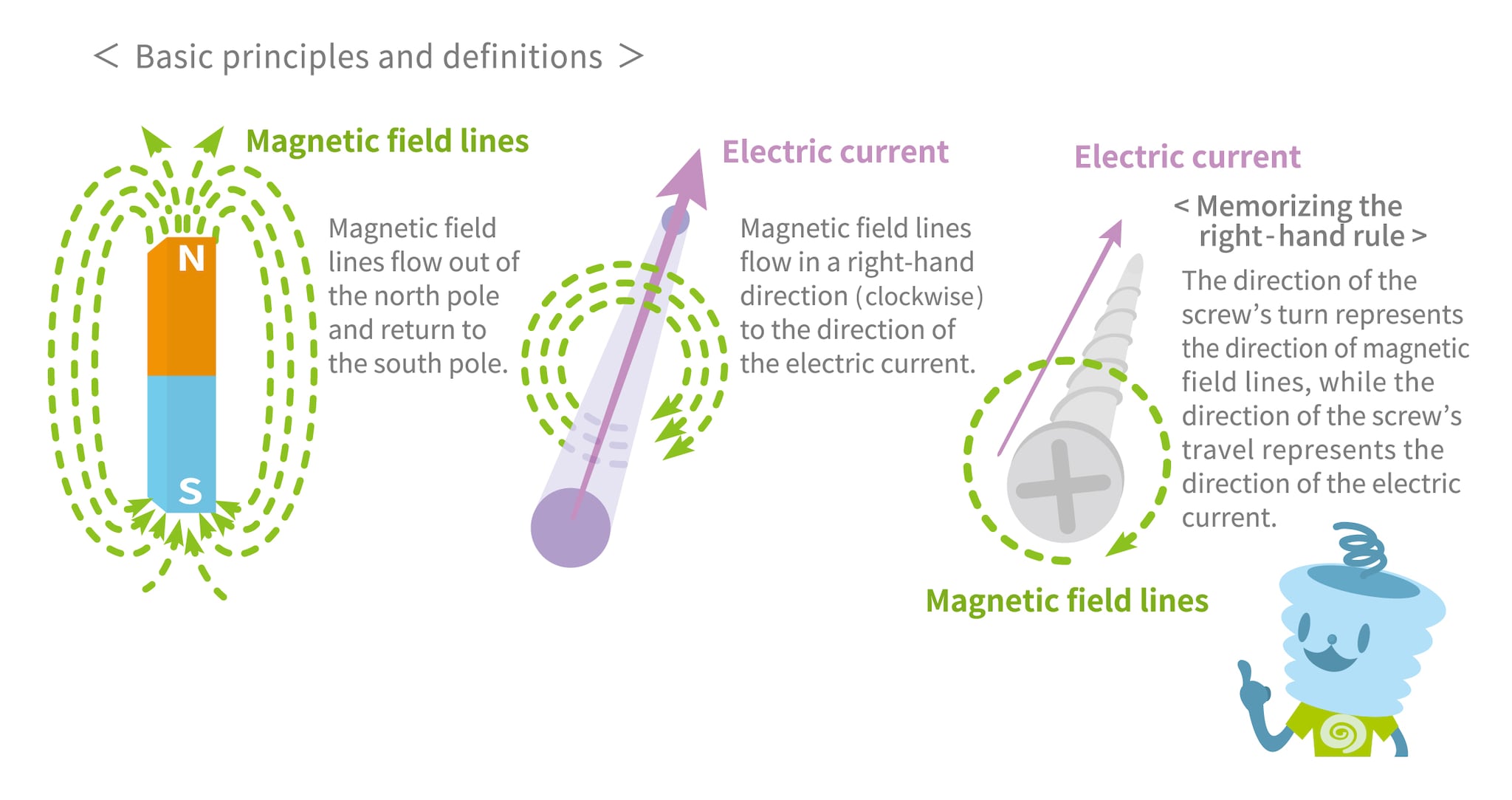
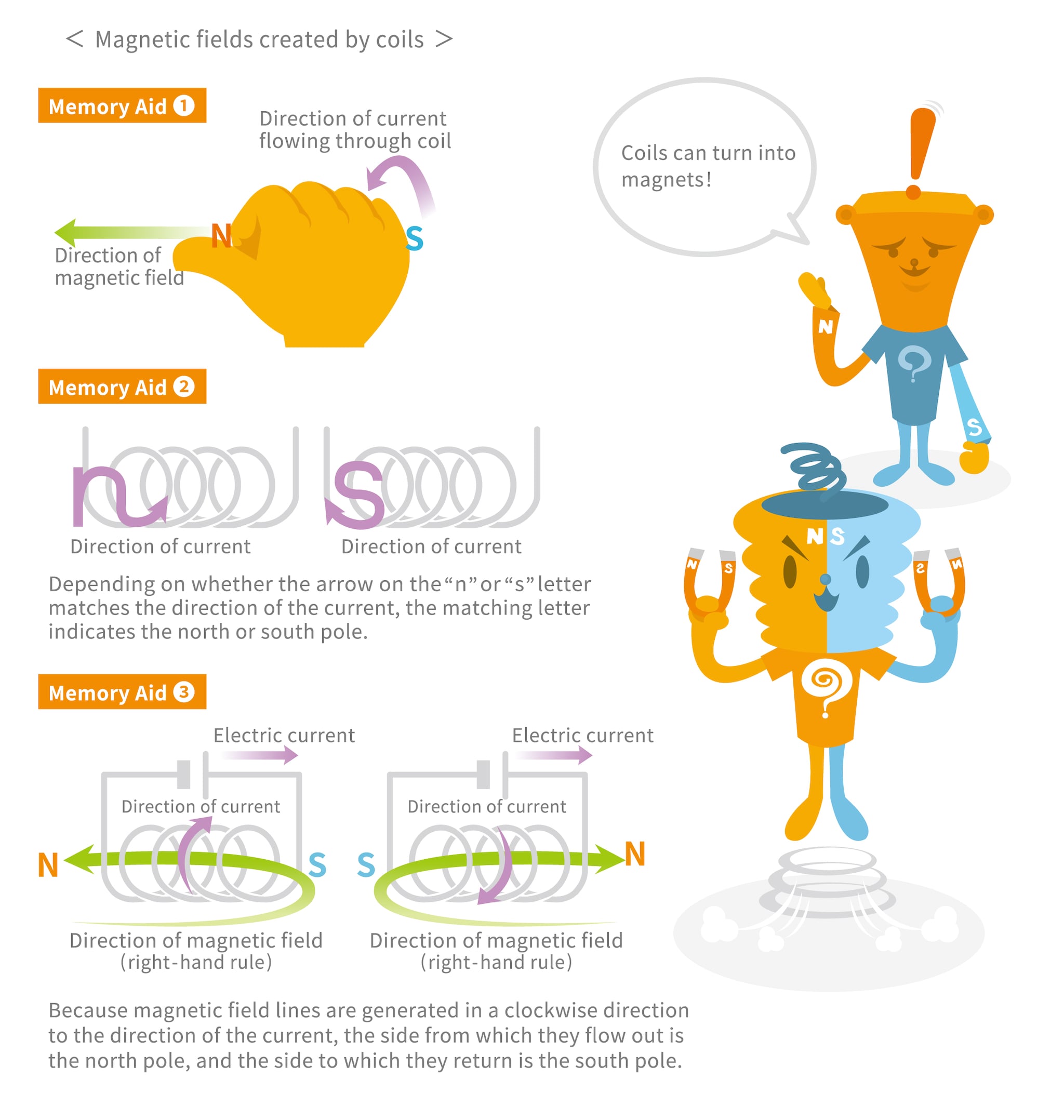
Ampère, well-versed in mathematics, expressed the magnetic field created by an electric current as a mathematical formula, giving rise to the new discipline of electrodynamics. According to Ampère’s right-hand grip rule, the direction of electric current and the direction of magnetic field lines are analogous to driving in a right-handed screw: magnetic field lines flow in the same direction as the screw’s turn, while current flows in the same direction as the screw’s travel. The rule is a simplified representation of Ampère’s law, which is defined in a mathematical formula.
While a coil with an electric current behaves like a bar magnet, its north/south polarity is determined by the direction of the current and the direction in which the coil is wound. This is a common test question that might have stumped you at some point. There are various ways to remember it, but the method described under Memory Aid 3 in the illustration below is the most versatile while remaining true to the basic principles. The polarity can be derived by memorizing just two rules: “A magnet’s magnetic field lines flow out of the north pole and return to the south pole” and “Magnetic field lines flow in a right-hand (i.e., clockwise) direction to the direction of the electric current flowing through a conductor (the right-hand grip rule).”
Conclusion
Modern wireless technologies—from NFC-enabled payments to smart cards and short-range communication—are built on fundamental electromagnetic principles discovered in the 19th century. The article’s visuals trace this heritage: Faraday’s induction, Oersted’s compass experiment, and the emergence of electromagnets through simple coils fed with current. These foundational ideas shape today’s inductive communication systems, which rely on coil geometry, magnetic field coupling, and controlled current flow.
The right-hand rule and coil-winding diagrams on pages 2–3 show how predictable magnetic polarity makes coils essential building blocks for motors, sensors, actuators, and data-transfer systems. By controlling coil direction, spacing, and current, engineers can precisely generate and manipulate magnetic fields—enabling the NFC antennas, wireless chargers, and magnetic components central to today’s consumer and industrial electronics.
FAQ
Q: How do contactless cards and NFC phones communicate?
A: They use electromagnetic induction. A reader generates a magnetic field, which induces current in the card or phone coil, enabling power transfer and data exchange between the two.
Q: What experiment proved the link between electricity and magnetism?
A: Oersted’s experiment, where electric current caused a compass needle to deflect, demonstrating that current produces a magnetic field.
Q: How does a coil become a magnet?
A: When electric current flows through a wound conductor, magnetic field lines form around the coil. Increasing turns or current strengthens the field.
Q: What does the “right-hand rule” tell us?
A: It identifies the polarity of an electromagnet: your thumb represents current direction, and your curled fingers show magnetic field orientation, revealing the coil’s north and south poles.
Q: Why does winding direction matter?
A: Clockwise and counterclockwise winding reverse the orientation of the resulting magnetic field, determining the polarity of the electromagnet.
Q: Are coils still important in modern electronics?
A: Yes. Coils underpin NFC antennas, wireless chargers, inductors, transformers, motors, and sensors—making them critical components in both power and communication systems.
TDK is a comprehensive electronic components manufacturer leading the world in magnetic technology
Share Share this article
RecommendedPeople who viewed this article also viewed here
The Wonders of Electromagnetism
vol.2 Magnetic head technology paved the way for smaller hard disk drives with higher storage capacities
The Wonders of Electromagnetism
Visualizing the Invisible: Coils Capture Changes in Magnetic Fields
Bridging the Past, Present, and Future of Tech
Quantum Computing Explained: How It Works, Real-World Applications, and Industry Impact
PickUp Contents